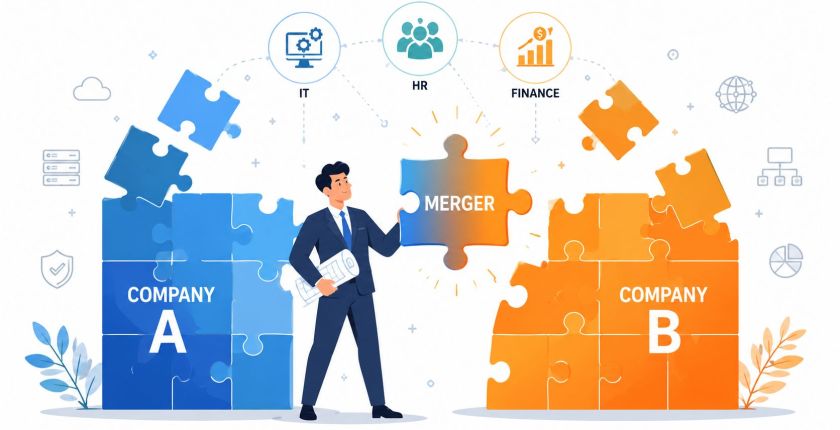
Post Merger Integration Consulting
The wire hits. The press release goes out. Your team takes a breath.
Then Monday arrives.
Two finance leads are using different revenue definitions. Sales asks which CRM is the source of truth. Product teams discover overlapping roadmaps. HR fields anxious questions about titles, managers, and benefits. Customers start hearing slightly different messages from two account teams who are now supposed to be one company.
That moment is where deal value is either protected or lost. Founders usually feel this fast. The transaction is finished, but the essential work has just started.
The Post Deal High and the Integration Hangover
A founder who just bought a smaller competitor often expects a short adjustment period. In reality, the first weeks can feel like trying to fly a plane while rebuilding the cockpit. Nothing is broken enough to stop the business, but enough is misaligned to slow every decision.
The risk isn't theoretical. PMI Stack's post-merger integration research notes that 83% of M&A deals fail to boost shareholder returns, and between 70% and 90% of mergers and acquisitions ultimately fail, often because integration execution is weak. That's why post merger integration consulting matters. It's not a luxury layer added after the deal. It's the operating discipline that keeps the acquisition from turning into a costly distraction.
One of the earliest mistakes is assuming normal management routines will absorb the work. They won't. Running the existing business and integrating a newly acquired one are different jobs with different cadences, owners, and decision rules.
Practical rule: If integration is everyone's side job, it usually becomes nobody's real job.
Founders who handle this well usually do one thing early. They create structure before confusion becomes political. That means defining workstreams, naming decision-makers, setting escalation paths, and keeping employee communication tight. A useful parallel sits in strong change management best practices for success. People can handle change better than leaders expect, but they struggle when the company sends mixed signals.
Where the hangover usually starts
The first signs are rarely dramatic:
- Duplicated decisions: Two leaders approve overlapping vendors, tools, or processes.
- Unclear authority: Legacy team members don't know who can make final calls.
- Customer-facing inconsistency: Pricing, support paths, and service expectations drift.
- Integration fatigue: Smart people spend hours in meetings and still can't tell what's changing.
This is why experienced operators treat integration consulting like deal insurance. You already paid to acquire the asset. Protecting that value is the next investment.
What Is Post Merger Integration Consulting Really
When 'consulting' is mentioned, slide decks often come to mind. Good post merger integration consulting is much more practical than that.
Think of it as hiring a general contractor for a full building renovation. The architect's drawings may be excellent, but someone still has to sequence the plumbing, electrical, framing, and inspections so the building is safe and usable. In a merger, strategy is the blueprint. Integration is the construction job.
The job isn't to close the deal
M&A advisors help evaluate targets, negotiate terms, and get the transaction done. Integration leaders step in to answer a different question: how will the combined company operate on Tuesday morning, then three months later, then a year later?
That includes choices such as:
- Which systems stay and which get retired
- How customer contracts and support models are handled
- Whether titles, compensation bands, and reporting lines change immediately or in stages
- How to combine go-to-market motions without confusing the field
- How to resolve duplicate roles without paralyzing the organization
A solid integration advisor doesn't just identify these issues. They force sequencing. Some decisions are urgent. Others should wait until the new leadership team has real operating data.
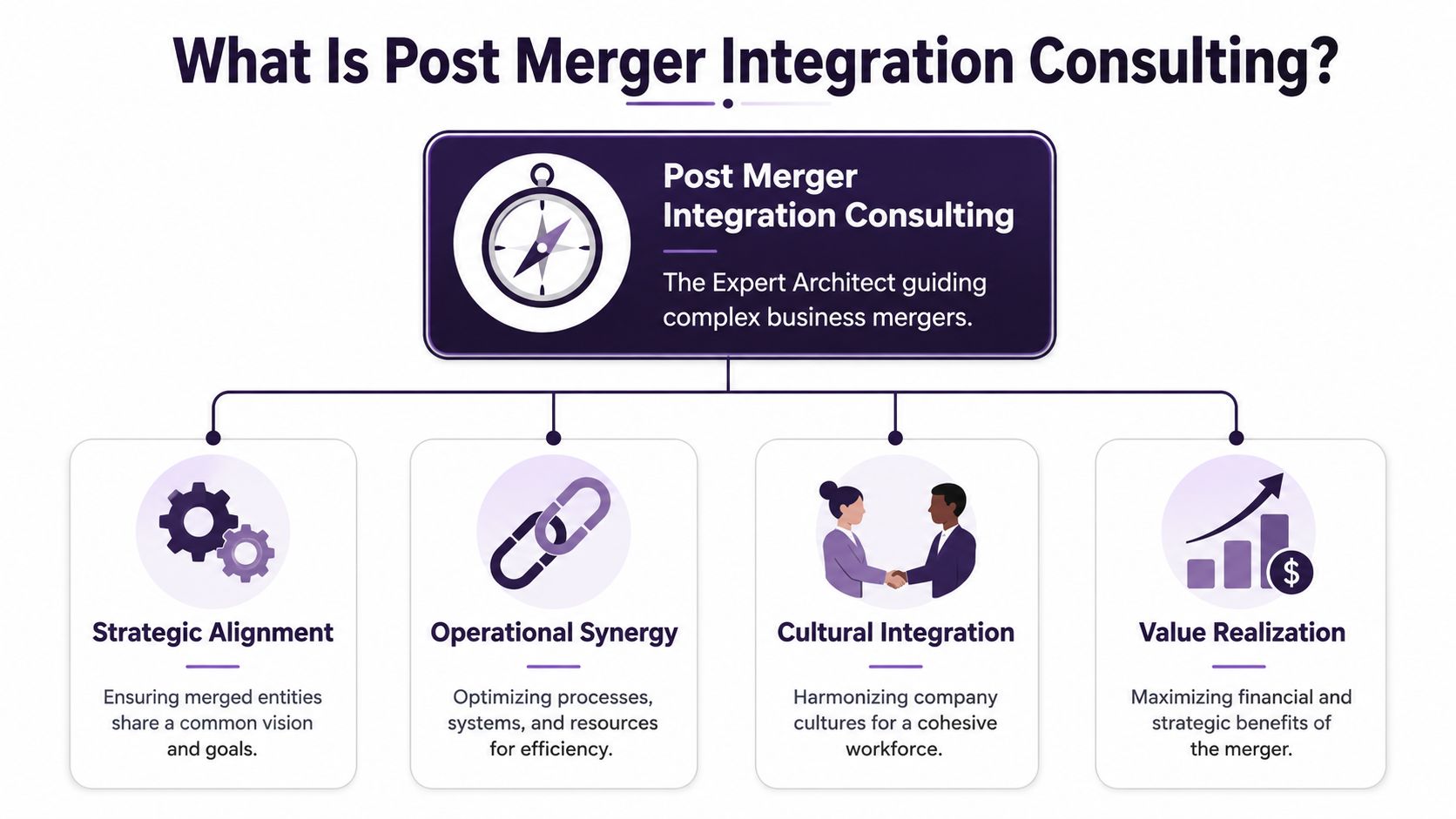
The four pillars that matter in practice
Most integration work falls into four connected buckets.
| Pillar | What it means in real life | What good looks like |
|---|---|---|
| Strategic alignment | The merged company agrees on priorities, decision rights, and the operating model | Leaders stop debating basic direction in every meeting |
| Operational synergy | Core processes, tools, and workflows are unified or intentionally kept separate | Teams know which systems to use and why |
| Cultural integration | Behaviors, communication norms, and management expectations are clarified | Employees understand how work gets done now |
| Value realization | Synergies are tracked, challenged, and translated into actual operating results | The deal thesis shows up in monthly performance |
A merger doesn't fail because leaders lacked ambition. It fails because the new company never became operationally coherent.
What consultants should actually bring
The best post merger integration consulting work delivers three things.
First, an outside point of view. Internal leaders are often too close to legacy politics.
Second, a working playbook. Not theory. A repeatable method for governance, workstreams, meeting cadence, issue escalation, and milestone tracking.
Third, focused time. Integration is one of those jobs that looks manageable until key decisions pile up all at once. A dedicated lead keeps momentum when the rest of the executive team gets pulled back into day-to-day firefighting.
The Four Phases of a Successful Integration Roadmap
An integration roadmap works best when it's broken into phases. That keeps leaders from treating everything as equally urgent, which is one of the fastest ways to create confusion and burn out the team.
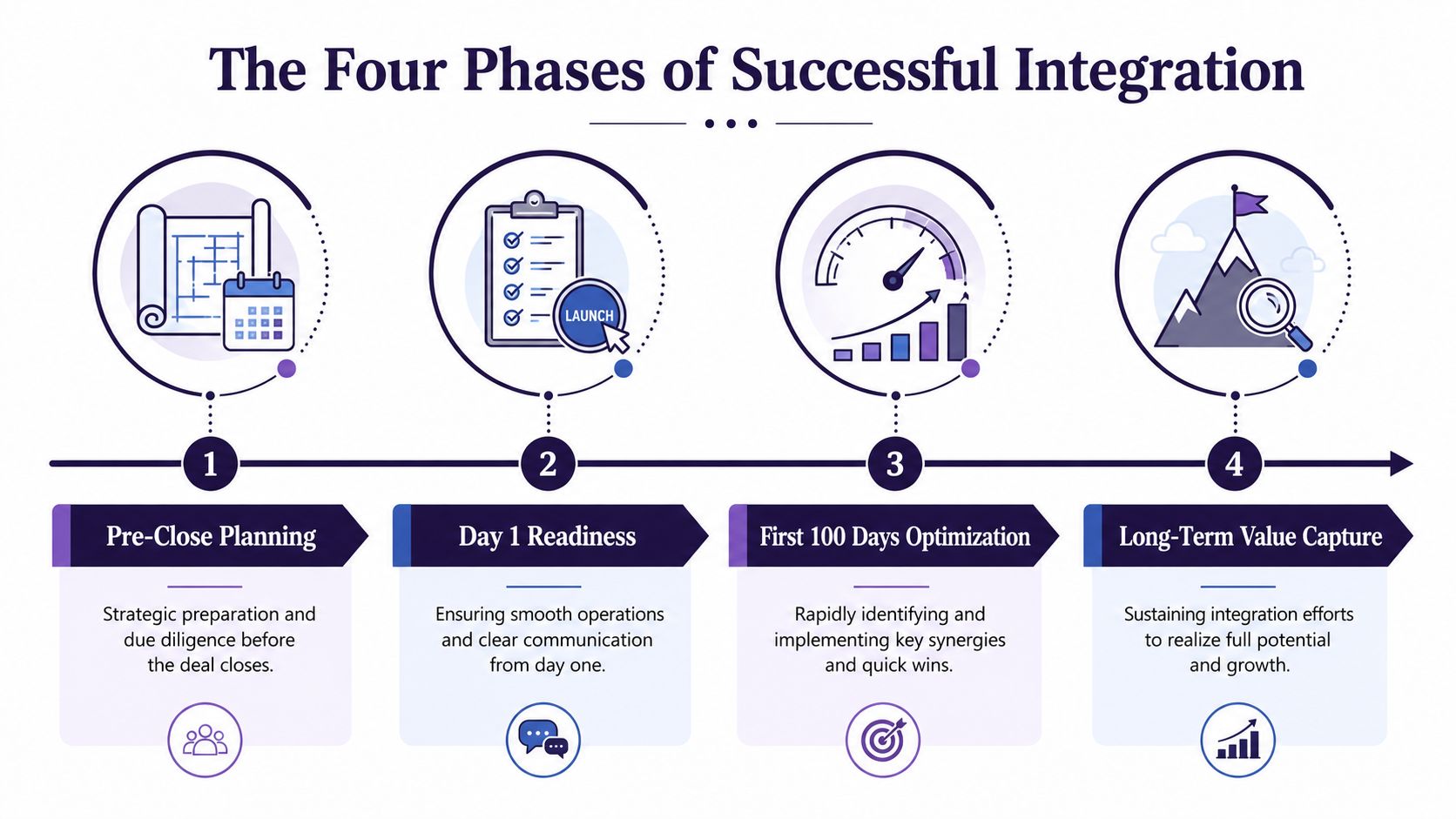
Pre-close planning
Many smaller companies often underinvest. They wait for signatures, then start integration design after the fact. That usually creates rushed decisions and unnecessary rework.
A better approach is to build an Integration Management Office, or IMO, before the deal closes. Tworld's analysis of hidden post-merger integration challenges says that establishing an IMO 60 to 90 days before close directly correlates to capturing 9% more value from M&A deals when proven frameworks are used.
At this stage, the team should focus on:
- Workstream design: Finance, HR, IT, operations, legal, customer success, and go-to-market each need clear ownership.
- Decision inventory: List the high-impact calls that can't wait until after close.
- Risk mapping: Flag customer, technical, compliance, and talent risks before they become surprises.
- Executive cadence: Set weekly leadership checkpoints and issue escalation rules.
A practical tool here is a simple strategic roadmap template for leadership teams. The format matters less than the discipline. One place for priorities, owners, timing, and blockers.
Day 1 readiness
Day 1 isn't about full integration. It's about continuity and confidence.
Employees need to know who leads what. Customers need reassurance that service won't degrade. Managers need a clear answer for immediate questions, especially around systems, reporting lines, and approvals.
The best Day 1 plans are boring in a good way. Nothing dramatic happens because the team already thought through the obvious failure points.
A useful Day 1 checklist usually includes:
- Leadership communication: One message, consistent language, no improvising.
- Customer communication: Segment by account type and risk level.
- Access and systems: Ensure teams can log in, invoice, support, and report.
- People decisions: Clarify interim reporting relationships and escalation routes.
First 100-day execution
Real integration work becomes visible. Some synergies can move quickly, but not every promised benefit should be chased at once. Fast wins help. Forced wins hurt.
Good operators usually separate the first 100 days into two lanes:
| Lane | Focus | Typical examples |
|---|---|---|
| Stabilize | Remove friction that disrupts daily work | approval workflows, support routing, sales handoffs |
| Optimize | Capture clear value with manageable execution risk | vendor consolidation, pricing alignment, reporting standardization |
Field note: If your integration dashboard only tracks milestones and not unresolved dependencies, you're probably getting a cleaner story than reality.
This phase is also where leadership needs to say no. Not every duplicated tool should be replaced immediately. Not every policy needs to be harmonized in quarter one. Sequence beats ambition.
Long-term value capture
Integration teams often lose focus after the early burst of activity. The meetings become less frequent. The hard cross-functional issues linger. Leaders assume momentum will carry itself.
It won't.
Long-term value capture means converting initial decisions into durable operating habits. The combined company should have one way to report, one way to resolve cross-functional conflicts, and a clear mechanism for reviewing whether synergy assumptions were realistic in the first place.
Three signs long-term integration is on track:
- The org chart matches actual decision-making
- Metrics are reviewed by the same leadership group on a regular cadence
- Customers experience one company, not two legacy businesses stitched together
Key Services and Common Deliverables
A lot of founders buy "integration support" without knowing what should come back from that engagement. That's where budgets drift and expectations get fuzzy.
Good post merger integration consulting should produce tangible work products. If the scope is real, you should be able to point to documents, decision logs, operating plans, and dashboards the team uses.
Core service areas
Below is a practical breakdown of the service categories that matter most.
Synergy assessment
Deliverables often include a value driver map, synergy assumptions register, dependency log, and leadership decision pack. This work helps separate plausible savings or growth opportunities from optimistic talking points.Governance design
Expect an IMO charter, workstream structure, RACI matrix, meeting cadence, and escalation rules. Without these, integration meetings become status theater.IT systems consolidation
The usual output is a systems migration plan, application inventory, data flow map, cutover sequence, and risk register. This area often determines whether the business feels smoother or more chaotic after the deal.Go-to-market alignment
Look for a commercial integration plan that covers account ownership, pricing logic, pipeline rules, brand transition choices, and customer messaging.
Deliverables founders should ask to see
Some deliverables are especially useful because they force clarity early.
| Service | Deliverable | Why it matters |
|---|---|---|
| HR integration | Talent retention plan | Protects key people before uncertainty drives exits |
| Finance integration | Chart of accounts mapping and close calendar | Prevents reporting confusion and delayed closes |
| Customer success integration | Service continuity playbook | Reduces churn risk during the transition |
| Culture work | Leadership behavior principles and manager FAQ | Turns abstract culture talk into repeatable action |
What weak consulting looks like
Poor integration support usually shows up in one of three ways:
- Too much abstraction: Big themes, few operating decisions.
- No owners: Recommendations exist, but nobody is accountable for execution.
- No artifact quality: Deliverables look polished, but teams don't use them in live decision-making.
Ask a simple question: "Which documents will my leadership team still be using 90 days from now?" If the answer is vague, the scope probably is too.
The best advisors leave behind infrastructure, not just opinions.
Hiring Your Integration Team The Smart Way
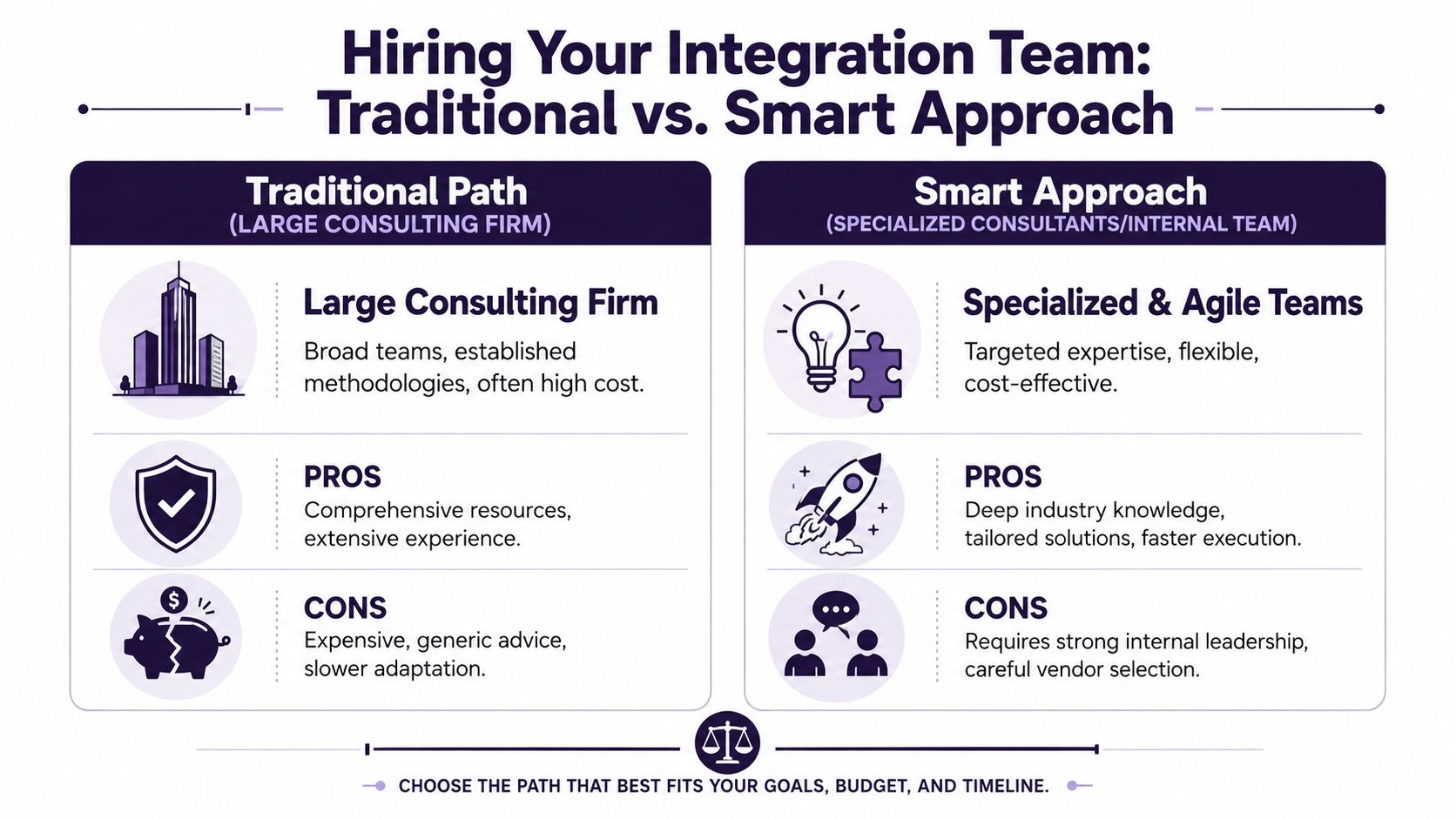
Founders usually see two paths after a deal closes.
The first is the traditional route. Hire a large consulting firm, get a broad team, and pay for depth, process, and institutional polish.
The second is more selective. Build a lean internal team and add specialized leaders where the risk is highest. For SMBs and startups, that often means using fractional executives to run key workstreams without carrying the cost and complexity of full-time executive hires.
Why the old model often fits poorly
Large firms can be useful when the deal is highly regulated, international, or structurally complex. But smaller companies often end up overbuying. They get junior staffing, generic frameworks, and a delivery model built for enterprises with deeper budgets and slower decision cycles.
That mismatch matters most when the integration challenge is concentrated in a few functions, not the whole business. Maybe finance needs a strong integration lead, IT needs experienced oversight, and HR needs short-term executive support. You don't always need an army. You need the right operators in the right seats.
NMS Consulting's post-merger integration perspective captures this issue well. Startups and mid-market firms face a "talent elasticity" gap because they often can't justify full-time integration leaders, even though technology and data now drive 10% of synergies and support 85% of business synergies. Fractional executives are a practical way to fill that gap.
A practical comparison
| Decision factor | Large consulting firm | Fractional or specialized model |
|---|---|---|
| Cost structure | Broad team, often heavier overhead | More targeted spend on critical workstreams |
| Flexibility | Scope changes can move slowly | Easier to add or reduce support by function |
| Hands-on involvement | Can tilt toward recommendations | Often closer to day-to-day operating decisions |
| Fit for SMBs | Sometimes oversized for the problem | Better aligned with lean teams and faster cycles |
The point isn't that one model is always right. It's that founders should match the support model to the integration risk, not to what looks prestigious.
Where fractional leadership fits best
Fractional leaders work especially well when the combined company needs senior judgment but not another permanent executive seat.
Common examples include:
- Fractional CFO or finance lead: unify reporting, close processes, forecasts, and cash visibility
- Fractional CTO or CIO: govern systems integration, vendor rationalization, and data architecture decisions
- Fractional HR executive: manage org design, retention risk, and manager communication
- Fractional operations leader: standardize workflows and reduce cross-functional friction
This model is also consistent with a broader shift in executive hiring. Umbrex's fractional executive playbook reports that in 2024, average monthly retainers for fractional sales leaders reached $9,651, with hourly rates at $213, reflecting a 21% increase in one year. Founders don't need to copy those exact economics across every function to understand the signal. The market is maturing because companies want senior expertise without carrying full-time executive cost in every seat.
If you're building that kind of bench, this overview of interim executive recruitment for growing companies is a useful reference point.
Red flags when hiring any integration lead
Watch for these problems early:
- They can't describe trade-offs: Real operators can explain what should wait, not just what should happen.
- They stay too high-level: Integration is won in details like decision rights, system sequencing, and communication discipline.
- They don't ask about capacity: A plan that ignores manager bandwidth will collapse under normal operating pressure.
- They sell certainty: Good advisors reduce risk. They don't pretend integration is ever frictionless.
Hire for operating judgment, not presentation quality. You need someone who can make the combined business function under pressure.
Measuring Success With Post Merger Integration KPIs
If the integration team can't show progress in a way your board and managers can understand, the plan is too loose.
The KPI set should be balanced. Founders often over-index on financial targets and miss the signals that tell them whether execution is holding together. The discussion summarized in this video on integration challenges notes that technology issues are now as critical as financial and people considerations, and that 50% of public synergy run rates are missed even by top performers. That's a good reminder to track tech and culture with the same seriousness as cost and revenue goals.
A practical scorecard
Use a scorecard with a small number of metrics in each category.
Financial KPIs
- Synergy realization rate: Are projected savings or growth gains showing up on schedule?
- Integration cost versus budget: Are workstreams staying within the expected spend?
- Working capital impact: Is the merger creating cash friction through billing, collections, or inventory issues?
Operational KPIs
- System uptime and incident volume: Especially important during tool migrations or platform consolidation.
- Close cycle stability: Finance should not lose control of monthly reporting.
- Decision turnaround time: Slow approvals usually signal governance problems.
Don't ignore people and customer signals
A merger can look fine in the spreadsheet while employee trust and customer confidence are weakening.
People KPIs
- Retention of key talent
- Manager span clarity
- Role acceptance and onboarding progress
Customer KPIs
- Customer churn
- Support ticket backlog
- Renewal risk concentration
- NPS trend after major changes
How to use the KPIs well
Don't turn the dashboard into a museum of numbers.
Review metrics with the workstream owners who can explain cause and effect. Pair lagging indicators, like realized synergies, with leading indicators, like system incidents or key-person retention risk. If a metric moves, assign action in the same meeting.
A useful dashboard doesn't just describe the integration. It changes how leaders respond.
Your Next Step From Integration Chaos to Control
Post merger integration consulting earns its value when it turns a fragile transition into a controlled operating plan. That's the difference between owning an acquired business on paper and absorbing it into the company you want to build.
For startups and SMBs, the smartest model is rarely the heaviest one. You need enough structure to protect the deal, enough senior judgment to make hard calls, and enough flexibility to avoid paying enterprise-level fees for work your business doesn't need. That's where fractional leadership stands out. It gives founders access to experienced operators who can lead high-risk workstreams without forcing permanent hires too early.

That approach is becoming more mainstream, not less. Vendux's summary of Gartner's forecast on fractional executives says over 30% of midsize enterprises will have at least one fractional executive on retainer by 2027. For founders navigating integration, that's a practical signal. The market is moving toward flexible senior talent because the old full-time-or-nothing model doesn't fit every growth stage.
If you're in the middle of post-deal noise right now, start with three questions:
- Which workstream has the highest risk if it drifts for the next 30 days?
- Who owns integration full time, not as a side responsibility?
- Where do you need senior expertise without a permanent executive hire?
Those answers usually make the path clearer than another strategy memo.
If you need experienced leadership for a merger without committing to a full-time executive search, Shiny helps you connect with vetted fractional operators who can step into critical integration roles quickly. You can explore the platform or schedule a conversation to find the right leader for your stage, budget, and integration risk.