

Pricing Optimization: A Practical Playbook for Startups
You know the feeling. The product is improving, pipeline is moving, and yet pricing still feels slightly off, like you're leaving money on the table every time a deal closes, a plan renews, or a discount gets approved because nobody wants to be the person who breaks the conversation.
That feeling is usually right. Pricing optimization is rarely a one-time exercise, it's an operating rhythm, built on segmentation, testing, and disciplined follow-through. Modern pricing systems use prescriptive analytics, mathematical modeling, and machine learning to estimate willingness to pay and protect margin, while real teams watch NRR, ARPU, margin, and price realization on a regular cadence, with dashboards updated weekly or in real time and reviewed at least quarterly according to one published framework (pricing metrics guidance).
The payoff is real enough to demand attention. One 2026 industry compilation says organizations implementing AI pricing optimization typically see a 2% to 7% revenue gain (AI pricing optimization statistics). That's why founders can't treat pricing as a dusty spreadsheet problem, or a task for “later.” It's a recurring commercial discipline, and the rest of this playbook shows how to tell whether pricing is the issue, how to research willingness to pay without overcomplicating it, how to test changes cleanly, and how to keep the gains from leaking back out.
Why Pricing Optimization Is the Lever Most Founders Ignore
The moment is familiar. You raise a price, or you hesitate to, and the reaction from sales, customers, or the board makes the whole thing feel fragile. Founders get stuck there because pricing looks like a single decision, when in practice it is a system that touches segmentation, discount policy, approvals, and renewal behavior.
The core problem is ownership
Most startups have someone who owns growth, someone who owns product, and someone who owns revenue operations. Pricing falls between those chairs. When nobody owns it, the company defaults to habit, and habit usually means stale tiers, inconsistent discounts, and pricing that reflects internal convenience more than customer willingness to pay.
The best pricing teams do not chase one perfect number. They build a pricing range, then manage within it using segmentation by customer tier, industry, channel, or region. That is how pricing becomes operational, not theatrical.
Practical rule: if a price change requires a long meeting every time, the company does not have a pricing strategy, it has a pricing bottleneck.
The reason this matters now is that pricing has moved from static markup to data-driven decision-making. Machine learning and modeling can estimate price elasticity, but the operational win comes from using that insight consistently, not from one clever experiment.
Why the upside gets ignored
Founders often assume pricing work is only worth it after scale. That is backwards. Even modest improvements compound because they hit every sale, every renewal, and every expansion motion. The 2% to 7% revenue gain reported in the 2026 AI pricing compilation is a good reminder that small pricing changes can matter a lot when they apply across the business (AI pricing optimization statistics).
The rest of this guide focuses on the part most guides skip, diagnosis, research, testing, metrics, and post-launch governance. That is where pricing becomes a repeatable operating system instead of a one-off initiative.
Diagnosing Whether Pricing Is Actually the Problem
Not every commercial problem is a pricing problem, and too many teams waste weeks adjusting packages when the issue is product fit, onboarding, or demand quality. Good diagnosis saves you from optimizing the wrong thing. A quick internal review can usually tell you whether pricing is the bottleneck or just the easiest thing to blame.
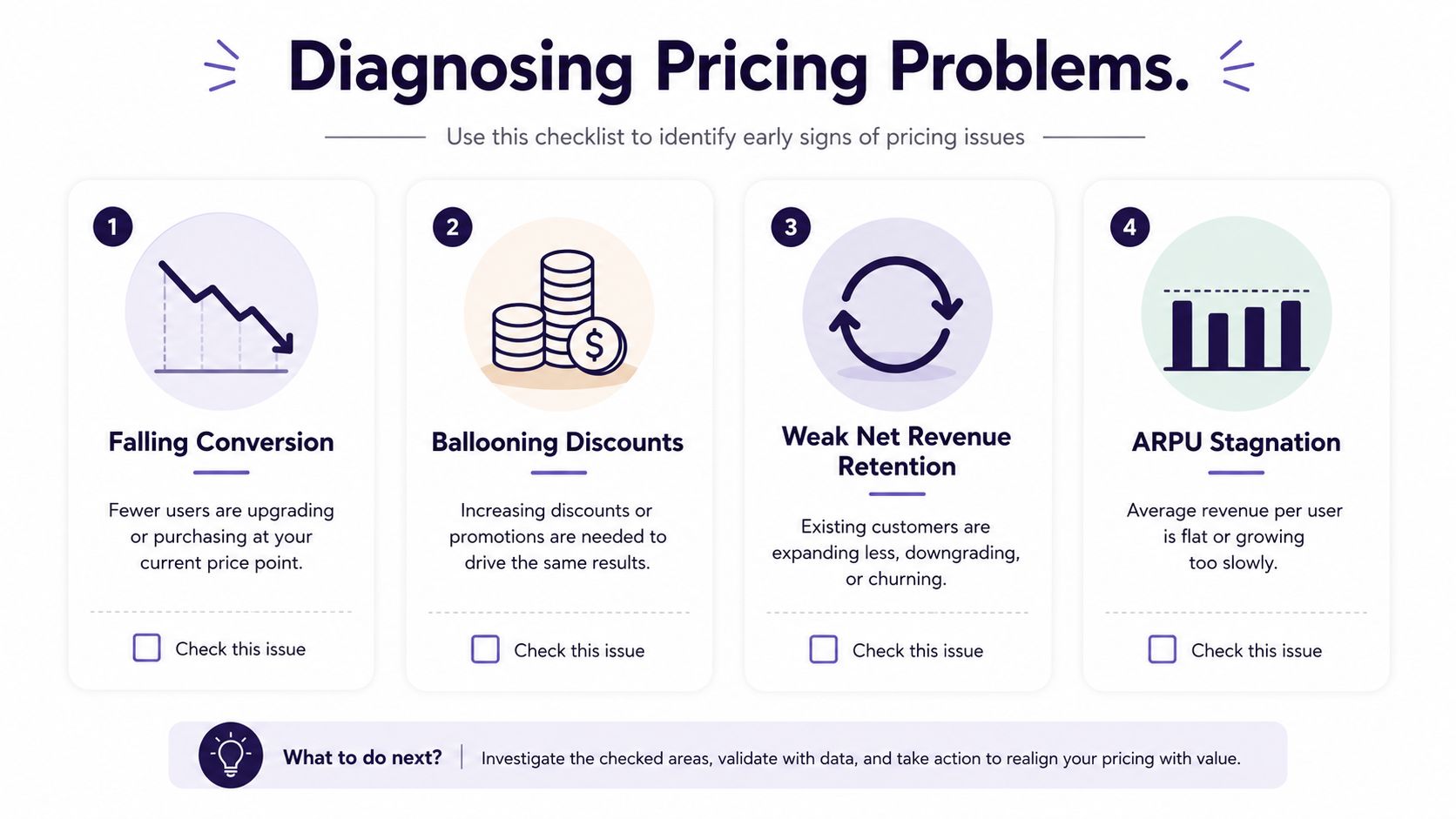
The four signals that matter
If pricing is the core issue, you'll typically observe one or more of these patterns:
- Falling conversion. Prospects keep showing interest, but too many stall at the pricing step. That often means the offer is out of alignment with perceived value, especially when objections cluster around “too expensive” rather than feature gaps.
- Ballooning discounts. Reps are constantly negotiating to close deals, and the list price barely survives first contact. That points to weak price discipline or a price architecture that doesn't fit the segments you're selling to.
- Weak net revenue retention. Existing customers renew, but expansion is thin, downgrades creep in, or retention softens after price changes. That suggests the price-to-value story isn't holding after the initial sale.
- ARPU stagnation. Pipeline may be healthy, but average revenue per user refuses to move. In that case, you may have a packaging issue, a tiering issue, or a discounting habit that's flattening revenue.
Those signals are useful because they isolate the pricing layer from the rest of the funnel. If conversion drops only after a new pricing page goes live, pricing is likely in play. If conversion falls before prospects ever hit the pricing page, the primary issue may be traffic quality or positioning.
A SaaS team can misread churn the same way. They'll call it a retention problem, then spend months on lifecycle emails, when the underlying issue is a mismatch between price and realized value. Customers don't always leave because the product is bad. Sometimes they leave because the package they bought didn't match how they use the product.
The fastest sanity check: compare discounts, conversion, NRR, and ARPU by segment. If the pain is concentrated in one cohort, pricing is probably part of the story. If every cohort looks broken, the problem is broader than pricing.
For a clean way to think about positioning and value communication, it's worth pairing this diagnosis with a simple pricing vocabulary, like the one in this explainer on price in marketing.
Building Your Willingness to Pay Foundation
The strongest willingness-to-pay work starts with a few simple questions, not a giant research project. Ask customers what feels too expensive, what feels too cheap, and where the offer begins to feel fair, then map the answers into a usable band. That band matters more than a single magic number.
Use the range, not the fantasy price
A lot of founders want one clean answer. That's usually the wrong output. Pricing works better when you identify the intersection between the too expensive curve and the too cheap curve, because that creates an acceptable range rather than a brittle point estimate.
The practical benefit is obvious. If you only chase a single price, you end up overreacting to every objection. If you work inside a range, you can segment by customer type, channel, region, or use case without forcing one list price to do jobs it can't do.
Here's the simplest version of the process:
- Ask the four questions. Use the standard willingness-to-pay prompts to surface perceived value and resistance.
- Plot the responses. Put “too expensive” and “too cheap” on the same axis to find the overlap.
- Test by segment. Different customer groups often land in different places, especially if your business sells to multiple industries or geographies.
- Set guardrails. Once the band is clear, stop changing the story every week.
Keep the research lightweight
You don't need a research vendor to get useful signal from under 50 customers. CRM notes, closed-lost reasons, support tickets, renewal conversations, and rep call summaries often contain enough language to reveal where buyers anchor. The point is to use the customer evidence you already have, not to invent a perfect dataset.
This is also where founders get tempted to tinker forever. Don't. The band is there to guide decisions, not to justify endless debate. Once the range is defined, the next move is experimentation, not more opinion.
Good pricing research should narrow decisions, not expand the meeting count.
If you're doing this work in a lean team, the broader unit economics context can help keep the conversation grounded, especially when you're balancing acquisition cost, expansion potential, and margin. A practical overview of that lens sits in this unit economics guide.
Designing Pricing Experiments You Can Actually Run
Good pricing experiments are boring in the best way. One variable changes, one population sees it, and the results are clear enough to act on. The founders who struggle here usually try to test too many things at once, or they run a test so small it only produces noise.
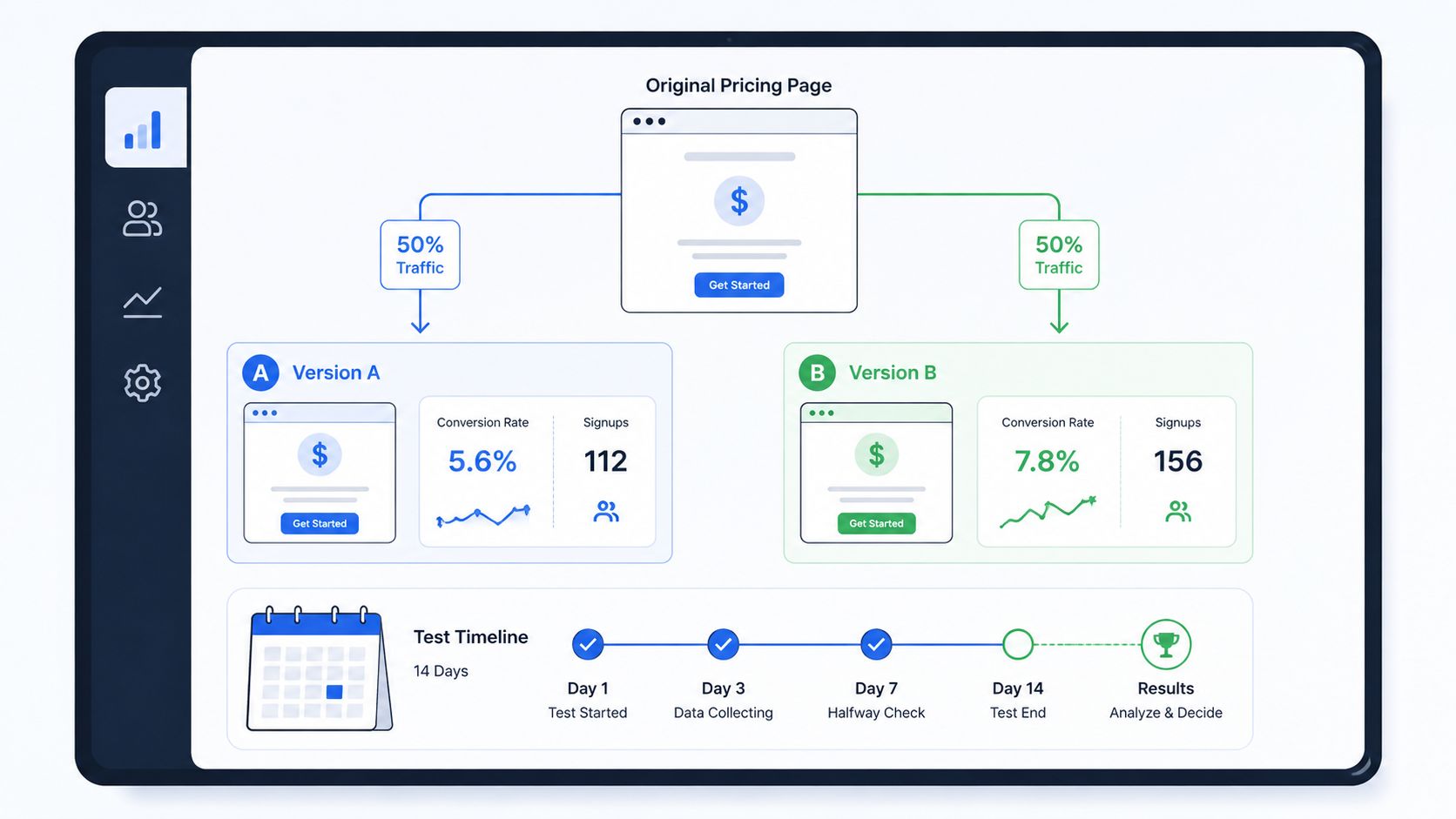
Build the test around one decision
Start with the question you need answered. Are you testing a higher price, a different package structure, or a discount policy change? Pick one. If you test multiple levers at once, you won't know what drove the result, and the team will spend the next month arguing about causality instead of learning.
A workable setup usually means:
- One variable only. Change the price, the package boundary, or the discount rule, not all three.
- Clean traffic or account splits. Keep the assignment logic simple so sales and customer success know who sees what.
- Enough duration. Short tests often reward randomness, not judgment.
- A decision rule. Decide in advance what outcome would justify a rollout, a rollback, or a second test.
The pricing guidance in the verified data is useful here. It recommends testing new prices on 10% to 20% of a customer base for 2 to 4 weeks, using at least 200 conversions per variant, and revisiting pricing every 6 to 9 months to keep pace with demand changes (AI pricing optimization statistics). That's the kind of structure that prevents “we kind of tried it” from masquerading as evidence.
Protect the experiment from internal interference
Sales teams will want exceptions. Customer success will want special handling. Leadership will want to peek at early numbers. If you don't set guardrails, the test gets contaminated before it's finished.
The cleanest rule is simple. Keep the test narrow, document who can override it, and make sure approvals don't create a side channel that changes the economics behind the scenes. Otherwise the data looks clean while the business process is going off the rails.
Measuring the Metrics That Actually Prove It Worked
Pricing changes can make one metric look better while another gets worse. That's why the scoreboard has to be explicit before you launch the test. If you only watch top-line revenue, you can miss a price increase that improves ARPU but pushes churn higher or weakens expansion later.
Read the metrics as a system
ARPU tells you whether the average customer is paying more. NRR tells you whether your existing base is expanding or shrinking over time. Conversion tells you whether the new price is blocking new sales. Churn tells you whether customers are leaving faster after the change.
Those metrics don't always move together. A price hike can lift ARPU immediately, while masking the fact that lower-value cohorts are churning. That's why founders should read pricing outcomes by segment, not just in aggregate.
| Metric | What it tells you | Warning sign |
|---|---|---|
| ARPU | Whether the average account is worth more | ARPU rises, but churn or downgrades rise too |
| NRR | Whether the current base is expanding | NRR weakens after a price or packaging change |
| Conversion | Whether the market accepts the new offer | Conversion drops sharply at the pricing step |
| Churn | Whether customers are leaving after purchase | Churn rises after renewal or post-change cohorts |
| LTV | Whether lifetime value is improving | LTV looks better on paper, but only because acquisition slowed |
The table is simple on purpose. Pricing teams monitor these kinds of measures on weekly or quarterly cycles, because the point is not just to raise revenue, but to make decisions faster and with less guesswork. That fits the broader pricing framework that emphasizes regular dashboard updates and historical trend analysis (pricing metrics guidance).
Don't let one win hide another loss
If the test improved ARPU but customer expansion softened, don't declare victory. If conversion improved but deal sizes fell, the move may have made the offer easier to buy while shrinking value capture. Every pricing change has a second-order effect, and the job is to find it before rollout becomes policy.
Useful habit: review pricing results by cohort, by channel, and by customer tier. The aggregate number is often the least interesting number on the page.
Governing Pricing Once the Tests Are Over
The first failure usually looks like a success. The new price goes live, the team gets a clean test result, and then the old habits return, discounting creeps back, reps start freelancing, channels split into their own price logic, and the original gain fades. Pricing work breaks down less because the strategy was wrong and more because nobody owns what happens after launch.
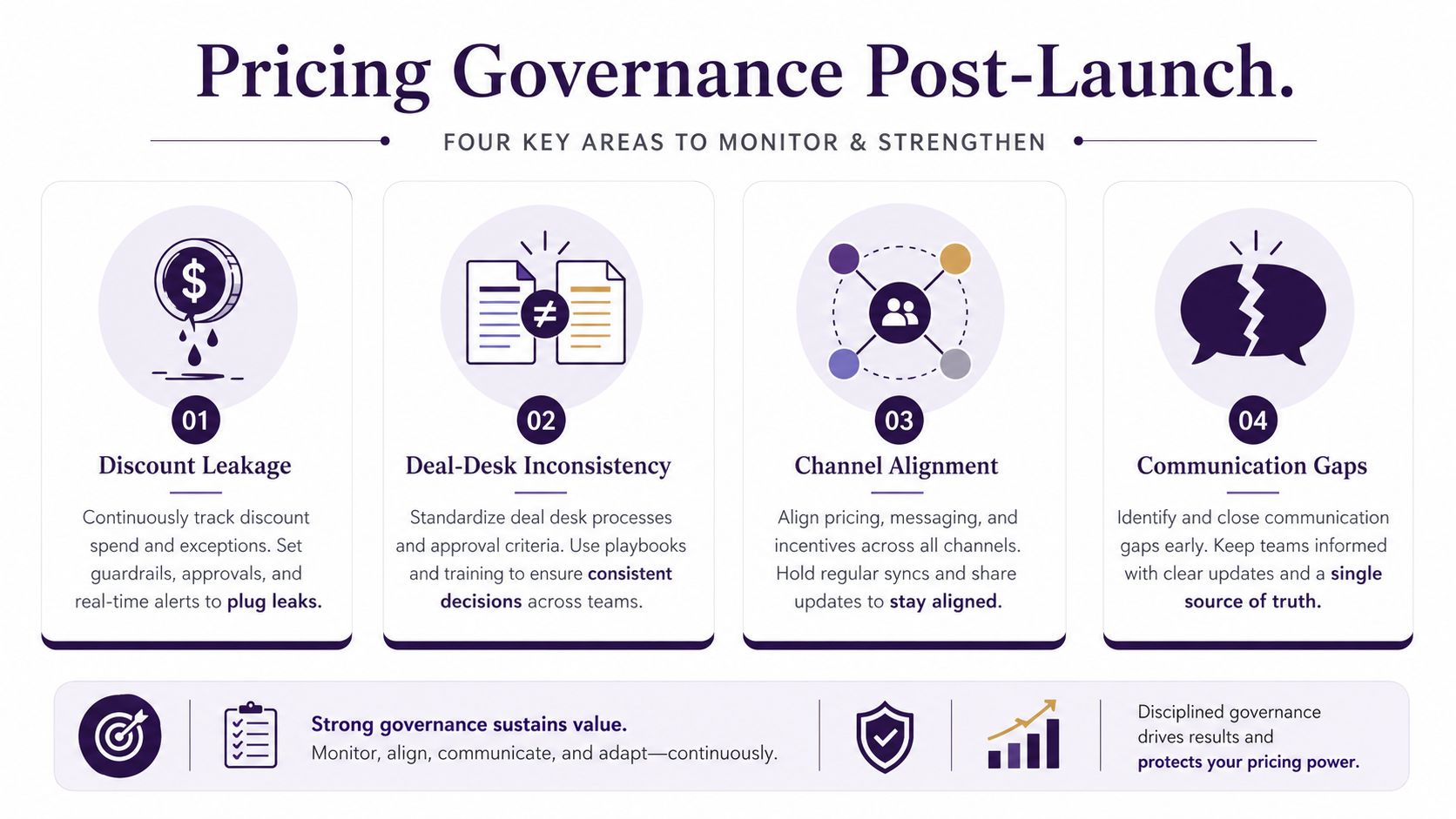
Where the leakage usually happens
Three failure modes show up again and again. Discount leakage happens when sales makes quiet exceptions that never reach reporting. Deal-desk inconsistency shows up when similar customers get different answers depending on who owns the quote. Channel conflict appears when direct, partner, and self-serve motions drift into separate pricing realities.
A fourth problem is automated chaos. Rules spread across systems, but no one is checking whether they still fit the current offer, customer segment, or sales motion. That gets dangerous fast when pricing logic is copied into multiple tools and no single owner is watching the downstream impact.
Measurement is where many teams slip. The right question is whether the commercial process is holding the line after the test. That is why pricing teams need clear views of net price realization, discount levels, deal profitability, and price variance across similar customers. pricing strategy guidance points to those signals as the ones that show whether the system is working.
Governance is an operating job
Price governance is recurring work. Someone has to review exceptions, reconcile channel differences, and keep the price architecture clear enough that sales can use it without improvising around it.
That requires visible targets and visible pricing data. It becomes much easier to execute consistently when the business is growing faster than the team behind the scenes, because the rules are written down, checked, and corrected before they drift too far. Without that discipline, a pricing change can look successful for a quarter and then slowly degrade.
A pricing system is leaking if the same customer can get three different prices through three different routes to market. If you need a closer look at how pricing operating models get set up and maintained, the pricing strategy consultants guide is a useful reference.
When a Fractional Pricing Leader Becomes the Smartest Hire You Make
The hiring decision is usually simpler than founders think. If the problem is one-off analysis, keep it in-house. If the problem is a full commercial transformation and the company is large enough to justify it, hire a full-time head of pricing. If the issue is strategy plus execution capacity, a fractional leader is often the cleanest answer.
That middle case is common. The team knows pricing matters, but nobody has enough bandwidth to own experiments, train sales, build governance, and keep the metrics clean. That's when outside leadership earns its keep, because the bottleneck isn't insight, it's sustained execution.
A pricing strategy consultant can help map the path, but a fractional operator can keep the system moving. For a deeper look at that distinction, see this guide to pricing strategy consultants.
A SaaS company I'd point to in spirit, if not by name, pulled back meaningful margin after it stopped treating pricing like a quarterly project and put a fractional revenue lead on the work. The change wasn't dramatic on day one, it was disciplined, especially around discounts, renewal alignment, and rep behavior. That's usually where the value shows up first.
Shiny connects growing companies with vetted fractional leaders across revenue, finance, and operations for 5 to 25 hours a week, which makes this kind of support practical when the team needs senior judgment without a full-time hire. For founders who can diagnose the pricing gap but can't spare the internal headcount to run the play, that's often the most efficient path.
If pricing keeps stalling because the team needs sharper strategy, better execution, or both, Shiny can connect you with the right fractional executive to own the work with you. Explore the marketplace or schedule a consultation, and use pricing as a real operating lever instead of a recurring headache.
