

Technology Implementation: A Practical Framework
You're probably looking at a project that sounded straightforward in the meeting and now feels heavier every week. The license is approved, the vendor is responsive, and the deck still says go-live is “on track.” Meanwhile, your team is juggling process gaps, half-finished integrations, and users who keep asking the same question, “Why are we changing this now?”
That gap between the plan and execution is where technology implementation usually breaks. The software isn't the main problem. The core problem is that most SMBs treat implementation like a buying decision, then discover it's a leadership assignment that touches scope, people, process, and accountability at the same time.
Why Most Technology Implementations Stall Before They Start
A founder I worked with once described a rollout as “simple.” It was a finance workflow tool, a few integrations, and a team that supposedly knew the process already. Six weeks later, the project was stalled because nobody had agreed on the baseline, the users had different definitions of success, and the internal owner was handling the rollout between three other jobs.
That's the pattern. Teams buy a tool before they've answered the harder questions about what problem they're solving, who owns adoption, and how the change will fit real work. A technology rollout becomes fragile when it's treated as procurement instead of an operating change.
The hidden failure is leadership, not software
The biggest mistake is assuming a vendor demo replaces executive oversight. It doesn't. Guidance on implementation success starts with requirements analysis and baselining, then moves through functional decomposition, alternative evaluation, and solution verification, because that sequence reduces rework by validating user needs before deployment technology implementation methodology.
That matters more in startups and SMBs because nobody has infinite bandwidth. The person “owning” the rollout is often a department head or founder who already has a full-time job. Without a strong operator in the middle, the project drifts into delays, scope creep, and low adoption.
Practical rule: If no one can explain the baseline process in one page, the rollout is too early.
Successful implementations look boring in the best way. The business knows what will change, the team knows what won't, and the leader keeps decisions moving. That's where fractional executives earn their place, not by “advising,” but by making the rollout feel controlled instead of improvised.
Scoping Your Project and Baselining Requirements
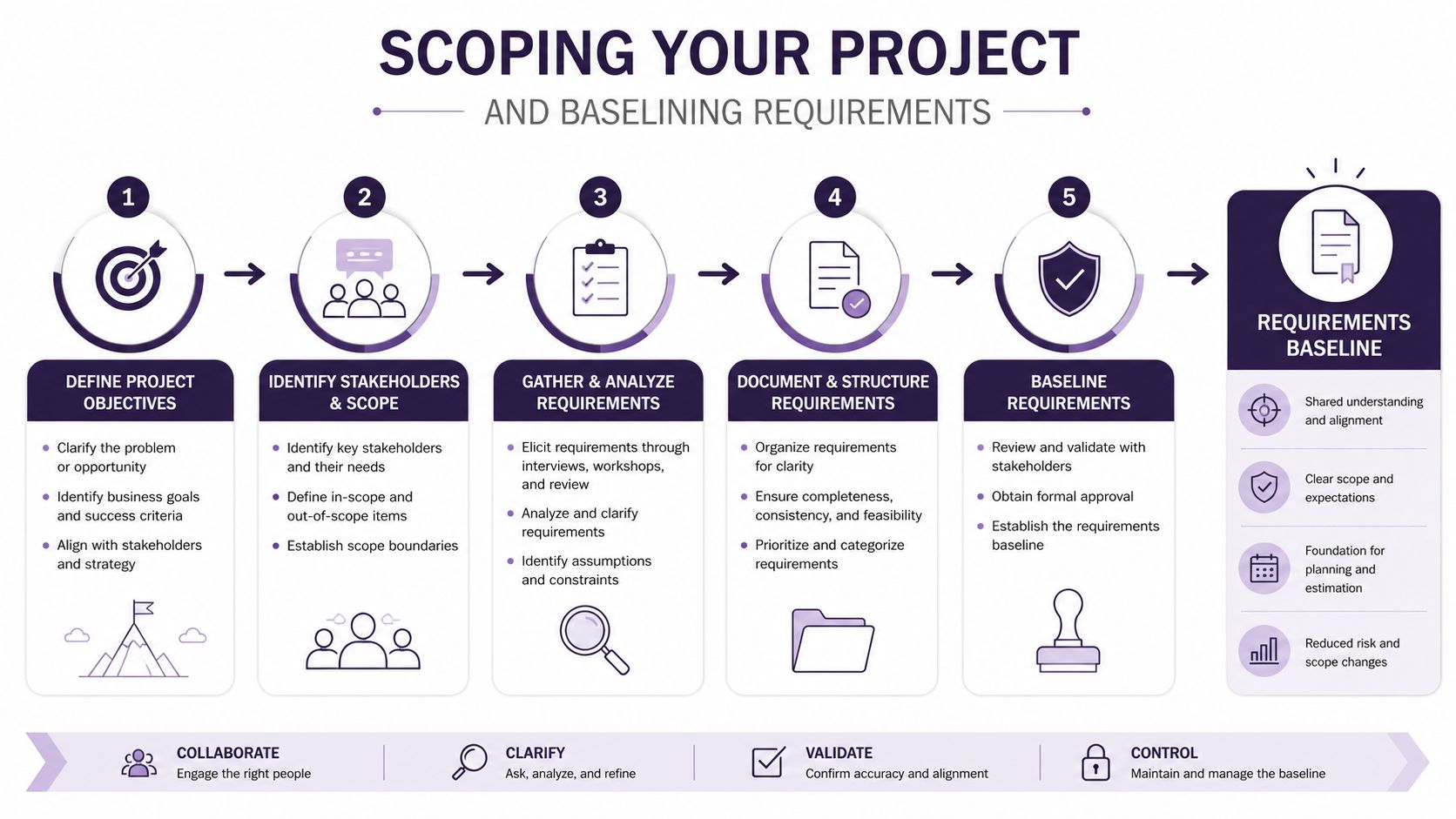
Start with the problem, not the product. If the team cannot say exactly what process is changing, what pain it creates, and what success looks like, every demo will seem persuasive and every feature will feel useful. A disciplined rollout begins with requirements analysis, then moves through functional decomposition, option comparison, and solution verification before anything is deployed implementation guidance.
The house-building comparison still holds because it captures the sequence. You do not order materials before the blueprint is done, and you should not sign a software contract before the workflow, handoffs, and must-have steps are clear. Baselines matter because they define what “better” means after go-live, not just what looks better in a sales deck.
Define the boundary before you define the tool
Start with the current workflow. Map who touches the process, what gets entered, where approvals happen, and where the bottlenecks sit. That baseline becomes the reference point for every later decision, especially when a vendor tries to widen the scope with attractive but unnecessary features.
A short list keeps the project honest:
- Current state: What happens today, step by step.
- Pain points: Where time is lost, duplicated, or manually re-entered.
- Must-have outcomes: What the new system has to solve on day one.
- Excluded work: What stays out of phase one, even if it sounds appealing.
- Pilot group: Who should test the rollout first and why.
A pilot-first rollout lowers risk because it gives the team a controlled environment to learn before wider deployment. Implementation guidance recommends starting with a high-impact, low-risk use case, then running short deploy-monitor-analyze-improve cycles with an initial cohort of 10 to 50 users before scaling pilot-first rollout approach.
A documented roadmap also keeps the work tied to operations instead of turning it into a standalone software purchase. A useful starting point is a documented roadmap like developing a technology roadmap, because it forces sequence and ownership before the tool choice hardens. Fractional executives are valuable at this stage because they close the experience gap, keep scope from drifting, and make the rollout feel controlled instead of improvised.
Evaluating Vendors and Technology Partners
Most SMBs lose ground during vendor selection because they judge platforms by the demo, not by the implementation burden. A slick interface can hide ugly realities like data migration pain, weak support, or a partner who disappears after signature. The better test is simple: compare what the vendor promises against what your team can absorb.
A fractional CTO or COO helps here because they've seen the failure modes already. They know when a platform is technically sound but operationally wrong, and they're less likely to be impressed by a polished sales cycle. That experience matters when the company doesn't have a procurement team or a deep internal bench.
Compare the options against operational reality
Use a scorecard that forces discipline, not enthusiasm.
| Evaluation Criteria | Common SMB Mistake | Recommended Approach |
|---|---|---|
| Integration fit | Believing “it connects” means “it works” | Verify actual system handoffs, data flow, and ownership |
| Total cost of ownership | Looking only at subscription price | Include setup, support, training, and internal admin time |
| Vendor lock-in risk | Ignoring exit complexity | Ask how data moves out and what changes require paid help |
| Support quality | Accepting generic service promises | Test response paths, escalation, and implementation support |
| Configuration depth | Equating customization with flexibility | Prefer configuration that keeps maintenance manageable |
| Change impact | Choosing the tool before assessing users | Match platform complexity to team readiness |
The goal is not to find the fanciest tool. It's to find the partner who can survive your rollout without dragging the business into avoidable complexity. In a startup or small business, that usually means fewer features, clearer ownership, and a stronger fit with your current operating model.
One practical filter is this, if a vendor can't explain how their implementation works without hand-waving, they're not ready for your business. Another is to ask who will be responsible after go-live, because some of the worst rollouts look successful until the support window closes.
Managing Change and Building User Readiness
The hardest part of implementation usually is not the technical setup. It is getting people to change how they work without making their day harder in the process. Evidence from digital health adoption puts time, cost, and limited workflow integration ahead of feature gaps as the main barriers, and underserved settings also run into weak infrastructure, limited funding, and training gaps systematic review of digital health adoption.
That matches what happens in SMBs. People do not resist software because they hate progress. They resist because the new workflow does not fit their job, their confidence, or the time they have.
Adoption follows trust, not announcements
A rollout needs more than a launch email and a training deck. Users need to know how the tool fits into their actual day, what happens when something breaks, and who they can ask without feeling foolish. Guidance for rural and underserved telehealth users makes the point clearly, device ownership, internet access, audio and video capability, comfort with devices, and trust in the virtual app all materially affect uptake telehealth barriers guidance.
That same logic applies in business software. If the workflow is clunky, the team will route around it. If the onboarding feels generic, they will forget it. If the support model is abstract, they will go back to spreadsheets.
Simple truth: People adopt what they understand and can use without embarrassment.
Leadership and operating context matter too. A UK government review of education technology implementation found that leadership, school culture, and technology infrastructure positively affected implementation, alongside training and learning opportunities for professionals UK education technology review. The lesson transfers cleanly to SMBs. Culture and readiness are not soft issues, they are deployment variables.
Use a change plan that includes:
- Role-specific onboarding: Show each user what changes in their day, not the whole system map.
- Peer support: Put early adopters next to skeptical users so learning feels local.
- Hands-on help: Keep live support close during the first wave of usage.
- Fallback paths: Define what users should do when the system does not fit a real scenario.
- Visible leadership: Have an executive reinforce the why, not just the schedule.
A practical change plan also needs clear ownership, and that is where many SMB rollouts fall apart. The project gets assigned to IT, the workflow impact lands on operations, and no one owns the human side of adoption. Fractional leaders fill that gap because they have seen enough implementations to spot where resistance will show up, and they know how to connect process, training, and leadership without turning the rollout into a committee exercise. For a closer look at that work, see change management best practices.
The biggest mistake is assuming adoption will happen after go-live. It will not, unless the rollout treats people as the product, not just the software.
Defining KPIs and Measuring Implementation Success
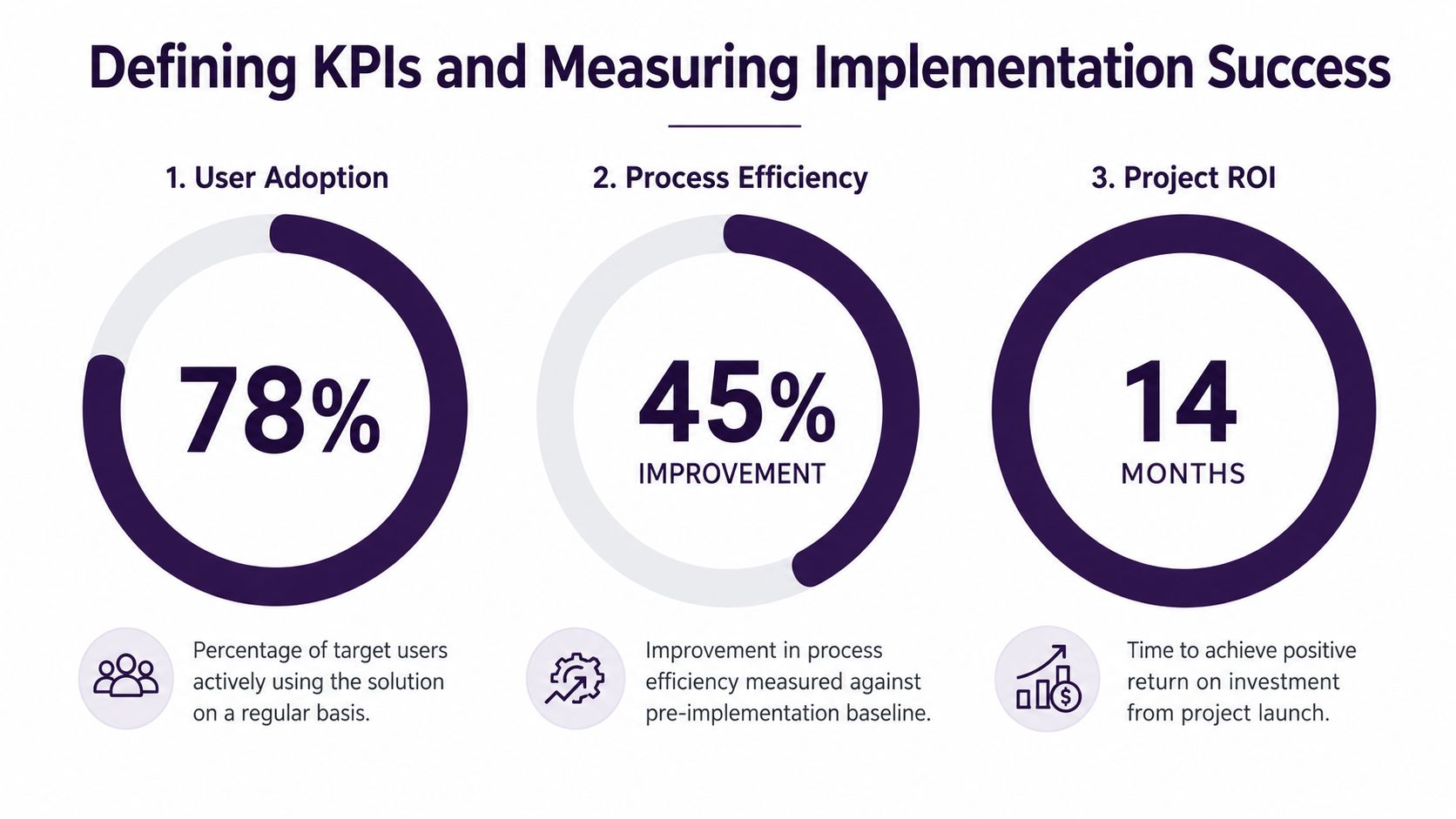
If success is not defined before launch, teams usually end up measuring whatever is easiest after go-live. That often means counting activity instead of proving outcome. Better implementations start with baseline KPIs, then track adoption and performance in real time so the team can correct issues before they harden into routine measurement discipline guidance.
Measurement discipline keeps a project from drifting. It also helps leaders tell the difference between a real implementation problem and a short learning curve. If process performance slips, someone has to determine whether the tool is failing, the workflow is unclear, or users need more support.
Build the metrics around the business outcome
A useful KPI set usually needs one leading indicator and one lagging indicator. Adoption shows whether people are using the tool. Process measures show whether the workflow is getting better. If the tool gets used but the process still breaks, the implementation is not finished.
A solid measurement setup should include:
- Baseline metrics: Capture the current state before change starts.
- Adoption tracking: Watch who is using the system and where usage drops.
- Workflow health: Track whether the process is faster or cleaner.
- Exception review: Examine where users route around the tool.
- Feedback loops: Create a standing cadence for fixes, not one-time clean-up.
In manufacturing-focused implementations, practitioners also stress keeping baseline KPIs intact during transition, aligning digital tools with standard work, and maintaining IT-OT integration so production does not get shocked by the change. That point matters for any business with a live operating environment, because change should not interrupt the system that pays the bills.
Useful checkpoint: If the team cannot describe what “normal” looked like before the rollout, they will not know whether the rollout helped.
Measurement is also where fractional leadership adds value. A part-time executive can own the scoreboard, press for consistent review meetings, and keep the rollout tied to business language instead of vendor language. That often separates a project that gets finished from a project that gets discussed forever.
A mature measurement plan also forces trade-offs into the open. If a team insists on speed, leaders may accept a narrower feature set and lighter reporting. If the business needs tighter control, the rollout may require more training, more exception handling, and a slower cutover. A fractional executive who has led other rollouts can keep those choices explicit, which is exactly why some teams pair implementation work with fractional CTO services and tech leadership.
How Fractional Executives De-Risk Technology Rollouts
A lot of SMB technology failure comes down to a missing layer of leadership. The company has a vendor, maybe an internal project manager, and plenty of opinions, but no one who has done enough rollouts to recognize the pitfalls early. That's the gap fractional executives fill, they bring operating judgment without forcing a full-time hire into the budget.
Shiny's marketplace connects startups with over 3000 vetted executives across SaaS, FinTech, HealthTech, Ecommerce, AI, Manufacturing, and other industries, including part-time CTOs, COOs, and CFOs who can step into implementation work when the business needs senior oversight. It's one option when a company needs cross-functional leadership, not just advice, and it pairs naturally with the kind of rollout discipline described in fractional CTO services and tech leadership.
Where the fractional leader changes the outcome
The strongest value shows up in four places. First, they shape the scope so the team doesn't buy a platform bigger than the problem. Second, they pressure-test vendors and contracts with implementation experience, not hope. Third, they keep change management tied to actual user behavior. Fourth, they hold the KPI line after go-live so the project doesn't lose momentum.
A good fractional executive also makes trade-offs visible. They'll tell you when the cleaner option is to delay a feature, reduce customization, or phase the rollout by workflow instead of department. That honesty saves money and keeps the team from calling confusion “progress.”
The right executive at the right moment
- Early stage: A fractional CTO or COO can frame the requirements, define the baseline, and help choose the implementation path.
- Selection stage: They can lead vendor conversations and push back on hidden complexity.
- Launch stage: They can coordinate adoption, training, and issue triage.
- Stabilization stage: They can review KPIs, tighten the process, and hand off a cleaner operating model.
That model works because implementation is not one event. It's a sequence of decisions that need senior judgment at each step. If your team is trying to run a serious rollout with junior-level oversight, the work will usually take longer, cost more, and create more internal friction than it should.
Your Technology Implementation Action Plan
Start with the business problem, not the software. Write the current workflow down, define the success criteria, and decide what stays out of phase one. If that baseline is fuzzy, fix that first.
Then move in three passes. Pre-launch, choose the vendor, assign ownership, and set the pilot group. Launch, train by role, monitor adoption closely, and keep feedback loops short. Post-launch, review the KPIs, remove workarounds, and standardize the new process so the gains stick.
A simple checklist helps:
- Before launch: requirements, scope, baseline, ownership.
- During launch: pilot users, support coverage, issue tracking.
- After launch: KPI review, process cleanup, operating handoff.
If your team lacks senior implementation experience, that's not a small gap. It's often the reason the project feels harder than it should. A fractional executive can close that gap quickly, keep the rollout grounded in operating reality, and make the next decision much easier.
If you're planning a rollout and want experienced help without hiring full time, Shiny connects businesses with fractional executives who've led technology change from the inside. Explore the marketplace or schedule a consultation if you want the right CTO, COO, or CFO to steady the project, reduce risk, and keep implementation moving.
