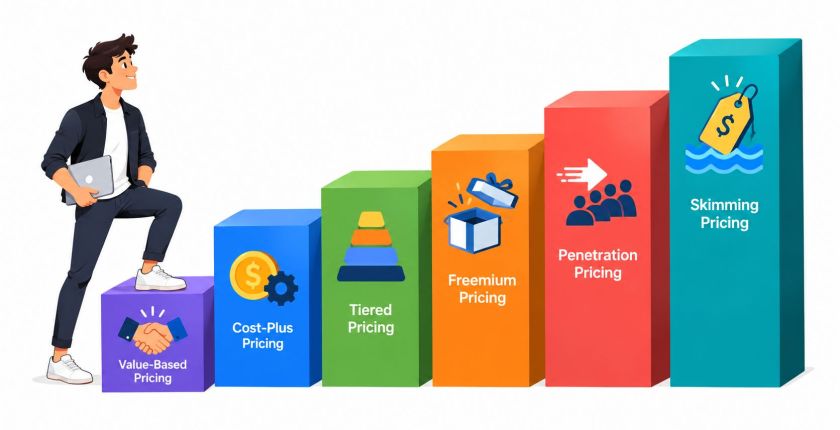
Pricing Strategies for Marketing: A Startup Playbook
You've probably set your price the same way most startup founders do. You checked your costs, looked at two competitors, added a margin, and published a number that felt defensible. Then sales started discounting it, prospects questioned the value, and your most demanding customers turned out to be the least profitable.
That isn't a marketing problem with a pricing problem attached. It's a leadership problem. Pricing strategies for marketing determine who buys, why they buy, how much support they require, and whether your growth creates cash or consumes it.
The High Cost of Getting Pricing Wrong
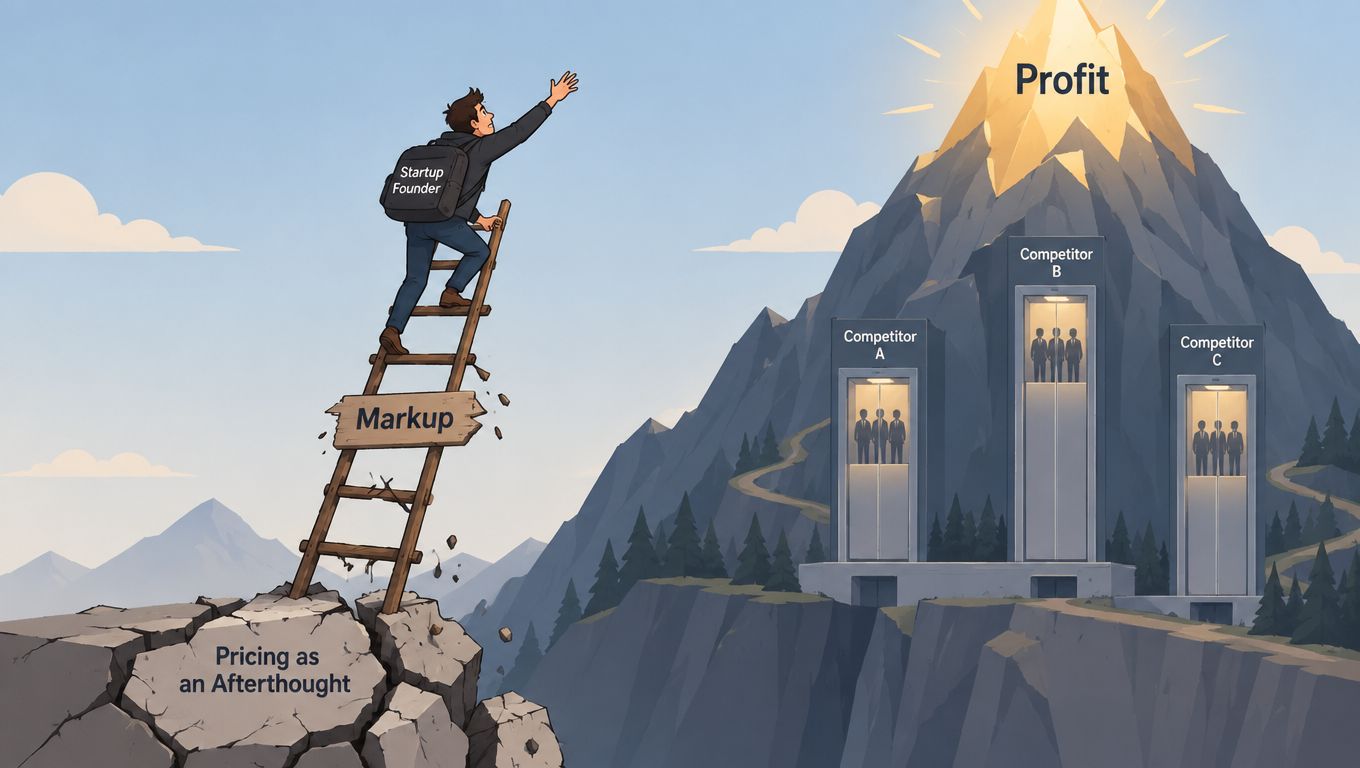
A founder I worked with once priced a software product by adding a markup to hosting, development, and support costs. The calculation was tidy. The result wasn't.
The price was too high for small customers who saw the product as a useful convenience, yet too low for larger customers who relied on it for a revenue-critical workflow. Salespeople responded by negotiating individual discounts. Marketing promoted the product as accessible, while the sales team positioned it as strategic. Product managers kept adding features to justify the price. Nobody could explain which customer the original number was designed to serve.
That startup didn't need another spreadsheet. It needed an executive decision about value, segmentation, positioning, and commercial execution.
Price is a message customers interpret
Customers don't see your cost structure. They see an offer and decide whether the expected outcome justifies the sacrifice. A low price can signal accessibility, low risk, or low quality. A high price can signal expertise and impact, but it can also expose weak proof and unclear positioning.
That's why pricing belongs in the marketing strategy, not only in finance. Product packaging, website copy, sales enablement, promotions, and customer success all reinforce the price. If those functions tell different stories, prospects feel the inconsistency before they ever mention the number.
Value-based pricing became more formalized in the late twentieth century through work such as Kent Monroe's Pricing: Making Profitable Decisions, first published in 1979, and Thomas Nagle and Reed Holden's The Strategy and Tactics of Pricing, first published in 1987. These works helped codify the principle that companies should price according to customer value and willingness to pay, rather than relying only on cost, as described in this overview of value-based pricing.
The founder's three expensive mistakes
Most pricing failures fall into recognizable patterns:
- Markup thinking: You protect a margin on internal costs but ignore the economic value created for the buyer.
- Competitor copying: You inherit another company's positioning, customer mix, discounts, and cost structure without knowing whether they fit your business.
- Universal pricing: You charge every buyer the same despite differences in urgency, budget, use case, geography, and willingness to pay.
Price segmentation exists to address those differences. Companies can charge different customer groups based on willingness to pay, timing, geography, or customer characteristics, using tools such as surveys, market research, questionnaires, and tiered offers. The explanation of pricing segmentation captures the central idea, pricing should reflect measurable differences in demand rather than treat every buyer as interchangeable.
Practical rule: If your team can't explain which customer receives which value at each price, your pricing isn't finished.
Bad pricing creates more than missed revenue. It attracts customers who need heavy service at low margins, trains buyers to wait for discounts, and makes sales forecasts unreliable. It also forces founders to revisit the same decision repeatedly because nobody owns the commercial logic.
A disciplined pricing strategy gives marketing a sharper promise, sales a clearer negotiation boundary, and finance a more reliable revenue model. That combination is difficult to create through a one-time founder decision. It requires an accountable leader who can make trade-offs across departments and keep the operating model aligned with the price.
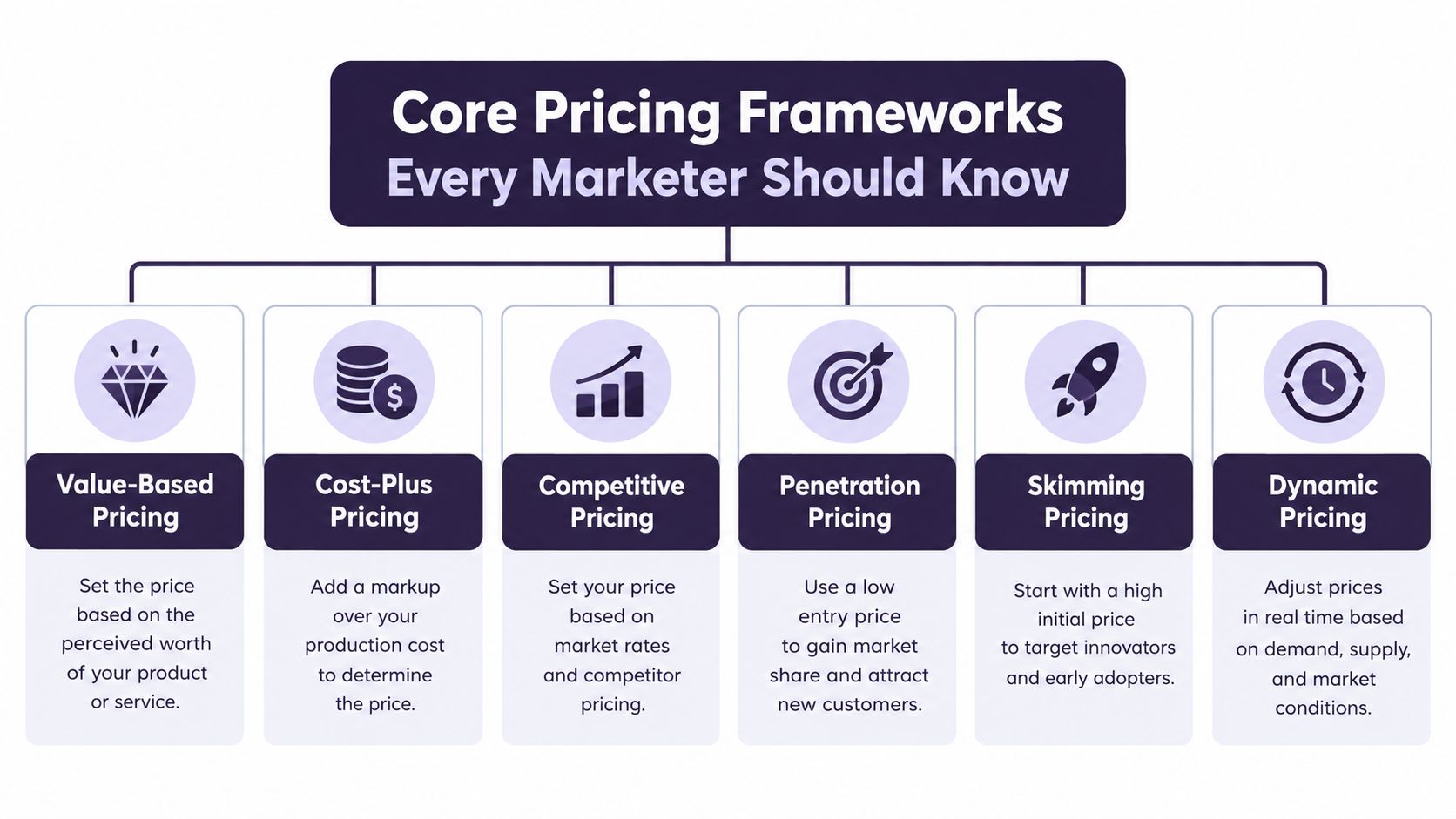
Core Pricing Frameworks Every Marketer Should Know
No framework is universally correct. The right choice depends on how customers experience value, how quickly they receive it, how much they use the product, and how much operational complexity your team can support.
Value-based pricing
Value-based pricing starts with the customer's outcome. You investigate the cost of the problem, the value of solving it, the alternatives available, and the buyer's urgency. A workflow tool that saves a small team occasional administrative effort should not be priced like a system that prevents costly operational failures.
This model works best when your product produces a visible business result or serves a customer with a clear willingness to pay. It requires strong discovery, customer interviews, segmentation, and sales training. It also exposes weak positioning quickly. If customers can't describe the value, increasing the price won't fix the offer.
Cost-plus pricing
Cost-plus pricing adds a markup to production or delivery cost. It's easy to calculate and useful as a margin floor, especially for physical products, agency services, and businesses with volatile delivery costs.
It's a poor ceiling. Customers don't care that your internal process became expensive. If you use cost-plus as the final answer, you'll often undercharge for differentiated value and overcharge when your cost base is inefficient.
Competitive pricing
Competitive pricing anchors your offer against market rates. It can help a new entrant avoid an obviously implausible position, but copying a competitor's number is not a strategy.
Use competitor prices as context, not as permission. Compare the complete offer, including onboarding, support, integrations, reliability, contract terms, and customer risk. A smaller company can charge more than an established competitor when it solves a narrower, more urgent problem.
Penetration pricing
Penetration pricing uses a deliberately low entry price to win attention and adoption in a crowded market. It makes sense when customers can adopt quickly, switching costs are manageable, and scale or network effects improve the economics.
The risk is psychological and operational. Buyers may treat the introductory price as the permanent value of the product. Raise prices only when the product has earned a stronger position, and define the transition rules before launch.
Skimming pricing
Skimming starts high and targets buyers who value early access, differentiated capabilities, or speed more than price. It can fund product development and reveal demand from innovators.
This approach fails when the product is not meaningfully better than available alternatives or when early customers feel they were used to finance an unfinished experience. Early buyers need a compelling reason to accept uncertainty.
Dynamic pricing
Dynamic pricing changes prices in response to demand, timing, inventory, competition, or customer context. It can work well in markets with changing capacity or time-sensitive demand. It can also undermine trust when customers compare prices across channels or expect predictability.
Recent research comparing online and offline buying contexts highlights this distinction. Online customers can respond more strongly to dynamic pricing, social commerce signals, and impulse-oriented framing, while offline customers often favor stable prices and direct product experience, as discussed in this channel-specific pricing analysis.
For a practical explanation of how price functions inside the broader marketing mix, see this guide to price in marketing. The important decision isn't which label sounds most impressive. It's whether the model fits the buyer, the channel, and your ability to operate it without creating confusion.
Freemium vs Tiered Pricing, Choosing Your Entry Point
Freemium and tiered pricing solve different problems, even though both can display multiple access levels.
Freemium is an acquisition mechanism. It removes the initial payment barrier and lets users experience the product before deciding whether to upgrade. That works when users can reach value without expensive human support, when usage can spread naturally, and when the free experience creates a reason to invite others or return frequently.
Tiered pricing is a monetization and segmentation mechanism. It gives different customers different combinations of capability, capacity, support, or governance. The buyer self-selects based on need and budget, which lets you serve more than one segment without negotiating every deal from scratch.
The decision in practical terms
| Question | Freemium | Tiered pricing |
|---|---|---|
| Primary job | Reduce adoption friction | Match offers to willingness to pay |
| Best fit | Self-serve products with fast time to value | Products with distinct customer needs |
| Main risk | A large free audience that costs money to serve | Confusing tiers or weak differences |
| Sales motion | Product-led and automated | Self-serve, sales-assisted, or sales-led |
| Upgrade trigger | Usage, limits, collaboration, or advanced features | Capacity, functionality, support, or control |
Freemium is dangerous when free users consume expensive infrastructure, require support, or never encounter a natural upgrade moment. A free plan should not be a watered-down version that leaves users unable to understand the product. It should demonstrate value while reserving a commercially meaningful capability for paid customers.
Tiered pricing is dangerous when every plan contains a random collection of features. Buyers need a clear progression. A basic plan might serve an individual use case, a professional plan might support collaboration and automation, and an enterprise plan might add security, governance, and dedicated assistance. The boundaries should reflect how customers grow, not how your internal departments are organized.
Choose based on customer behavior
Use freemium when your product can create value cheaply and repeatedly without a salesperson. Use tiered pricing when customers differ materially in complexity, risk, or required support.
Don't choose based on what a famous software company does. Interview users who activated but didn't pay, users who upgraded quickly, and customers who requested discounts. Look for the moment when the buyer first experiences value and the constraint that makes additional value worth paying for.
The right entry point makes the next purchase feel logical, not forced.
Your model also determines your marketing language. Freemium marketing must communicate speed, accessibility, and the path to activation. Tiered pricing must communicate fit, trade-offs, and why the next plan earns its premium. If your team can't explain the upgrade event in one sentence, the packaging needs work.
Testing Price Points Without Burning Cash
You don't need a large research budget to test pricing. You need a controlled question, a defined customer segment, and a willingness to separate evidence from opinion.
Start with the outcome you're trying to improve. “Find the perfect price” is not a useful test objective. “Learn whether operations leaders value automated reporting enough to buy a higher-support package” is specific enough to guide an experiment.
A practical testing sequence
Map the segments first. Separate customers by use case, urgency, company context, buying authority, and service requirements. A single blended average can hide the fact that one segment is highly price-sensitive while another is paying for speed.
Interview for value before asking for a number. Ask what the buyer does today, what the problem costs in time or risk, what alternatives they considered, and what would make the purchase feel safe. Don't lead with your proposed price.
Use a willingness-to-pay survey. A Van Westendorp Price Sensitivity Meter can help identify an acceptable price band by asking when a price feels too cheap, inexpensive, expensive, or too expensive. Treat the result as directional evidence, not a purchase commitment.
Run a concierge test. Offer the proposed package manually to a small, clearly defined group. Deliver the service, observe objections, track which features customers use, and record the language they use to describe the value.
Test the message and price together. An A/B landing page test can compare different packages and price presentations, but the copy must describe equivalent value. If one page has stronger proof or a clearer outcome, you're testing the offer, not only the price.
Review behavior after the sale. Track qualified inquiries, sales conversations, close quality, discount requests, onboarding effort, early cancellations, and expansion signals. A higher conversion rate means little if the new customers require unprofitable support.
Protect the experiment
Never change multiple commercial variables without documenting them. Record the segment, channel, offer, price, discount policy, sales owner, test dates, and success criteria. Avoid drawing conclusions from a short seasonal period or from one unusually strong salesperson.
The person running the test should also have enough authority to stop it. Pricing experiments affect sales scripts, product promises, contracts, billing, and customer expectations. A fractional revenue leader can set the test design, align marketing and sales, and make sure the result becomes an operating decision rather than a forgotten spreadsheet.
Test the price customers will pay for the complete offer, not the number they tolerate on a survey.
The most useful output is not a single magic price. It's a decision rule. You might learn that one segment accepts a higher-touch package, another needs a simpler entry plan, and a third should not be pursued until onboarding costs fall.
Why Fractional Leadership Accelerates Pricing Success
Founders often assume they need a full-time executive before they can make serious pricing decisions. That assumption is backwards. You need the decision-making capability first. You can add permanent headcount later if the operating need justifies it.
A fractional Chief Revenue Officer is particularly useful because pricing sits at the intersection of marketing, sales, product, finance, and customer success. A marketing leader may understand positioning but lack control over discounting. A finance leader may understand margin but miss buying friction. A product leader may understand usage but overlook sales capacity. The CRO has to make the commercial system work as one system.
The economics favor flexibility
Fractional leadership is commonly positioned as an alternative to full-time executive hiring. One industry analysis reports that companies using fractional executives often reduce executive compensation costs by roughly 30% to 40%, while another reports savings of 40% to 70%, depending on role scope and engagement structure, as detailed in this analysis of fractional leadership economics.
The point isn't to buy a cheaper executive. It's to buy the right level of leadership for the current constraint. A startup may need a senior operator to redesign packaging, establish discount authority, coach sales, and build a revenue forecast. It may not need a permanent executive team member with a broad mandate and a fixed cost structure.
Demand for this model has also become more visible. One analysis cites the number of fractional leaders in the United States rising from 60,000 in 2022 to 120,000 in 2024, while LinkedIn job mentions rose from 2,000 in 2022 to 110,000 in 2024, according to this report on the changing fractional leadership market.

Reduce the risk of the wrong permanent hire
External executive hiring carries a real downside. Executive recruiting can cost an average of $35,879 per hire, and one benchmark reports that 40% of externally hired executives leave within 18 months. Failed executive hires can cost up to 10 times annual salary after accounting for severance, lost productivity, and turnover, according to this analysis of fractional executive hiring risk.
A fractional CRO gives you a period of working evidence before you commit to a permanent structure. You can evaluate judgment, communication, operating discipline, and the ability to earn trust across functions. If the company later needs a full-time revenue executive, the fractional leader can help define the role and transition the systems.
The work should be concrete:
- Diagnose the revenue model: Audit customer segments, pricing pages, sales stages, discounting, retention, support load, and gross margin.
- Choose the commercial experiment: Select the pricing question with the largest potential impact and the lowest operational risk.
- Create decision rights: Define who can approve discounts, change packages, alter contract terms, and stop an unprofitable motion.
- Equip the team: Rewrite sales messaging, train managers, improve qualification, and give marketing proof it can use.
- Install a review rhythm: Revisit price realization, segment performance, objections, customer outcomes, and delivery economics on a consistent schedule.
A fractional CRO isn't a substitute for founder involvement. The founder still owns the strategic ambition and customer promise. The executive brings structure, cross-functional accountability, and the experience to turn those decisions into repeatable execution.
For a broader view of how this model works across executive functions, explore this guide to fractional leadership.
Building Your Roadmap to Pricing Excellence
Pricing excellence is not a one-time repricing exercise. It's a management system that connects customer value to packaging, acquisition, delivery, and expansion.
Start with a narrow commercial diagnosis. Identify your most attractive segment, the outcome it values, the current friction in the buying process, and the cost of serving it. Then choose the pricing model that matches the way that segment experiences value.
Use this sequence:
- Clarify the value: Document the customer problem, alternatives, urgency, and measurable business consequence.
- Design the offer: Build a simple package structure with a clear reason to move up.
- Set guardrails: Define minimum prices, discount authority, contract terms, and exceptions.
- Test in context: Run interviews, surveys, landing page tests, and concierge offers with defined segments.
- Operationalize the result: Update messaging, billing, sales compensation, onboarding, and reporting.
- Review and adapt: Watch for discount creep, support-heavy customers, changing usage, and new buying behavior.
A strategic roadmap template can help turn these decisions into owners, milestones, and dependencies. The important shift is treating pricing as a leadership function. Marketing creates demand, but leadership decides which demand is profitable and how the company will serve it.
Shiny connects startups with experienced fractional executives who can lead pricing, revenue, marketing, finance, and related operating work without requiring an immediate full-time hire. Visit Shiny to explore the marketplace and schedule a consultation about the executive support your pricing strategy needs.