What Does a COO Do at a Startup? the Real Role
Most startup advice treats the COO as a universal second-in-command. That framing is too vague to help a founder make a hiring decision. A startup COO isn't hired to occupy a prestigious box on an org chart. They're hired to remove the operational constraint that's slowing the company down.
So, what does a COO do at a startup? The honest answer depends on where execution is breaking. In one company, the COO may own finance, recruiting, and customer support. In another, they may build revenue operations, clarify decision rights, and create the cadence that keeps product, sales, and delivery aligned. The title stays the same. The operating problem changes.
Redefining the Startup COO Role
The generic COO job description usually includes “manage daily operations,” “support the CEO,” and “improve efficiency.” Those phrases sound reasonable, but they don't tell a founder what the person should own on Monday morning.
A startup COO is better understood as an operator responsible for an end-to-end business outcome. Their scope is a moving boundary shaped by the CEO's delegation and the company's most urgent bottlenecks, rather than a fixed list of departments. This is also the conclusion reached in startup-focused guidance on the COO role, which emphasizes that the role changes with the company's current operational needs.
That distinction matters because startups rarely have clean functional boundaries. A problem that looks like a sales issue may come from slow onboarding. A hiring problem may come from unclear priorities. A customer support backlog may expose a product delivery or staffing problem. The COO connects those issues instead of treating each one as an isolated department failure.
Own outcomes, not activity
A weak COO becomes the person who attends every meeting, chases every update, and maintains a growing collection of spreadsheets. The company gets more administration, but the founder still makes every consequential decision.
A strong COO owns an outcome such as:
- Reliable delivery: Customers receive the promised product or service through a repeatable process.
- Controlled hiring: The company adds people against clear priorities, budgets, and capacity needs.
- Cross-functional execution: Sales, product, support, and finance work from shared definitions and deadlines.
- Operating visibility: Leadership can see bottlenecks before they become customer or cash problems.
The difference is authority. If the COO owns an outcome, they need the ability to change the process, assign responsibility, and make decisions inside the domain. Giving someone responsibility without decision rights creates a coordinator, not a chief operating officer.
Don't hire complexity before you have it
Hiring a COO too early can create bureaucracy without reducing founder workload. If the company still moves quickly through direct founder decisions and has only a few tightly connected functions, a full executive layer may add meetings instead of value.
The right question isn't, “Do we need a second-in-command?” Ask:
Which recurring operational problem is now too cross-functional for the founder to keep managing personally?
If the answer is unclear, document the bottleneck first. Define the outcome, identify the functions involved, and list the decisions the role must control. That operating design should come before the job description.
Startup COO vs Enterprise COO
The title “COO” hides the key difference: a startup COO designs the operating system while the company is still being built. An enterprise COO improves a system that already has departments, controls, and specialist leaders. Treating the roles as interchangeable leads to the wrong hire.
An enterprise COO typically works through established teams, formal reporting, documented processes, and support functions. The work centers on coordination, efficiency, consistency, and scale. A startup COO works with fewer layers and less certainty. Their job changes with the company's bottleneck, which may involve hiring, cash management, customer operations, compliance, or commercial execution.
In early-stage companies, the role often covers the non-engineering operating backbone, including finance, HR, recruiting, legal, customer support, and sometimes marketing or business development. This broad remit is outlined in early-stage COO operating guidance. The founder should map that scope to the company's actual constraints instead of copying an enterprise job description.
The practical difference
| Feature | Startup COO | Enterprise COO |
|---|---|---|
| Scope | Broad ownership across several non-engineering functions | Coordination and optimization across established functions |
| Resources | Small teams, external specialists, and limited management layers | Specialist departments, support staff, and formal systems |
| Decision speed | Fast decisions with incomplete information | Structured decisions through defined governance |
| Process maturity | Builds repeatable workflows from scratch | Improves and standardizes existing workflows |
| Primary challenge | Creating clarity while priorities shift | Managing scale, complexity, and consistency |
| Useful profile | Adaptable generalist with strong execution judgment | Experienced operator with deep functional and organizational expertise |
The table is a hiring guide, not a rule. A startup may need an operator focused on recruiting and finance during one phase, then customer delivery and planning during another. Define the recurring bottleneck first, then decide whether it requires a full-time executive, a functional leader, or fractional COO support.
Enterprise experience can help, but only if the candidate can work without a large support structure. Test for direct execution. Can they build a budget and challenge an inefficient approval process? Can they hire a support lead and investigate a customer escalation themselves? Can they make a sound decision with incomplete information, then create the reporting needed to improve the next one?
Look for operating range
The startup version of the role rewards range, learning speed, and judgment. The right person does not need to be the deepest expert in finance, legal, recruiting, and customer success. They need to spot risk, bring in the right specialist, and keep the work tied to a business result.
Set the partnership boundaries before hiring. Define which operating problems the COO owns, which decisions sit within that domain, and how conflicts are resolved. If the company cannot yet justify that scope, start with a fractional arrangement. It gives the founder experienced operating capacity without locking the company into an executive structure before its needs are clear.
Core Responsibilities and Revenue KPIs
A COO should not inherit a fixed checklist. The role must be designed around the startup's recurring bottlenecks. If priorities disappear in meetings, ownership is unclear, or customer work stalls between teams, the COO's first job is to build an operating system that exposes those failures and assigns responsibility.
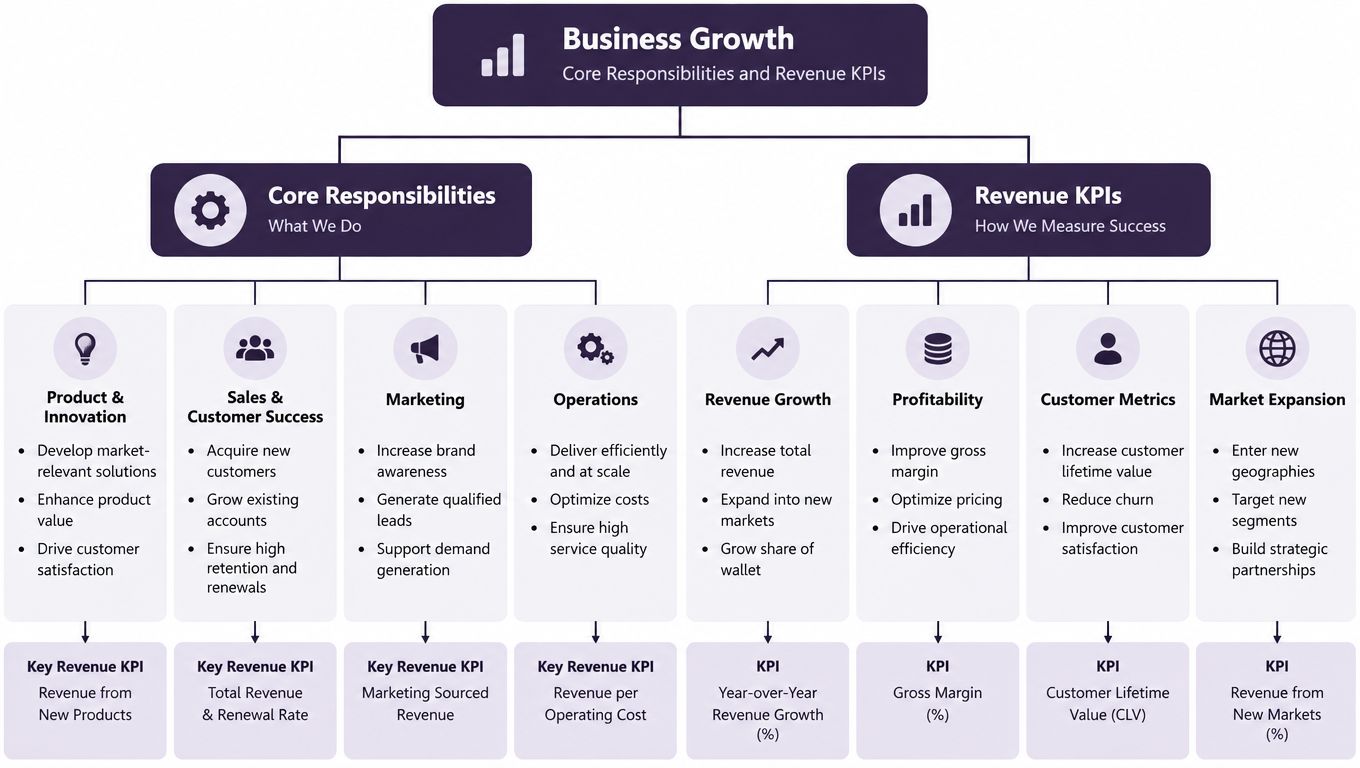
Start with a small set of company-level measures. A practical startup KPI framework helps founders avoid dashboards full of metrics that nobody reviews or acts on.
Build the operating cadence
The COO should establish a rhythm that matches the company's pace. That normally means a weekly leadership review, functional planning meetings, a recurring financial review, and a clear route for escalating blocked work. Every meeting should answer four questions:
- What matters most right now?
- Who owns each outcome?
- What is blocked, and who can remove the obstacle?
- Which result requires a decision from the CEO or leadership team?
The COO also converts repeated work into documented workflows. Customer acquisition needs a defined handoff into onboarding. Product delivery needs acceptance criteria and clear ownership. Hiring needs an approved role, budget, interview plan, and decision process. Budgeting needs actual spending compared with the plan.
Documentation has a practical purpose. It stops the company from solving the same coordination failure in a new meeting every week.
Connect operations to revenue quality
Revenue operations metrics show whether growth is becoming more efficient or just more expensive. A startup COO should understand:
- ARR growth: Whether recurring revenue is expanding and whether operating capacity can support it.
- LTV:CAC ratio: Whether expected customer value justifies acquisition cost.
- CAC payback period: How long the company takes to recover customer acquisition cost.
- Net revenue retention: Whether existing customers expand, contract, or leave over time.
These metrics should drive decisions about hiring, marketing allocation, sales capacity, support coverage, and product priorities. Startup operations guidance on revenue metrics connects these measures to cash efficiency and scalability.
Pair revenue metrics with process measures such as cycle time, throughput, budget variance, and handoff delays. Strong demand does not solve a limited onboarding capacity. A hard-working support team can still leave the company paying to manage recurring problems if those issues never reach product leadership.
Choose the COO's scope from these bottlenecks. If the company needs operating design but cannot yet justify a permanent executive role, a fractional COO can build the cadence, reporting, and workflows before the founder commits to a full-time hire.
Practical rule: Every important KPI needs an owner, a decision attached to it, and a defined response when performance moves in the wrong direction.
When to Hire Your First COO
A startup does not need a COO because it reached a particular funding stage. It needs one when coordination has become the founder's limiting constraint. Hiring earlier adds management cost before the company has a problem that requires executive ownership.
Independent startup guidance places the first COO hire around 30 to 50 employees in many companies. Other startup-focused advice points to Series A or B, often after product-market fit and when teams reach roughly 50 to 100 people. Treat those ranges as signals, not rules. The better question is whether cross-functional complexity now requires one person to design and enforce the operating system, as explained in guidance on hiring a startup COO.
Watch for the operational symptoms
The right timing becomes visible in the work:
- The CEO spends most of the week firefighting: Approvals, escalations, hiring decisions, and process repairs displace strategy and external relationships.
- Functions optimize locally: Sales commits work delivery cannot support, product prioritizes requests without commercial context, or finance discovers spending after commitments are made.
- The same decisions keep returning: Leaders revisit ownership, priorities, and process questions because no one has authority to settle them.
- Growth exposes weak handoffs: New customers, hires, or product lines create delays that were hidden when the company was smaller.
- Managers lack a shared operating system: Department heads can run their teams, but planning, reporting, and escalation practices remain inconsistent.
Use these symptoms to define the mandate. “Run operations” is too vague. Give the COO a measurable operating problem, such as building the planning process, establishing financial control, aligning go-to-market with delivery capacity, or formalizing hiring and people operations. Founders who need a practical timing and mandate checklist can review this guide to hiring a COO.
Factor in runway pressure
Cash planning affects both the timing and scope of the hire. Startup guidance recommends 18 to 24 months of cash runway for seed-stage companies and at least 12 months for Series A companies, according to startup COO role guidance focused on scaling and planning. A COO can protect those targets through budgets, hiring plans, forecasting, and resource allocation.
Match the executive to the constraint. If financial modeling is the problem, hire a fractional finance leader. If one sales channel is failing, a revenue executive may create more value. If the bottleneck is still unclear, start with an operational audit or a fractional COO engagement.
Hire when the founder can name the bottleneck, define the desired outcome, and grant the role real authority. Until then, a permanent COO is a costly answer to an undefined problem.
The Case for Fractional COO Leadership
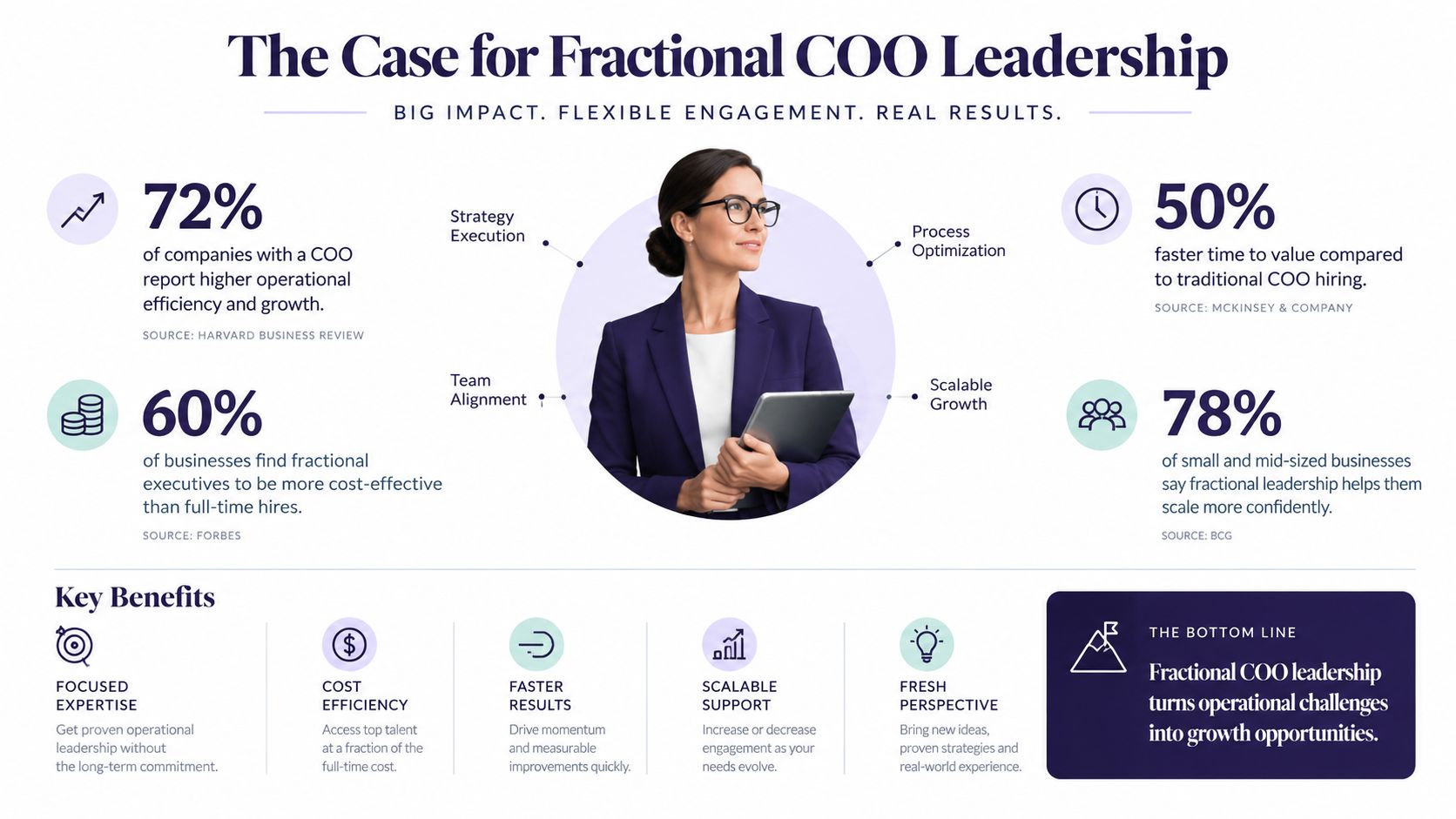
A permanent COO is often the wrong first hire. Startups usually need a specific operating capability before they need another long-term executive salary, reporting layer, and set of fixed commitments. Design the role around the bottleneck, then choose the hiring model that solves it with the least overhead.
A fractional COO can establish leadership cadence, clarify ownership, rebuild workflows, and improve visibility on a defined part-time schedule. The founder gets a practical test of the role against a real business problem instead of making a large fixed commitment based on a vague job description.
Buy the capability before the overhead
The case for fractional leadership is direct. Bring in an experienced operator when the company needs that capability, then expand the engagement if the operating burden becomes permanent.
A fractional COO can help with:
- Operating diagnosis: Identify the bottleneck consuming founder attention or limiting delivery.
- System design: Build dashboards, meeting rhythms, planning processes, and cross-functional handoffs.
- Leadership support: Coach functional leaders and create accountability without adding several management layers at once.
- Hiring preparation: Define the permanent role, its decision rights, and the team it should eventually build.
- Transition planning: Document the systems created and set a clear path to a full-time executive if the need develops.
This model also limits the risk of hiring a polished operator whose experience does not fit the company's constraints. The founder can assess how the executive handles ambiguity, challenges assumptions, communicates decisions, and improves execution before making the appointment permanent. That evidence is more useful than a strong interview performance.
The market has changed
Fractional leadership has moved beyond a niche stopgap. One market report values the global fractional executive market at $5.7 billion and describes annual growth of roughly 14%. It also reports that the professional base grew from 60,000 in 2022 to 120,000 in 2024. These figures appear in the 2026 State of the Market report on fractional work.
Those figures do not establish that every startup needs a fractional COO. They show that companies increasingly use experienced executives through flexible arrangements. The founder's decision should remain operational: does the company need sustained ownership now, or a focused intervention that builds the system before a permanent hire?
Set a hard mandate
Give the engagement a defined scope, measurable outcome, and review point. Do not ask an external COO to remain generally available for whatever breaks. Grant access to the relevant leaders and data, define decision rights, and agree on how the founder will judge progress.
The first assignment might be creating a company-wide operating cadence, connecting hiring to the budget, fixing customer onboarding, or aligning sales commitments with delivery capacity. Once the work stabilizes, extend the engagement, convert it into a full-time role, or bring in a different specialist. That sequence keeps the hire tied to the company's actual constraint.
Real-World Impact on Startup Scaling
The value of a COO becomes visible when operational problems stop absorbing founder attention and start receiving repeatable solutions.
Consider a startup that approves hiring informally. A manager requests a role, the founder agrees during a busy week, and finance discovers the commitment later. The COO can replace that pattern with a simple process: define the business outcome, confirm the budget, set the hiring priority, assign ownership, and review capacity against the plan. The result isn't bureaucracy. It's a decision that can be inspected before it becomes an irreversible cost.
A similar issue appears in customer acquisition. Sales may close new accounts faster than onboarding can support them. Customers wait, support volume rises, and the product team receives urgent requests without a clear pattern. The COO maps the handoff, defines readiness criteria, assigns implementation ownership, and tracks where work stalls.

Three operating problems worth solving
Hiring and cash burn: The COO connects headcount decisions to actual priorities and financial capacity. They can stop the company from adding people to compensate for an unclear process, then redirect the budget toward the constraint that is genuinely limiting growth.
Customer acquisition economics: If the CAC payback period is too long, the COO doesn't merely tell marketing to spend less. They examine lead quality, sales cycle time, pricing, onboarding effort, retention, and the operational cost of serving each customer. The correction may require a change in process rather than a smaller budget.
Support capacity: When sales volume increases, the COO aligns support staffing, service standards, escalation rules, and product feedback. This protects the customer experience while giving product and commercial leaders a shared view of the capacity problem.
These examples show why the COO should not be treated as overhead by default. The role can influence runway and valuation through better hiring decisions, stronger delivery, tighter cash control, and more reliable growth quality. The executive earns their place by improving the system that produces results.
The right COO doesn't make every department busier. They make the company's important work easier to see, easier to own, and harder to drop.
Founders should be wary of vague transformation promises. Ask the candidate to identify the first bottleneck, the information they'll need, the decisions they expect to own, and the operating change they would make first. Specificity is more valuable than an impressive vocabulary.
Finding the Right Executive Partner
Knowing that you need operating leadership is only the start. The difficult part is finding someone whose experience matches the company's actual constraint.
Start with the mandate, not the résumé. Write down the outcome the executive must own, the functions involved, the decisions they can make without approval, and the evidence that will show progress. A candidate who has scaled a large organization may still be wrong if they can't work hands-on in a small company. A candidate with a less conventional background may be right if they can learn quickly, create clarity, and take responsibility for the full outcome.
Vet for operating behavior
Use interviews to test judgment rather than ask for a polished career narrative.
- Ask for a diagnosis: Give the candidate a realistic cross-functional problem and ask what they would investigate first.
- Test decision rights: Ask which decisions they would make independently and which they would escalate to the CEO.
- Review a failed process: Ask them to describe a system they inherited, what was broken, and how they changed it.
- Assess communication: Find out how they report uncertainty without spreading confusion across the team.
- Check founder fit: Discuss disagreement, trust, pace, and how the CEO and COO will divide responsibility.
A traditional executive search process can be slow and expensive, while a founder's personal network may offer too few relevant candidates. A specialized fractional executive marketplace offers another route, allowing a startup to compare experienced operators against a defined mandate and begin with a flexible engagement.
The right partner should also support the practical work around the hire, including candidate matching, interviews, contracting, invoicing, and onboarding. That matters because founders often lose momentum not during the decision itself, but in the administrative gap between choosing an executive and getting them into the operating rhythm.
Don't ask whether a candidate has performed the COO title before. Ask whether they've solved the problem your company has now. That is the difference between hiring status and hiring capability.
Shiny connects startups with experienced fractional executives for part-time operational leadership, including COO support, and helps manage matching, interviews, contracts, invoicing, and onboarding. Visit Shiny to define your operating need and explore a flexible executive partnership before committing to a permanent hire.