A Better Quarterly Business review Format for Growing Companies
Let's be honest: if your QBRs feel like a painful, repetitive status update that everyone dreads, your format is broken. A great quarterly business review isn't just a look in the rearview mirror; it's the strategic engine that powers your next 90 days of growth. The goal is to shift the focus from simply reporting data to making decisions based on it.
Why Your QBR Format Isn’t Working
If your Quarterly Business Review (QBR) has turned into a marathon of slide decks and status updates, it’s time for an intervention. For any growing company, a QBR can't just be about what happened last quarter—it has to be the launchpad for what you'll achieve in the next one.
Too many businesses fall into the "data dump" trap. Each department leader presents an endless stream of slides while everyone else in the room zones out. This isn't just boring; it's a colossal waste of your leadership team's time.
The biggest problem with this report-heavy format is that it puts everyone on the defensive. Leaders show up ready to justify their numbers, not to solve business problems together. The meeting splinters into a series of disconnected monologues instead of becoming the single, focused strategic conversation it needs to be.
From Reporting to Strategizing
An effective QBR flips this dynamic. It stops being a presentation and starts being a working session. The goal isn't just to share information—that should happen in a pre-read document sent out beforehand. The real work is to debate, challenge assumptions, and align on the most critical priorities for the upcoming quarter.
This requires a fundamental shift in mindset and structure:
- Focus on the "Why," Not Just the "What." Instead of just listing metrics, leaders need to tell the story behind the numbers. What drove the wins? What caused the misses? And most importantly, what does it all mean for the business?
- Encourage Healthy Conflict. The best QBRs involve rigorous, respectful debate. When leaders feel safe to challenge each other constructively, that’s where the best decisions come from.
- Prioritize Future Actions. At least half of the meeting should be dedicated to looking forward. This means digging into key opportunities, figuring out how to mitigate risks, and setting crystal-clear, accountable goals for the next 90 days.
A QBR is not a performance review for your leadership team; it is a performance review of your business strategy and its execution.
Imagine trying to navigate a ship by only looking at the wake behind it. That's what a report-only QBR does. You see where you've been, but you have no idea if you're heading for clear seas or a storm. A strategic QBR is like moving to the bridge, looking at the charts and the horizon, and actively steering the ship.
This is an area where bringing in an outside perspective, like a fractional executive, can be a game-changer. An experienced fractional CFO or COO can facilitate these tough conversations and keep everyone focused on strategic outcomes. They don't have the baggage of internal politics, so they can cut through the noise and ensure the data leads to decisive action. We’ve seen this structured approach cut decision-making time by nearly 40%, a massive advantage when speed is critical.
More insights on QBR efficiency can be found via Statisfy.
Building a Productive QBR Agenda
A quarterly business review lives or dies by its agenda. Without a tight, well-thought-out structure, the meeting will almost certainly devolve into a chaotic mess of random updates and circular conversations. The real goal is to shift your QBRs away from being glorified status reports and transform them into high-stakes strategic working sessions.
This is the evolution you should be aiming for—moving from a backward-looking report-out to a forward-looking, action-oriented planning session.
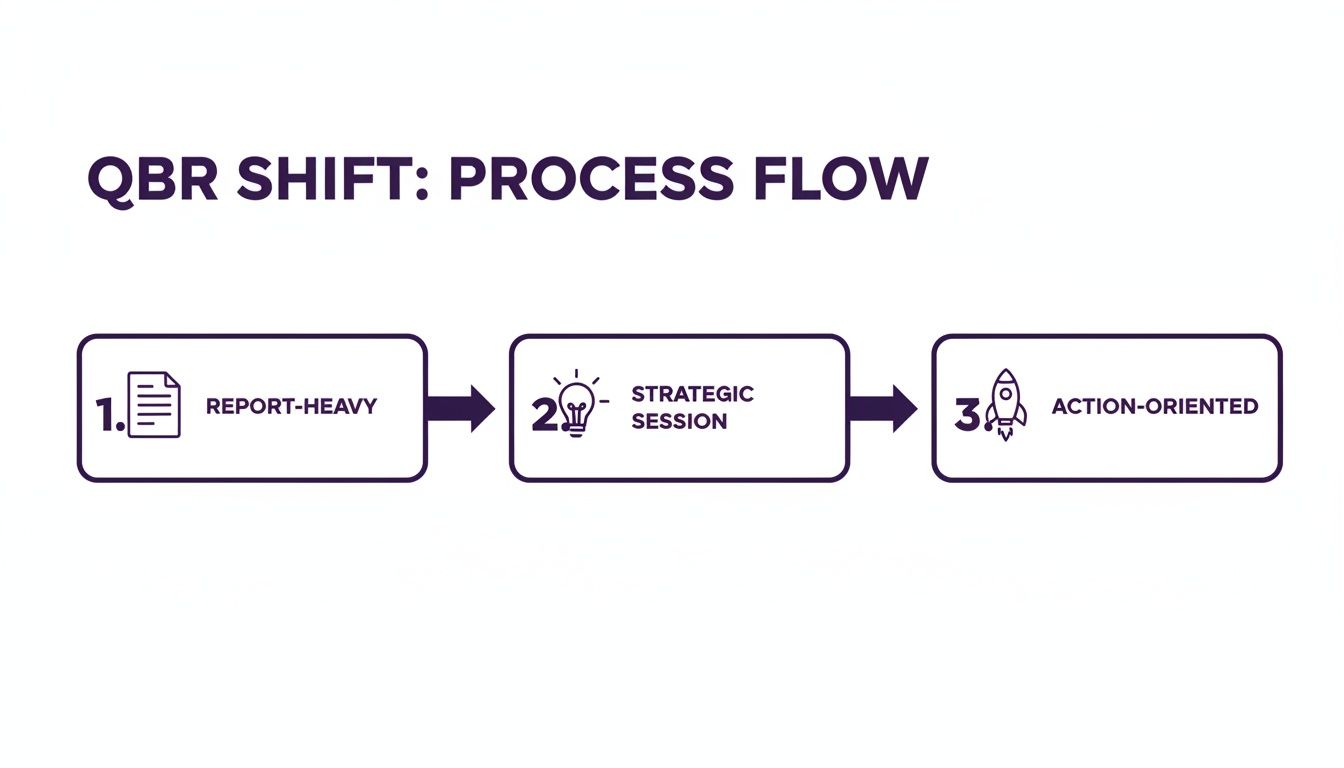
It’s all about using the data from the past quarter to fuel future growth and generate clear, accountable action plans. Anything less is a missed opportunity.
Crafting the Agenda Framework
The best agendas are both structured and flexible. They use specific time blocks to keep everyone on track but also leave room for the deep discussions that actually move the needle. Think of it as a roadmap, not a rigid script.
A shocking 72% of senior executives think most QBRs are a waste of time—and it's almost always due to a poorly planned agenda.
To get ahead of this, circulate a draft agenda at least a week before the meeting. Ask every attendee for input. This simple step creates shared ownership and ensures you’re not overlooking a critical topic.
A Proven Agenda for High-Impact QBRs
This practical, time-boxed agenda prioritizes a forward-looking perspective while still holding everyone accountable for past performance.
Here’s a sample breakdown you can adapt to keep your quarterly business review focused and efficient.
| Agenda Item | Objective | Time Allotment |
|---|---|---|
| Previous Quarter's Action Items | Start with accountability. Review commitments from the last QBR to build a culture of execution. | 15 mins |
| Performance vs. Goals Review | High-level review of results, wins, losses, and key lessons. Keep it brief and focused on the "why." | 45 mins |
| Strategic Deep Dive | The core of the meeting. Debate 1-2 critical challenges or opportunities that emerged from the review. | 60 mins |
| Next Quarter Planning & Goal Setting | Turn insights into a concrete plan. Set 3-5 company-wide priorities for the next 90 days. | 45 mins |
| Action Items & Ownership | End with absolute clarity. Document every action, assign a single owner, and set a firm due date. | 15 mins |
This structure ensures the entire session is productive and squarely focused on outcomes, not just discussion.
A great agenda ensures the QBR is not just a review of the business, but a vital recalibration of its direction and focus for the next 90 days.
This format keeps the conversation moving and prevents it from getting bogged down. For many growing companies, bringing in an external facilitator—like a fractional executive—can be a game-changer. They have the experience to keep the team on track, ask the uncomfortable-but-necessary questions, and ensure the discussion stays strategic.
If your QBRs consistently run off the rails, an outside perspective might be exactly what you need. Explore our network of vetted executives to find a partner who can elevate your strategic planning.
Designing a QBR Deck That Tells a Story
Your QBR presentation deck is more than a collection of charts; it’s the narrative of your quarter's journey. A great deck doesn't just present data. It tells a compelling story that guides the conversation, highlights critical insights, and drives strategic decisions. The goal is to move beyond a simple data dump and craft a narrative that sparks meaningful dialogue.
Think of your deck like an architect's blueprint. The blueprint isn't the house, but it provides the essential structure needed to build it correctly. Your deck provides that same structure for a productive strategic conversation.
The Essential Slides for a Narrative-Driven QBR
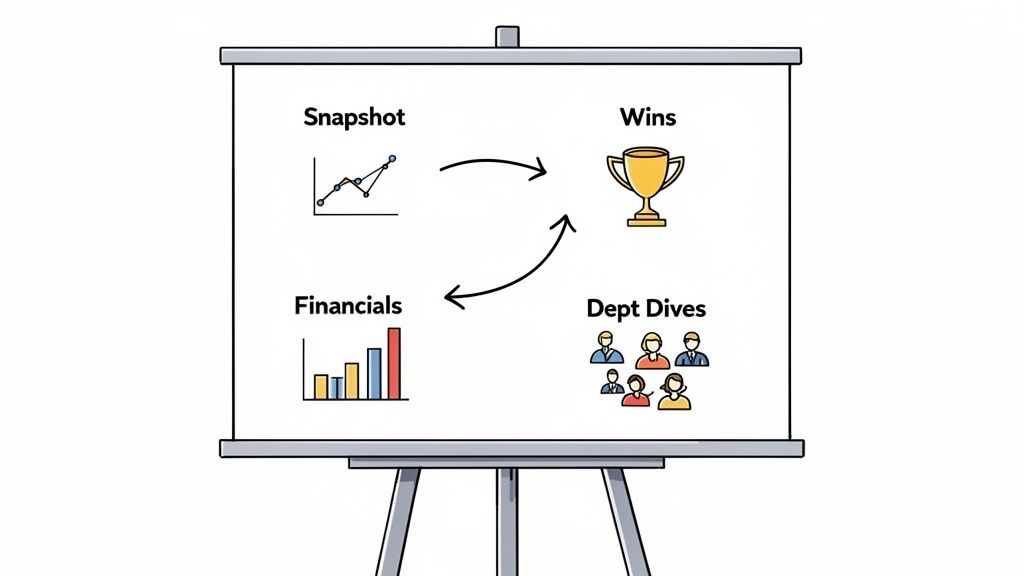
To build a deck that tells a story, every slide needs a clear purpose and must flow logically into the next. Your structure should guide your team through a journey: where you planned to go, what actually happened, what you learned, and where you're headed next.
Here are the must-have slides every QBR deck should include:
- Performance Snapshot Against Goals: Kick things off with a high-level executive summary. This slide should give a clear, visual overview of your performance against last quarter's goals. Use simple red/yellow/green indicators to instantly show what’s on track and what’s not.
- Key Wins & Crucial Lessons: This is where you inject context. Celebrate the big wins, but more importantly, be candid about the misses. The focus here should be on lessons learned, not assigning blame. What did a failure teach you that will make the business smarter next quarter?
- Transparent Financial Review: Give a straightforward look at key financial metrics—revenue, profit, cash flow, and burn rate against your forecast. The story here is all about financial health and sustainability.
- Departmental Deep Dives: Each department head should present just 1-2 slides focusing on their most critical KPIs and how their team contributed to company goals. This isn't a full departmental review; it's a strategic highlight reel.
From Data Points to Story Points
The magic happens when you connect these slides into one cohesive narrative. The performance snapshot sets the stage. The wins and lessons provide the plot. The financial review acts as the reality check. Finally, the departmental deep dives offer the perspectives of your key characters, showing how each contributed to the overall plot.
Your QBR deck should be a tool for conversation, not just a script for presentation. Design it with enough data to inform but enough white space to invite discussion and debate.
This structure helps you avoid getting lost in the weeds. By keeping each section focused, you ensure the conversation stays at a strategic level. A fractional leader can be invaluable here, helping your team refine this narrative and ensuring the presentation focuses on insights that will drive future growth, not just rehash the past.
If your deck feels more like a dense report than a strategic story, it’s time for a new quarterly business review format. Connect with one of our vetted executives who can help you transform your QBR presentation into a powerful tool for alignment.
Tracking KPIs That Actually Matter
Let's be blunt: generic metrics lead to generic conversations. A powerful QBR lives and dies by the Key Performance Indicators (KPIs) you track. These numbers need to directly reflect the health and momentum of your business. Without the right data, your QBR is just a meeting full of opinions.
The metrics you choose send a clear signal to your team about what you value. If you only talk about top-line revenue, you might miss a dangerously high customer acquisition cost (CAC) that’s eating away at your profitability. The point is to pick KPIs that tell the full story.
Choosing Metrics That Align With Your Model
The right KPIs are completely dependent on your business model. What’s mission-critical for a SaaS company is often irrelevant for a direct-to-consumer brand.
- A SaaS business, for instance, lives and dies by metrics like Monthly Recurring Revenue (MRR) and Customer Churn Rate. These directly measure the heartbeat of its subscription model.
- A D2C ecommerce brand, on the other hand, will be obsessed with Customer Acquisition Cost (CAC) and Customer Lifetime Value (LTV) to ensure every marketing dollar is building profitable relationships.
Choosing the right metrics is foundational. You can learn more about selecting the most impactful numbers in our guide to key performance indicators for startups.
The goal isn't to track every possible metric. It's to identify the vital few that provide a true pulse-check on your business performance and strategic progress.
When you align KPIs with your business model, each leader comes to the QBR ready to discuss their performance in a way that’s directly tied to the company's big-picture goals.
Essential KPIs by Business Function
To get a holistic view of the business, every department needs to own a handful of primary and secondary KPIs. This creates clear accountability and ensures every functional area is measuring what ladders up to the company’s main objectives.
Here’s a breakdown of essential metrics we often see tracked for a comprehensive QBR.
Essential KPIs by Business Function
| Department | Primary KPIs | Secondary Metrics |
|---|---|---|
| Sales | New Bookings/Revenue and Sales Cycle Length | Lead-to-Close Rate and Average Deal Size |
| Marketing | Marketing Qualified Leads (MQLs) and Customer Acquisition Cost (CAC) | Website Conversion Rate and MQL-to-SQL Conversion Rate |
| Finance | Gross Margin and Cash Runway | Operating Profit Margin and Accounts Receivable Aging |
| Operations | Customer Churn Rate and Net Promoter Score (NPS) | Customer Support Ticket Volume and Average Resolution Time |
This kind of structure keeps the QBR conversation balanced. It stops one department’s data from dominating and gives everyone a 360-degree view of the business's health.
This is an area where an experienced fractional executive can be incredibly valuable. They bring an objective, outside perspective to help you cut through the noise and select the few KPIs that genuinely matter for your growth stage, focusing your team on what will drive the most impact.
If you’re struggling to define and track the right metrics for your business, it might be time to bring in an expert. Schedule a consultation to connect with a vetted fractional leader.
Leading a QBR That Drives Action
A perfect agenda and a polished slide deck are great starting points, but they don't guarantee a productive Quarterly Business Review. The real magic happens during the meeting itself, driven by strong, intentional facilitation.
Without a firm hand guiding the conversation, even the best-laid plans can devolve into unfocused discussions. The point is to turn the QBR from a presentation into a collaborative working session. This means actively steering the conversation away from blame and toward forward-looking solutions. It takes a leader who can manage the clock, make sure every voice is heard, and keep the team focused on the strategic big picture.
Defining Roles for a Focused Discussion
Clear roles are essential. The CEO's main job is to set the tone, ask big strategic questions, and keep everyone anchored to the company’s vision. Department heads are on the hook to present their performance with total candor—highlighting wins and crucial lessons from any setbacks.
This is where a fractional executive can be an incredible asset. They step in as an objective third party, moderating discussions without getting tangled in internal politics. Their only focus is on driving a productive outcome, asking the tough-but-necessary questions, and ensuring the meeting transforms into a true problem-solving forum.
A well-facilitated QBR doesn’t just review the past; it builds a bridge between last quarter's lessons and next quarter's priorities, ensuring every decision is a step forward.
Navigating Common QBR Pitfalls
Even with the best intentions, QBRs can get derailed. Knowing the common traps is the first step to sidestepping them.
- Getting Stuck in the Weeds: It’s easy for a strategic discussion to get bogged down in minor operational details. A good facilitator knows how to redirect the conversation back to a higher level, asking, "How does this impact our quarterly goals?"
- The Blame Game: When results fall short, it’s human nature to point fingers. The facilitator has to reframe this immediately. Instead of "who's at fault," the question becomes, "What did we learn, and what will we do differently next time?"
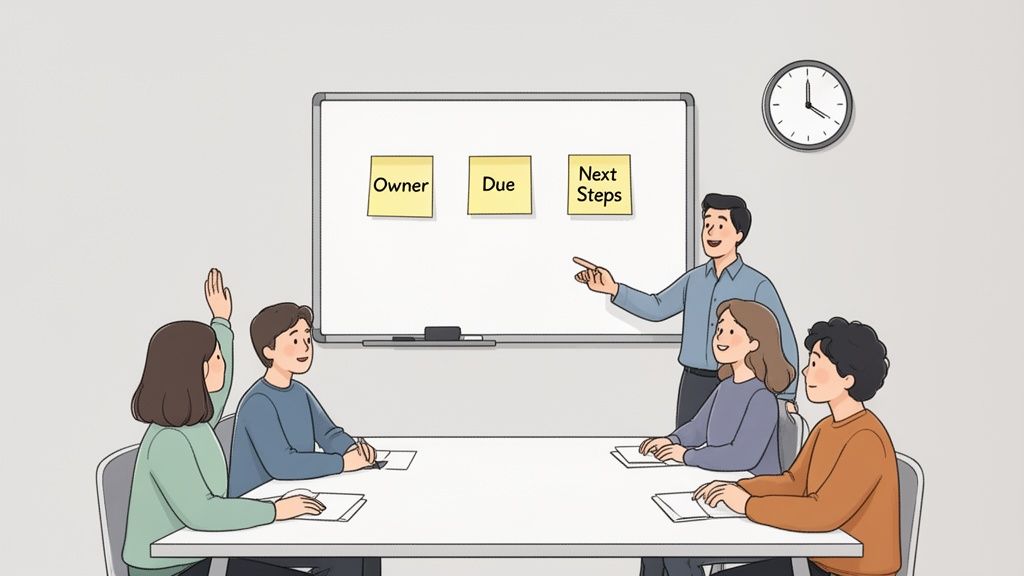
- Leaving Without a Plan: This is the single biggest failure of any QBR. Every decision must be translated into a specific task with a single owner and a firm due date. No exceptions.
Leading these sessions well is a skill that takes practice. For a deeper dive, check out our guide on how to run effective meetings.
A strong facilitator—whether that’s the CEO or a fractional leader—ensures your quarterly business review format produces more than just conversation. It generates real commitment and clear momentum for the next 90 days.
Common Questions About QBRs
Even with a solid game plan, you're bound to have questions as you dial in your quarterly business review process. Let's tackle some of the most common ones we hear. Getting these details right is often what turns a routine meeting into a high-impact strategic session.
We see it all the time with the leaders we work with—small tweaks can lead to huge improvements. The goal isn't just to have a meeting. It's to build a predictable rhythm of accountability that pushes the company forward every quarter.
How Long Should a QBR Be?
The sweet spot is two to four hours. This gives you enough time for deep discussion without hitting burnout. If your QBRs consistently drag on past the four-hour mark, it usually means you're not sending enough pre-read materials, or your agenda is too packed.
A tight, well-managed meeting respects everyone’s time and keeps the conversation sharp.
Who Should Attend the QBR?
Keep the core group small and focused on senior leadership. This means the CEO, founders, and the heads of your key functions—Sales, Marketing, Finance, Operations, etc. You can invite specific team members to present on a particular topic, but the main strategic debate should be reserved for the core decision-makers.
The most critical outcome of a QBR is a documented list of priorities and action items for the next 90 days. Without this, the meeting is just a conversation, not a strategic planning tool.
Bringing a fractional executive into this circle can be incredibly valuable. They add an unbiased, external perspective that can challenge internal assumptions and keep the discussion centered on strategic outcomes, not departmental politics.
How to Ensure the QBR Leads to Real Change?
Accountability is everything. The single most powerful habit you can build is to end every QBR by summarizing all decisions and action items out loud.
- Assign Clear Ownership: Every task gets one—and only one—designated owner. No ambiguity.
- Set Firm Due Dates: "Sometime next month" won't cut it. Assign a specific deadline.
- Document and Track: Get these commitments into a shared, visible system where everyone can see them.
Then, the very first item on the agenda for the next QBR has to be a review of these action items. This creates a powerful, closed-loop system of accountability and builds a culture where people do what they say they're going to do.
A well-run quarterly business review format is a serious competitive advantage, but it takes skilled leadership to pull off. If your strategic meetings aren't producing clear, actionable results, the right fractional executive can bring the structure and objectivity you're missing. Shiny connects you with a network of over 3,000 vetted executives who know how to build and lead QBRs that drive real growth. Schedule a consultation to find the right expert for your team.