React JS Development Services: A Startup’s Guide
You've likely hit this point already. The product idea is clear, customers seem interested, and your team can describe what the app should do. But when the conversation turns to building it, everything gets fuzzy.
Should you hire a freelance React developer? Sign with an agency? Build an internal team? Use Next.js? Is React even the right fit for what you're building?
For a non-technical founder, this is less like buying software and more like commissioning a building. You're not buying bricks. You're buying judgment, sequencing, tradeoff decisions, and a crew that can deliver something safe, usable, and expandable. That's where React JS development services become a business decision, not just a coding task.
Your App Idea Needs a Blueprint Not Just Bricks
A lot of founders make the same early mistake. They think they need “a developer” when what they really need is a delivery system.
If you were opening a physical location, you wouldn't start by hiring one person with a hammer and hoping they could also do structural design, permitting, wiring, plumbing, and site management. Software works the same way. A product build needs architecture, interface design, implementation, testing, launch planning, and someone making sure the finished result supports the business model.
That's why React JS development services can be such a practical starting point. You're not choosing an obscure stack that only a handful of specialists understand. React was released by Facebook in 2013, and by 2026 it was reported as running on 4.8% of websites globally, with over 11 million websites using it worldwide. The same source reports that more than 40% of software developers used React, which signals a mature talent pool and broad support across the market, according to React adoption statistics from eSparkInfo.
For a CEO, that matters because technology risk isn't just about bugs. It's about hiring risk, maintenance risk, and the chance that your product becomes difficult to evolve a year from now.
Practical rule: Buy technology the way you'd buy a long-term facility lease. You're not just asking whether it works today. You're asking whether it stays workable as the business changes.
React often enters the conversation because it gives product teams a widely supported foundation for modern interfaces. That doesn't mean it's automatically the right answer for every project. It does mean you're evaluating a mainstream option with a deep ecosystem, established practices, and a large labor market.
Before you hire anyone, it helps to define the product in business terms first. A clear technology roadmap for growth-stage companies usually answers questions like what gets built now, what can wait, and which capabilities affect revenue, retention, or operations most directly.
That's the blueprint. The code comes after.
What Are React JS Development Services Really
Most founders hear “React JS development services” and picture front-end coding. That's only part of what you're buying.
A better analogy is a general contractor for a custom build. The masonry crew matters, but so do the site plan, materials schedule, inspections, subcontractor coordination, and final handoff. In software, React is the construction method for the user-facing layer. The service is the system that turns requirements into a working product.

What you're actually purchasing
A serious React engagement usually includes several workstreams:
- Planning and architecture so the app has a sensible structure before teams start shipping screens.
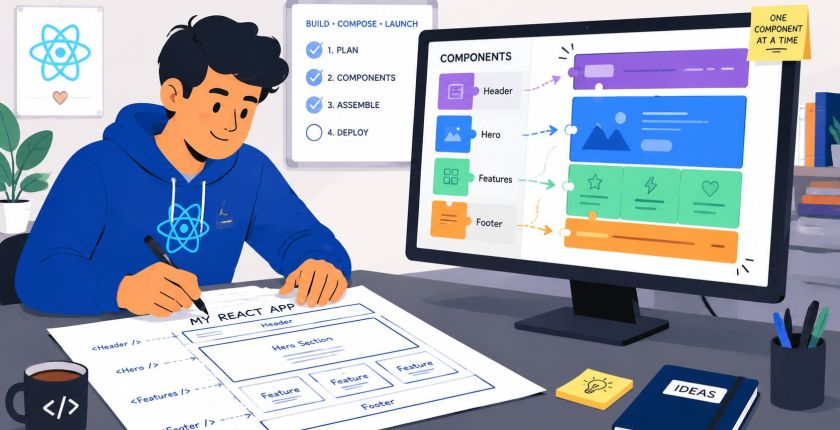
- UI implementation using React components, which are reusable building blocks like nav bars, forms, cards, dashboards, and account settings modules.
- API integration so the interface can talk to your backend, payment systems, CRM, inventory platform, or internal tools.
- Testing and quality control to catch regressions before customers do.
- Deployment and maintenance so launch isn't treated like the finish line.
The most important business concept here is component-based architecture. Effective React JS development services are built around this model because it isolates UI logic into reusable units. That makes it easier to deliver new features across different parts of a product without rebuilding each screen from scratch, as explained in Mindpath's guidance on React developer skills.
Why reusable components matter to a CEO
Think of components like standardized parts in a hotel build. If every room uses a completely custom door, custom lock, and custom light switch, expansion becomes slow and expensive. If those pieces are standardized, you can open new floors faster and maintain them more easily.
The same logic applies in software:
- Brand consistency improves because teams reuse the same buttons, forms, and layout patterns.
- Feature delivery speeds up because developers assemble known parts instead of rebuilding common elements.
- Maintenance gets cheaper because a fix in one shared component can improve multiple areas of the product.
A React vendor shouldn't just promise speed. They should show you how their structure prevents your app from turning into a patchwork of one-off screens.
The service layer is where the value lives
Many buyers get confused. They compare providers as if they're buying hourly coding time. They're not. They're buying process discipline.
A weak provider can still write React code. But if they don't define scope well, document component standards, manage dependencies, coordinate QA, and communicate tradeoffs in plain English, your project can become expensive long before it becomes useful.
The best React JS development services don't sell “developers.” They sell a production system that helps your company launch, learn, and expand without rebuilding the foundation every quarter.
Choosing Your Engagement Model
How you buy React development matters almost as much as who you hire. The wrong model creates drag even when the people are capable.
Some companies need a turnkey partner. Others need extra hands under existing leadership. Others need flexibility because priorities change every few weeks. The mistake is assuming one model is always best.
The three common ways to buy React development
Here's the high-level comparison.
| Model | Best For | Cost Structure | Management Overhead | Speed to Start |
|---|---|---|---|---|
| Agency | Companies that want a packaged, end-to-end delivery partner | Project-based or retainer-based | Lower on your side | Usually fast |
| Dedicated team | Companies building a long-term product capability | Ongoing payroll or team contract | Higher | Usually slower |
| Contractors or freelancers | Companies with narrow, well-defined needs | Hourly or milestone-based | Highest | Often fast |
Agency model
An agency is like hiring a design-build firm for an office renovation. You get one contract, one delivery framework, and a team that usually includes project management, design support, engineering, QA, and launch help.
That can work well when you need momentum quickly and don't have internal technical management. The tradeoff is that you often get less day-to-day control over individual team members and implementation choices.
Agency engagements tend to fit situations like these:
- You need a launch partner for an MVP, customer portal, or internal platform.
- Your internal team is thin and can't coordinate design, engineering, and QA.
- You want accountability in one place instead of stitching together several freelancers.
Dedicated team model
A dedicated team is closer to building your own in-house construction crew. You get more continuity and more control, but you also take on more operating responsibility.
This works best when software is becoming a core function of the business, not just a one-time project. If your roadmap is active, your product will evolve constantly, and you expect ongoing releases, a dedicated team can create durable knowledge inside the company.
The challenge is management load. Someone still has to set priorities, review architecture, resolve disagreements, and connect engineering effort to business goals.
If nobody on your side can evaluate tradeoffs, even a strong dedicated team can drift into building what's interesting instead of what matters.
Contractor model
Contractors and freelancers can be extremely useful. They're often the quickest route to specialized execution, especially for targeted tasks like building a dashboard, polishing a design system, or integrating a specific API.
But this model has a hidden cost. You become the general contractor.
That means you may need to:
- define scope in detail
- coordinate handoffs between contributors
- catch architectural issues early
- handle missed deadlines or availability gaps
- make technical decisions you may not be equipped to make
For many founders, that overhead is larger than expected. A helpful reference point is this guide to outsourcing software development effectively, especially if you're weighing flexibility against management burden.
Which model fits which stage
A simple way to think about it:
- New product, no internal tech leader. Agency is often the safest route.
- Growing product, recurring development needs. Dedicated team becomes more attractive.
- Specific deliverable, short timeline, strong internal oversight. Contractors can work well.
The smartest choice often comes down to one question: who is going to own the outcome?
Not who writes the code. Who owns the result.
Key Business Benefits for Startups and SMBs
Technical buyers often talk about React in engineering terms. CEOs should look at it through a different lens. The value of React JS development services shows up in operating speed, product flexibility, and execution risk.

Faster product iteration
When a team builds with reusable components and clear standards, they don't have to reinvent common UI patterns each time a stakeholder requests a new feature.
That matters when sales asks for a new portal screen, marketing wants a campaign landing experience, and operations needs an internal workflow view. A well-structured React app lets teams extend what already exists rather than start from zero.
- New screens arrive faster because teams reuse existing modules.
- Cross-functional requests become easier to support because the same design and code patterns can serve multiple departments.
- Priorities can shift without total rework when the system is modular.
Better customer experience
Customers don't care what framework you use. They care whether the product feels responsive, understandable, and trustworthy.
Good React implementation supports cleaner interfaces, smoother interactions, and a more coherent experience across the product. That can reduce friction during onboarding, checkout, account management, and support flows.
Easier scaling over time
Growth creates software stress. More features, more users, and more edge cases expose weak foundations quickly.
A disciplined React build helps because teams can expand functionality without turning the app into a pile of one-off solutions. The codebase stays easier to test, update, and hand off between developers.
A scalable product isn't one that can theoretically grow. It's one your team can still change confidently six months from now.
Access to a broad talent market
React's popularity gives businesses another practical benefit. It's easier to find developers, contractors, QA talent, and technical leaders who understand the ecosystem than it is with a niche framework.
That doesn't guarantee a good hire. It does reduce dependence on a tiny specialist pool, which lowers staffing risk if your current vendor changes, your needs expand, or you eventually hire internally.
Stronger long-term ROI
The cheapest build is rarely the least expensive one over time.
Long-term return usually improves when the team creates a maintainable front end, documents reusable components, and makes sensible architectural decisions early. You spend less time paying people to untangle yesterday's shortcuts and more time funding features customers want.
How to Choose the Right React Development Partner
A portfolio can be helpful, but it doesn't answer the most important procurement question. Can this team make good decisions under uncertainty?
Any polished website can show pretty screens. What you need to know is how the partner handles scope, ambiguity, quality, communication, and architectural tradeoffs when the project gets messy. Because it will.

Questions that reveal execution quality
When you interview React vendors, ask questions that force them to explain their operating model in business language.
A strong partner should answer clearly without hiding behind jargon.
- How do you handle unclear requirements? Look for a process that includes discovery, prioritization, and written assumptions.
- How do you structure communication? You want named owners, regular check-ins, visible task tracking, and clear escalation paths.
- How do you approach testing and QA? Good teams can describe when they test, what they automate, and how they prevent regressions.
- What happens after launch? Maintenance, bug triage, monitoring, and iterative improvements shouldn't feel like an afterthought.
Ask one modern architecture question
Here's a useful filter for separating generic providers from current experts: ask how they decide between server components and client-side rendering in a modern Next.js or React 19 setup.
Expert teams increasingly think in hybrid architectures, not just classic client-heavy React builds. This architectural approach affects cost, performance, and maintainability, as noted in this discussion of the shift toward server and client boundaries in modern React.
You don't need to judge the technical correctness of every sentence they say. You do need to hear whether they can explain tradeoffs plainly.
A weak answer sounds like this: “We use React for everything on the client.”
A stronger answer sounds more like: “We decide which parts need interactivity in the browser and which parts should be rendered on the server to improve load behavior, reduce complexity, or simplify data fetching.”
Look for business fluency, not just React fluency
The best partner understands your business model, not just your component tree.
They should ask questions like:
- What action creates value in the product?
- Which user flows affect revenue or retention most?
- What must launch first, and what can wait?
- Which internal teams will depend on this app?
That's a different level of conversation. It shows they're not just taking tickets. They're trying to align product decisions with company priorities.
Choose the team that talks about tradeoffs, constraints, and sequencing. Be careful with the team that only talks about speed.
Check how they work with non-technical leadership
This point gets overlooked. If you're a non-technical CEO, you need a partner who can report progress without turning every update into a translation exercise.
A practical checklist helps:
- Plain-language reporting so status updates connect to milestones and business outcomes.
- Transparent documentation so decisions don't disappear into Slack threads.
- Structured planning that distinguishes must-haves from nice-to-haves.
- Realistic pushback when a request creates unnecessary complexity.
If your company is exploring external build support, this guide to outsourcing website development projects with stronger oversight is useful because it frames the vendor relationship as governance, not just delivery.
Common Pitfalls and How to Avoid Them
A balanced buying process includes one uncomfortable question. What could go wrong even if the vendor seems capable?
Quite a lot. Most failed software engagements don't collapse because React was a bad framework. They fail because the scope was muddy, leadership was thin, or the build quality couldn't support what the business needed next.
Scope creep disguised as flexibility
Founders often hear “we can add that later” and assume that means low risk. Sometimes it does. Sometimes it's the beginning of a runaway build.
If your team hasn't defined what version one must accomplish, every meeting can create new work. Budget expands. Timelines slip. The team stays busy, but progress becomes hard to measure.
Protect yourself with a written scope that includes:
- Core user flows that must ship first
- Explicit exclusions so “not now” is documented
- Decision owners so changes don't enter the roadmap informally
Cheap code creates expensive debt
A fast, low-cost build can look efficient right up until you need to modify it.
If the provider hardcodes UI behavior, duplicates logic across screens, or skips testing discipline, your product becomes fragile. New features take longer because each change risks breaking something unrelated.
This is why procurement should include technical review, not just rate comparison. A lower quote can conceal a much higher future maintenance burden.
Communication failures become strategic failures
Poor communication is not a soft issue. It's an operating issue.
If your vendor can't explain delays, surface tradeoffs, or tell you when assumptions changed, you lose the ability to steer the project. By the time the problem is visible in the product, you've usually already paid for it.
React isn't always the right tool
This is the contrarian point many service pages skip.
A common pitfall is assuming React is automatically SEO-friendly. It can be, but client-heavy React apps can still suffer from slow initial loads and indexing issues. Strong SEO results often require server-side rendering or static site generation, according to this explanation of React's SEO tradeoffs.
That means some business sites don't need a full React application at all. If you're building a mostly static marketing site with limited interactivity, a lighter or more static-first approach may be a better investment.
Good advisors don't force React into every situation. They help you decide when it's the right engine, and when it's unnecessary machinery.
The goal isn't to avoid React. The goal is to avoid buying complexity you don't need.
From Code to Company The Shiny Advantage
Procurement decisions around React are rarely just technical. They're leadership decisions in disguise.
You're choosing how product work gets prioritized, who makes tradeoffs, how risk is managed, and whether the build supports the company you're trying to become. That's why the smartest founders don't treat React JS development services as a commodity purchase.
They treat it like hiring a construction team for a flagship location. The crew matters. The foreman matters more. And the person who knows how the building should support the business matters most.
That's where fractional leadership becomes valuable. A seasoned fractional CTO can help define scope, assess whether React is even the right fit, vet agencies and contractors, challenge weak architectural choices, and keep the build aligned with business goals. You don't just reduce delivery risk. You reduce decision risk.
If you're weighing a React build and want experienced leadership before you commit to the wrong team or scope, Shiny can help you find vetted fractional executives who bring senior judgment without the overhead of a full-time hire. It's a practical way to add CTO-level oversight when key decisions are on the line and the next technical decision will shape your growth.