

How Recruitment Agencies for Professionals are Evolving
Finding truly great professionals in today's market is a grind. It's a challenge every leader is grappling with. The old ways of hiring just don't cut it anymore, often leaving you with critical leadership gaps that pump the brakes on your growth. This guide is your roadmap for moving beyond the resume pile and into strategic talent acquisition that actually drives business results.
Why Finding the Right Professionals Is Harder Than Ever
The entire landscape of finding talent has shifted. Just a few years ago, you could post a job and expect a wave of qualified people. That's not the world we live in now. The best professionals are often passive candidates—they aren't scrolling through job listings, but they are open to the right opportunity. Getting on their radar requires a much more deliberate game plan.
On top of that, the explosion of remote work has technically widened the talent pool to a global scale, but it's also cranked up the competition. You're not just up against local companies for talent anymore; you're competing with businesses all over the world. This makes it nearly impossible for most internal HR teams to keep pace.
The Pain Point of a Transactional Approach
Too many companies still treat hiring like a simple transaction: post a job, collect resumes, and pick the person who checks the most boxes. This approach is fundamentally broken when you're trying to land high-impact professionals. It misses the big picture—the strategic needs of your business—and fails to vet for crucial abilities like strategic thinking, adaptability, and cultural alignment.
Think of it like building a high-performance engine. You wouldn't just grab generic, off-the-shelf parts and expect to win a race. Each new hire should be a strategic component that makes the whole machine run better.
This is exactly where specialized recruitment agencies for professionals are supposed to come in. They move past the transactional to act as strategic partners. They help you define the role, pinpoint the right talent, and secure a candidate who will create long-term value.
A key shift in the market is the demand for specialized expertise on a flexible basis. Companies need access to senior-level strategic thinking without the commitment and cost of a full-time executive hire, a pain point traditional recruitment models weren't built to solve.
Working with a partner who understands these modern business pains isn't just a good idea; it's a critical decision. It has a direct line to your company's ability to grow and innovate. If you're ready to stop putting out hiring fires and start building a real talent advantage, understanding your options is the first step.
Understanding Your Professional Recruitment Options
Dipping your toes into the world of professional recruitment can feel overwhelming. You’ll hear a whole new vocabulary, with terms like contingency, retained, and RPO thrown around. But to make the right call for your company, you need to understand the basic models and how they work. Each one comes with a different partnership, a different price tag, and is built for a different hiring need.
The "No Win, No Fee" Race: Contingency Search
The most common model is contingency search. Think of it as a 'no-win, no-fee' sprint. You give the job description to multiple agencies, and they all compete to find you the right person. You only pay a fee to the one whose candidate you hire.
This model is a go-to for junior to mid-level roles where the talent pool is large. But the competitive nature has a downside. Agencies are incentivized to be first, not necessarily best, which can lead to a flood of resumes without deep vetting. For a strategic hire, you need a different game plan.
The Dedicated Partner: Retained Search
When you’re hiring for a role that could make or break your company's future—a new VP of Engineering or your first Chief Financial Officer—you need a true partner. This is where retained search comes in. You engage a single agency exclusively and pay them an upfront fee (a retainer) to dedicate a team to your search. It’s less of a race and more like hiring a special ops team for a critical mission.
That upfront commitment changes the dynamic. It aligns your goals with the agency's. They spend serious time getting to know your company culture and strategic goals, delivering a hand-picked shortlist of candidates who are a fantastic fit on every level.
A retained search signals to the market that you are serious. The best candidates—the ones who aren't actively looking—are far more likely to engage with a retained recruiter because they know the company is fully committed.
The Rise of the Specialist: Niche Agencies
Beyond these core models, the recruiting world has become incredibly specialized. Niche agencies focus exclusively on a specific industry or role. Need a data scientist who knows HealthTech compliance? There’s an agency for that.
Working with a niche firm gives you instant access to a curated network of talent. These recruiters speak your language and have relationships with key players, which can dramatically speed up the search and improve candidate quality. A solid grasp of these models is a cornerstone of any effective talent acquisition strategy template.
But there was still a gap. All of these models were designed for one outcome: a full-time, permanent hire. As the business world got faster, companies needed a way to bring in top-tier expertise without the long-term strings attached. This opened the door for a new, more flexible talent solution.
How to Choose the Right Recruitment Partner
Picking a recruitment partner is a major strategic decision. Get it wrong, and you're stuck with wasted time, a revolving door of candidates who aren't the right fit, and a critical role that stays empty for far too long. To avoid this, you need a solid plan for vetting partners that goes beyond a surface-level sales pitch.
Imagine your growing SaaS company needs a Head of Product. This isn't just about filling a seat; you're looking for a leader who can shape your product roadmap and outmaneuver the competition. The questions you ask a potential recruitment firm should match the weight of that decision.
Asking the Critical Questions
Don't just ask about the size of their candidate database. You need to dig deeper to understand their actual process and strategic thinking. A true partner will have solid answers that prove their expertise.
Here’s where to start:
- How do you screen for strategic thinking, not just past experience? A resume tells you what someone did, not how they think. A great partner uses behavioral interviews and situational questions to test a candidate's problem-solving skills.
- Can you prove you understand the unique talent challenges in my industry? Ask for specific examples of similar roles they've filled. You're listening for a nuanced understanding of your market, competitors, and the exact skills you need.
- What’s your process for ensuring a strong cultural fit? A skilled partner takes time to get to know your company’s values and work environment. They should be able to explain exactly how they assess candidates for more than just technical ability.
The answers will quickly separate the resume-pushers from the real strategic advisors. You want someone who acts like an extension of your own leadership team. For a closer look at what separates the best from the rest, check out our ultimate guide to executive recruiting services and strategies.
Understanding the Evolving Recruitment Landscape
The way agencies find talent is changing fast. A recent analysis shows the big focus for recruitment agencies for professionals in 2025 is digital transformation. Attracting new clients is the top goal for 25% of firms, with AI and automation right behind. We’re already seeing the impact: AI tools are cutting time-to-hire by up to 75%, and skills-based hiring shot up to 81% in 2024. You can see more on these recruitment market trends on Bullhorn.com.
This decision tree gives you a simple visual for figuring out which model works best, depending on whether the role is a standard hire or a business-critical one.
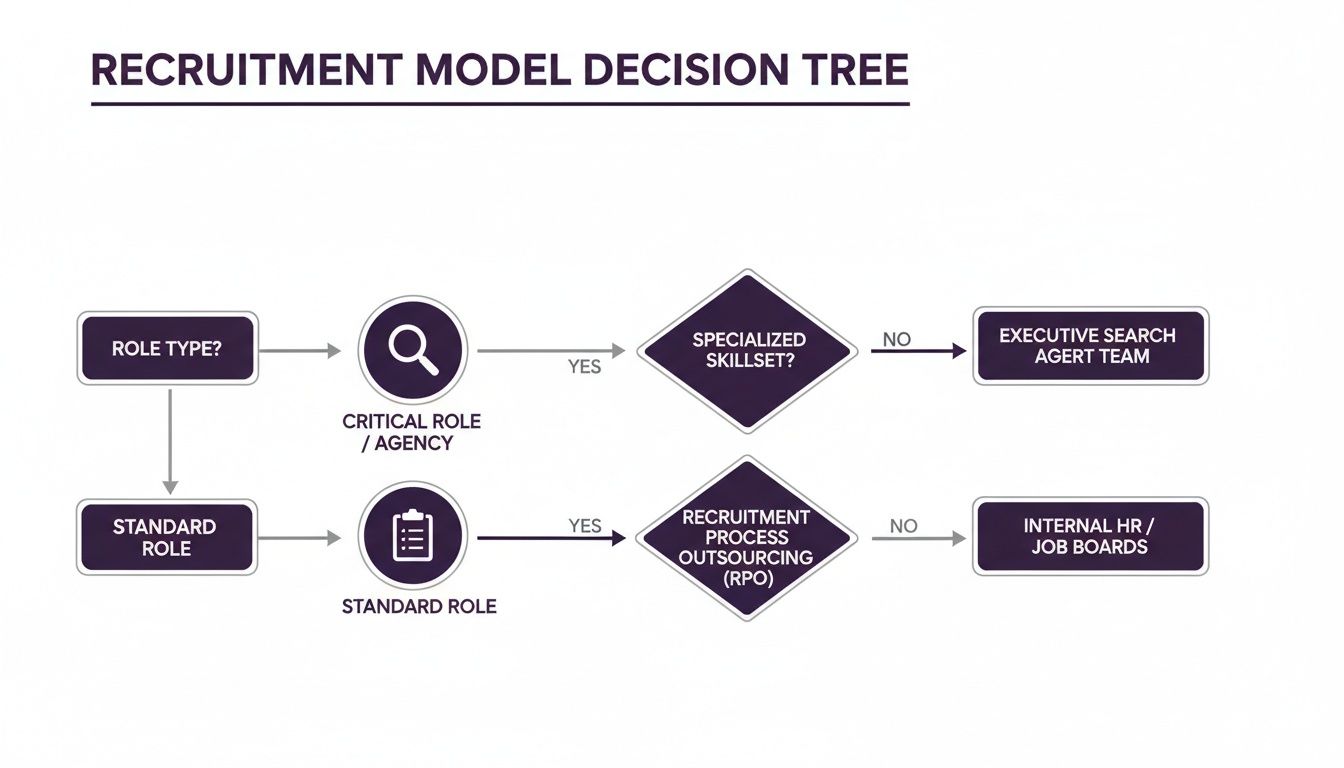
The main takeaway is simple: the role itself should dictate your recruitment strategy. This helps you choose the most effective path for any hiring challenge.
Comparing Your Partnership Options
To make the right call, you have to understand the different recruitment models out there. Each one is built for a different kind of hiring need, with its own fee structure and level of partnership.
Comparing Professional Recruitment Models
This table breaks down the key features of each professional recruitment model, helping you decide which is the best fit for your goals.
| Model Type | Best For | Fee Structure | Level of Partnership |
|---|---|---|---|
| Contingency | High-volume, non-critical roles where speed is the main goal. | Fee is paid only when a candidate is hired (no win, no fee). | Low to moderate; often transactional and not exclusive. |
| Retained Search | C-suite, executive, and other highly specialized, critical roles. | Upfront retainer plus a final fee upon placement. | High; a dedicated, exclusive partnership. |
| Niche Agency | Industry-specific roles (e.g., tech, finance, healthcare). | Varies (can be contingency or retained). | Moderate to high; brings deep industry expertise. |
| Fractional Marketplace | Accessing senior leadership expertise on a part-time basis. | Flexible subscription or project-based fees. | Strategic and ongoing; access to a vetted talent pool. |
This table shows there's a clear model for almost any situation, from filling standard roles quickly to finding that one-in-a-million executive.
The fractional leadership model is a game-changer. It gives businesses access to top-tier strategic guidance without the cost or commitment of a full-time executive hire. You get immediate access to seasoned leaders who can drive growth and solve tough problems on a flexible basis.
By weighing these models and asking the tough questions, you can find a partner who doesn't just fill a role but helps drive your company's long-term success. And for those critical leadership gaps where you need proven expertise right now, exploring a fractional marketplace can give you the strategic firepower to accelerate your growth.
The Strategic Advantage of Fractional Leadership

What if you could tap into an elite, C-level executive's brain without shouldering the full-time cost? That’s the powerful idea behind fractional leadership, a model that’s quickly becoming a strategic advantage for companies that want to move fast.
It’s a complete shift away from the old-school thinking that impactful leadership has to be a full-time, permanent role.
Think of it as having a world-class strategist on demand. Instead of a massive, long-term commitment, you get the precise senior-level thinking you need, exactly when you need it. This approach solves some of the most common and painful business problems.
For instance, a fast-growing startup might desperately need a seasoned Chief Financial Officer to lock down its next funding round but can't justify a $250,000+ annual salary. A fractional CFO brings that high-caliber financial strategy to the table for a fraction of the cost, instantly making the company more attractive to investors.
The Value Proposition Unpacked
The magic of fractional leadership goes beyond just saving money. It's about getting access to a level of talent that would otherwise be out of reach. Companies can now bring in executives from the top 1% of their field—people with decades of experience who can provide immediate, high-impact guidance.
This model delivers value in a few key ways:
- Targeted Expertise: You’re not hiring a generalist. You’re getting a specialist who has solved your exact problem multiple times before. Whether it's scaling a sales team or overhauling operations, they arrive with a proven playbook.
- Cost Efficiency: Accessing executive talent without the overhead of a full-time salary, benefits, and equity is a game-changer. It transforms a major fixed cost into a flexible, strategic investment.
- Unmatched Flexibility: Need to scale leadership up or down? No problem. This kind of agility is impossible with traditional full-time hires, allowing you to respond to market shifts in real-time.
Fractional leadership isn’t about finding a temporary fill-in. It’s about injecting specific, high-level strategic expertise into your organization to hit a clear business goal. It’s a surgical approach to building your leadership team.
This strategic flexibility is a huge reason why fractional roles are becoming a smarter choice than working with traditional recruitment agencies for professionals that are only focused on permanent hires. You can dive deeper by exploring the core principles of what fractional leadership means for modern companies.
How Fractional Leadership Works in the Real World
Here's a common scenario. A mid-sized tech company has a fantastic product but is struggling to get market traction. Their marketing feels scattered, and there's no cohesive strategy. Hiring a full-time Chief Marketing Officer is a huge financial leap, and the search could drag on for months.
Instead, they engage a fractional CMO. This executive, who has already scaled three other SaaS companies, comes in for just 15 hours a week.
Within the first 90 days, the fractional CMO:
- Conducts a full audit of their current marketing channels.
- Develops a clear, data-driven strategy focused on the most profitable customer segments.
- Hires and mentors a junior marketing manager to handle day-to-day execution.
- Implements key performance indicators (KPIs) to track progress and prove ROI.
The company gets immediate strategic direction and sees tangible results in one quarter—all without the long-term expense of a full-time hire. This is the power of fractional leadership in action. It provides the wisdom of a seasoned executive while building up your internal team's capabilities.
For businesses looking to accelerate growth and navigate challenges with confidence, this model offers a smarter way to build a leadership team. When you connect with a fractional executive, you aren't just filling a role—you're securing a strategic partner dedicated to your success.
Navigating Global Talent and Industry Trends

In today's interconnected world, your company's physical address is becoming irrelevant. The perfect person for your most critical role might be an ocean away, and the smartest companies are leaning into this new reality as a core strategic advantage.
The old geographic limits have been demolished by the rise of remote work. This shift gives you direct access to a global pool of elite professionals, changing the nature of how you fill key positions. It’s no longer about finding the best person in your city; it’s about finding the absolute best person, period.
Embracing the Borderless Workforce
This move toward borderless hiring isn’t just a passing trend. It's a fundamental change in how competitive businesses are built.
Tapping into a worldwide network allows you to solve critical skill shortages. Imagine needing an AI specialist with experience in a niche manufacturing process—your local talent pool could be dry, but a global search might turn up dozens of ideal candidates.
A global approach also injects invaluable diversity of thought into your organization. Professionals from different backgrounds bring unique perspectives that can spark innovation and open up new avenues for growth. This is the new frontier where recruitment agencies for professionals must operate to deliver true value.
The numbers back this up. An overwhelming 71% of hiring teams are now recruiting internationally to combat skill shortages. It’s working, too: 87% of employers are successfully filling at least four out of every ten roles with candidates from outside their local area. This is especially true in tech, where 89% of employers are expanding their global workforces. And it’s not just for junior roles; 85% of companies hired international senior-level employees in the past year alone. You can dig deeper into these global hiring trends on HireBorderless.com.
Gaining a Competitive Edge in Key Industries
Certain sectors are already reaping massive benefits from this global talent strategy. The ability to source expertise from anywhere in the world is a powerful competitive advantage.
Just look at these high-demand fields:
- Artificial Intelligence: The demand for AI experts wildly outstrips the supply in any single region. Going global is essential for finding the specialized talent needed to build complex AI systems.
- Biotechnology: Groundbreaking R&D in biotech often happens in specific global hubs. Accessing talent from these clusters can dramatically accelerate a company's innovation pipeline.
- Finance: In specialized areas like FinTech and quantitative analysis, specific skills are incredibly rare. A borderless search lets companies pinpoint professionals with the exact experience needed to navigate complex financial markets.
Tapping into the global talent pool isn't just a recruitment tactic; it’s a business imperative. It allows you to build a more resilient, innovative, and capable team that is not constrained by geography.
This global mindset is crucial for staying ahead. As companies compete for top-tier talent, those who limit their search to a commutable distance are at a huge disadvantage.
The best partners understand that excellence knows no borders. By embracing a global view, you can transform your hiring process from a local search into a worldwide talent acquisition strategy. This not only fills your immediate needs but also positions your company for long-term success.
Making Your Next Hire a Strategic Win
Choosing how to build your leadership team is one of the biggest strategic calls a founder or CEO can make. We've walked through the landscape, from traditional agencies built for permanent roles to the agile power of fractional leadership. The right partner doesn’t just fill a seat; they pour fuel on your growth and give you a genuine edge.
By understanding your options and matching them to your business goals, you can turn hiring from a necessary chore into a serious advantage. The trick is to match the model to the mission. While recruitment agencies for professionals are great for finding a perfect long-term hire, today’s world often demands more flexibility.
Turning Talent into a Competitive Advantage
Think of your leadership team like a portfolio. A full-time executive is a long-term, buy-and-hold investment. A fractional leader is a high-impact asset you deploy with surgical precision, right when you need it most.
This approach lets you solve immediate business problems—like bringing on a seasoned CFO to steer you through a funding round or a CMO to nail a product launch—without the long-term cost and commitment.
The real victory is gaining strategic clarity. When you can tap into top-tier executive talent on-demand, you're no longer handcuffed by a traditional hiring timeline or budget. You can act decisively, solve problems faster, and jump on opportunities your competitors can't touch.
This kind of flexibility isn't just a "nice-to-have"; it's essential for any company that wants to grow quickly and smartly. If that blend of deep expertise and adaptable engagement sounds like what you need, exploring the fractional model is the logical next step.
We invite you to see how our curated marketplace connects companies like yours with the strategic leadership they need to win. Explore our services to see how the right executive can change the game for you.
Got Questions? We've Got Answers.
Jumping into the world of professional hiring can be a maze, especially with new, flexible ways of building a team. Let's clear the air and tackle some of the most common questions we hear from founders and business leaders.
What's the Real Difference Between a Recruitment Agency and a Fractional Leadership Marketplace?
A traditional recruitment agency has one job: find you a full-time, permanent employee. They run the search process from start to finish, and you pay them a significant percentage of that new hire's first-year salary. Their entire model is built for finding "forever" employees.
A fractional leadership marketplace plays a totally different game. It’s not about filling a permanent seat; it’s about connecting you to a network of elite, C-suite executives for part-time or project-based work. You get top-tier strategic brainpower exactly when you need it, without the massive salary and long-term commitment of a full-time hire.
How Long Does It Actually Take to Hire Through a Specialized Agency?
The timeline can swing depending on the role's complexity. If you're using a traditional retained search firm for a senior position, you're usually looking at a 4 to 12-week process. That covers everything from defining the role and sourcing candidates to interviews and offer negotiation.
Fractional leadership platforms blow that timeline out of the water. Because they have a curated bench of pre-vetted executive talent, they can often connect you with the perfect leader in just a few days or a couple of weeks. For businesses with a critical leadership gap that needed to be filled yesterday, that speed is a game-changer.
The point of a fractional marketplace is immediate impact. You skip the painfully long traditional search and bring in a seasoned executive who starts delivering value from day one.
Is Fractional Leadership Just for Big Corporations?
Not at all. In fact, it's arguably even more powerful for startups and mid-sized businesses. These are the companies that desperately need C-suite expertise to navigate growth, secure funding, or figure out how to scale—but they almost never have the budget for a full-time executive salary.
Fractional leadership is the perfect solution to this classic startup dilemma. It gives smaller companies access to the kind of top-tier talent they could normally only dream of, letting them bring on a seasoned fractional CMO, CFO, or COO. It’s the secret weapon that allows ambitious businesses to get the strategic guidance they need to compete with the big players.
Ready to stop searching and start solving? Shiny connects you with a curated network of vetted, top-tier fractional executives who can drive immediate impact for your business.
Explore our marketplace and find the strategic leader you need today.
