
How to Write a Sales Consulting Job Description That Attracts a True Growth Partner
Your sales consulting job description has one job: to attract a strategic partner who can drive revenue, not just an employee to manage tasks. It's your first and most critical marketing document for the role. For the kind of high-level consultant you want, this document is a window into your company's ambition, challenges, and vision.
Why Your Job Description Fails to Attract Real Sales Leaders
Let’s be honest—if your current sales consulting job description isn't pulling in the right candidates, it’s probably because it reads like a generic task list. Top-tier sales consultants and fractional executives aren't just browsing job boards looking for another gig; they're looking for a mission. They are strategic problem-solvers hunting for a challenge worthy of their expertise.
Think of your job description as a menu at a high-end restaurant. A bland menu just lists ingredients: "Chicken, potatoes, carrots." It's factual but uninspiring. A great menu, however, tells a story: "Pan-seared free-range chicken with roasted heirloom carrots and a rosemary-garlic potato confit." It makes you crave the meal by painting a picture of the experience and the quality.
Right now, your job description is the bland menu. Listing duties like "manage sales pipeline" or "develop sales strategy" is the same as just listing ingredients. It completely fails to convey the strategic importance of the role or the potential for real impact.
Moving Beyond a List of Duties
Elite sales leaders scan for opportunities where they can make a tangible difference. A description filled with vague responsibilities is a major red flag—it suggests a lack of strategic direction at your company.
To grab their attention, you must articulate the "why" behind the role. What is the core business pain point this person is coming in to solve?
- Are you struggling to break into a new market?
- Is your sales process a mess, causing deals to stall?
- Do you need to build a repeatable revenue engine from the ground up?
These are the kinds of challenges that excite strategic thinkers.
A great job description doesn't just outline a role; it issues a challenge. It tells a story of where the company is, where it wants to go, and why this specific leader is the hero needed to get there.
The Fractional Leader's Mindset
This is especially true when you're looking for fractional leadership. Fractional executives operate on a high-impact model, delivering specific, game-changing results without the overhead of a full-time hire. They aren’t looking to get bogged down in corporate bureaucracy; they're hired to solve critical business problems fast.
A generic job description signals that you might not understand the value they bring, which is an immediate turn-off. By framing the role around strategic challenges and tangible impact, you signal that you're searching for a true partner in growth.
Defining Responsibilities as Strategic Business Outcomes
Top-tier sales consultants aren't looking for a to-do list; they're hunting for a results sheet. To attract that caliber of talent, your job description has to stop listing mundane tasks and start defining strategic business outcomes.
You wouldn't hire a world-class architect and hand them a list that says "draw lines" and "pick colors." You'd share the vision: "Design a skyscraper that becomes an iconic part of the city skyline." The same logic applies here. You're hiring a partner to build your revenue architecture, not just a manager to check boxes.
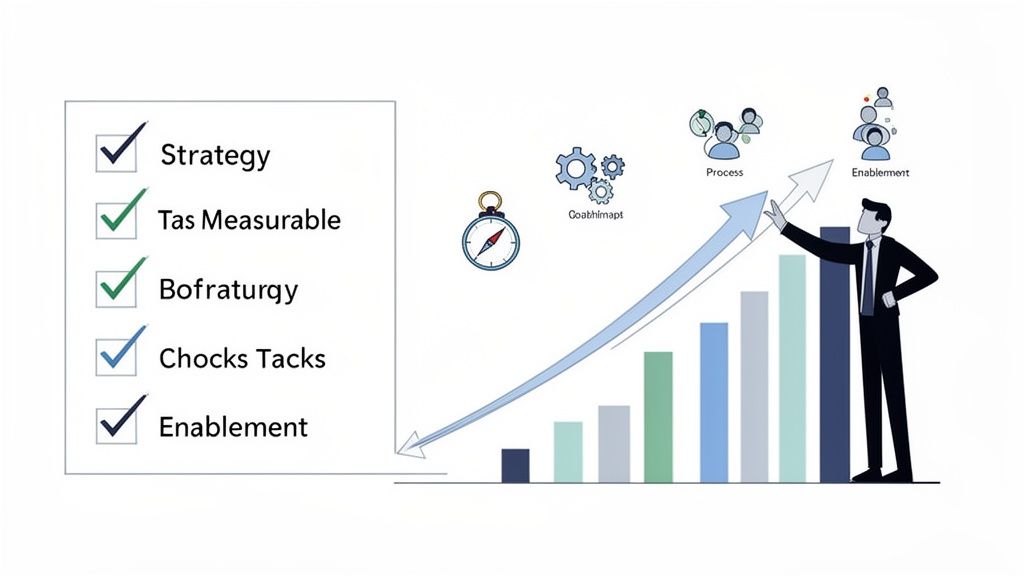
This results-first approach immediately signals that you understand what true strategic leadership looks like. It tells a candidate you’re serious about growth and impact, which is exactly the kind of challenge a high-performer is eager to solve.
Moving From Tasks to Impact
A sales consultant's work generally falls into three buckets: strategic planning, process optimization, and team enablement. But just listing those categories is lazy. You have to tie each one to a tangible, measurable outcome that gets a high-achiever's attention.
The North American market, which accounts for roughly 40% of global sales consulting revenue, is intensely focused on sales optimization. Your job description needs to mirror that same strategic intensity. You can learn more about the growth in the sales consulting market in recent reports.
Let's break down how to reframe these pillars into something compelling:
- Strategic Planning: Instead of a vague "develop a sales plan," get specific. Try: "Architect and execute a go-to-market strategy to capture 15% market share in a new vertical within 18 months."
- Process Optimization: Don't just say "improve the sales process." Define the goal: "Re-engineer the B2B sales cycle to slash the average close time from 90 to 60 days, directly impacting cash flow."
- Team Enablement: Go beyond "train the sales team." Describe the desired outcome: "Implement a coaching framework and sales playbook that increases the team's average deal size by 25%."
This level of detail does two critical things: it clearly defines what success looks like and naturally weeds out candidates who can't deliver at that level.
The Power of Results-Oriented Language
When you use impact-driven language, you're showing candidates that you've thought deeply about your business challenges and have a clear vision for the future.
A task-based description asks, "Can you do these things?" An impact-driven description asks, "Can you achieve these results?" Top performers are always more interested in the second question.
The table below really drives home this shift. Notice how the "Impact-Driven" column uses active verbs, hard numbers, and clear business objectives. This is the language that attracts leaders who think in terms of ROI and growth.
From Task-Based to Impact-Driven Responsibilities
| Generic Task | Impact-Driven Responsibility |
|---|---|
| Manage sales pipeline. | Optimize the sales pipeline for a 3x lead-to-close conversion rate by implementing a structured qualification methodology (e.g., MEDDIC). |
| Create sales reports. | Develop and maintain a real-time analytics dashboard to provide actionable insights on team performance and forecast accuracy, ensuring 95% forecast reliability. |
| Collaborate with marketing. | Lead sales and marketing alignment to build a seamless lead handoff process, aiming to increase MQL to SQL conversion by 30%. |
| Hire new sales reps. | Build and scale a world-class sales team by recruiting, hiring, and onboarding top talent, with the goal of reducing ramp time by 50%. |
By framing the responsibilities in your sales consulting job description this way, you’re doing more than just posting a job—you’re extending an invitation to a true strategic partner. You're making it clear that you need a leader who can solve complex problems and drive measurable growth.
Specifying the Skills That Actually Drive Growth
Hiring a sales consultant is like drafting a specialist for a sports team. You don't just look for a good athlete; you need someone with the precise skills to counter your opponent's strengths. Slapping a generic list of software proficiencies on your job description will only attract generalists, not the game-changer you actually need.
To find that real growth driver, you have to dig deeper than vague requests like "CRM experience." Instead, articulate what you're really after: "Proven experience architecting a Salesforce instance for a B2B SaaS sales motion to automate lead routing and improve forecast accuracy." That level of detail instantly tells top-tier candidates you know exactly what your challenges are.
The Three Pillars of Sales Consulting Expertise
The best sales consultants blend expertise across three critical areas. Your job description needs to attract people who are strong in all three, ensuring they can not only build a strategy but also execute on it and bring your team along for the ride.
- Strategic Acumen: This is the "what" and the "why." A consultant with sharp strategic skills can dissect the market, pick apart competitor strategies, and build a go-to-market plan that gives you a real edge.
- Technical Mastery: This is the "how." It’s all about building the systems and processes that bring the strategy to life. This covers everything from CRM architecture and sales analytics to designing comp plans that actually drive the right behaviors.
- Leadership DNA: This is the "who." It’s about coaching, mentoring, and managing change. A great consultant knows how to inspire a team, roll out new frameworks, and make sure new processes stick.
From Vague Requests to Targeted Requirements
Let's walk through a common scenario. A mid-stage SaaS company is getting bogged down by a long, messy sales cycle. Deals are stalling, forecasting is a guessing game, and the sales team is burning out.
The problem isn't just a slow process. The real issue is the lack of a structured qualification methodology and a CRM that's not configured to support it. So, the job description shouldn't ask for a generalist; it needs to demand a specialist.
This transforms the requirement from "experience improving sales processes" into something much more powerful:
- "Deep expertise in implementing and coaching teams on a value-selling framework (e.g., MEDDPICC or Command of the Message) to shorten complex sales cycles."
- "Demonstrated ability to configure a CRM (e.g., HubSpot) to track deal stages, enforce qualification criteria, and provide real-time pipeline visibility."
This targeted language acts as a filter, attracting candidates who've solved this exact problem before. That precision is critical. Data shows 94% of businesses see higher sales productivity after a well-implemented CRM, leading to a 29% increase in sales. You can find more stats on the impact of CRM on sales performance on spotio.com.
Ultimately, a detailed skills section in your sales consulting job description ensures you’re hiring for the specific capabilities needed to solve your most urgent business challenges. For more ideas, check out our guide on writing a powerful sales leader job description.
How to Define and Showcase Success in the Role
The best sales consultants aren't just looking for a list of duties; they're looking for a finish line. High-achievers are wired to win. If your job description doesn't clearly map out what winning looks like, you're going to lose the very people you need most.
A powerful job description builds this "Success Roadmap" directly into the role. It’s about showing a candidate not just what they’ll do, but exactly how their performance will be measured.
Go Beyond Quota with Leading and Lagging Indicators
Relying only on revenue targets (a lagging indicator) gives you an incomplete picture. Real sales effectiveness comes from mastering the daily activities that lead to those big results. Your job description needs to reflect this with a mix of both.
- Leading Indicators: These are forward-looking metrics that predict future success, such as pipeline growth or lead conversion rates. A consultant can directly control these.
- Lagging Indicators: These are backward-looking metrics that measure past results, like revenue closed or profit margins.
A great job description showcases both. So instead of just saying "achieve sales targets," you break it down into the specific, actionable goals that get them there.
A job description that only lists lagging indicators is like judging a chef solely on the final dish without considering their technique. Top consultants want to know you appreciate the entire process.
Building a Success Roadmap for the First 90 Days
One of the most powerful things you can add to your job description is a section titled, "What Success Looks Like in the First 90 Days." This simple addition sets crystal-clear expectations and attracts goal-oriented leaders who thrive on structure and clear objectives.
This roadmap transforms the role from a vague commitment into a series of achievable, high-impact milestones.
For example, you could lay out a clear timeline:
- Within 30 Days: Deliver a comprehensive audit of our current sales process and present a strategic optimization plan to the leadership team.
- Within 60 Days: Roll out the first phase of the new sales methodology, including initial team training and CRM dashboard configuration.
- Within 90 Days: Show a 10% improvement in a key leading indicator, like lead-to-opportunity conversion rate.
Defining clear success metrics helps consultants deliver value fast, which is critical in a competitive landscape. You can read more about the rise of sales effectiveness consulting on everstage.com.
By painting a clear picture of success, you give top performers the clarity they crave. It shows you’re a strategic organization that has thought deeply about what this role needs to accomplish. If you want to dig deeper, check out these excellent key performance indicators examples for inspiration.
Tailoring the Job Description: Fractional vs. Full-Time Leaders
Deciding between a fractional sales consultant and a full-time leader is one of the biggest calls a growing company can make. This isn’t just a headcount choice; it fundamentally alters the DNA of your job description, from the scope of work right down to the specific words you use.
You need to be crystal clear on which problem you're trying to solve right now.
A full-time sales leader is an investment in long-term, daily operational command. They become part of your company's cultural fabric, deeply embedded in team management and the granular execution of your sales strategy.
A fractional leader is a strategic accelerant. You bring them in for their specialized expertise to hit high-impact goals on a part-time basis. Think of them as a special forces operator for your revenue engine—they parachute in, execute a critical mission like building your first sales playbook, and equip your team to carry the torch. Their value is measured in milestones, not hours logged.
Get this distinction wrong in your job post, and you'll attract the wrong candidates, wasting everyone’s time.
Highlighting Key Differences in Focus and Scope
When you sit down to write, the core focus has to be sharp. For a fractional role, the language must be project-based and zeroed in on specific, time-bound deliverables. You’re not hiring someone to "manage the team"; you're hiring an expert to "architect and implement a scalable sales process within six months."
The scope for a fractional consultant is intentionally narrower. They are laser-focused on solving the specific strategic challenge you hired them for. For a deeper dive into this model, understanding the role of a fractional VP of Sales can shed more light on the unique value they bring.
Conversely, the job description for a full-time role needs to shout long-term vision, cultural leadership, and team development.
This roadmap is a great way to visualize the typical journey with a fractional leader. It’s all about rapid, milestone-driven impact.
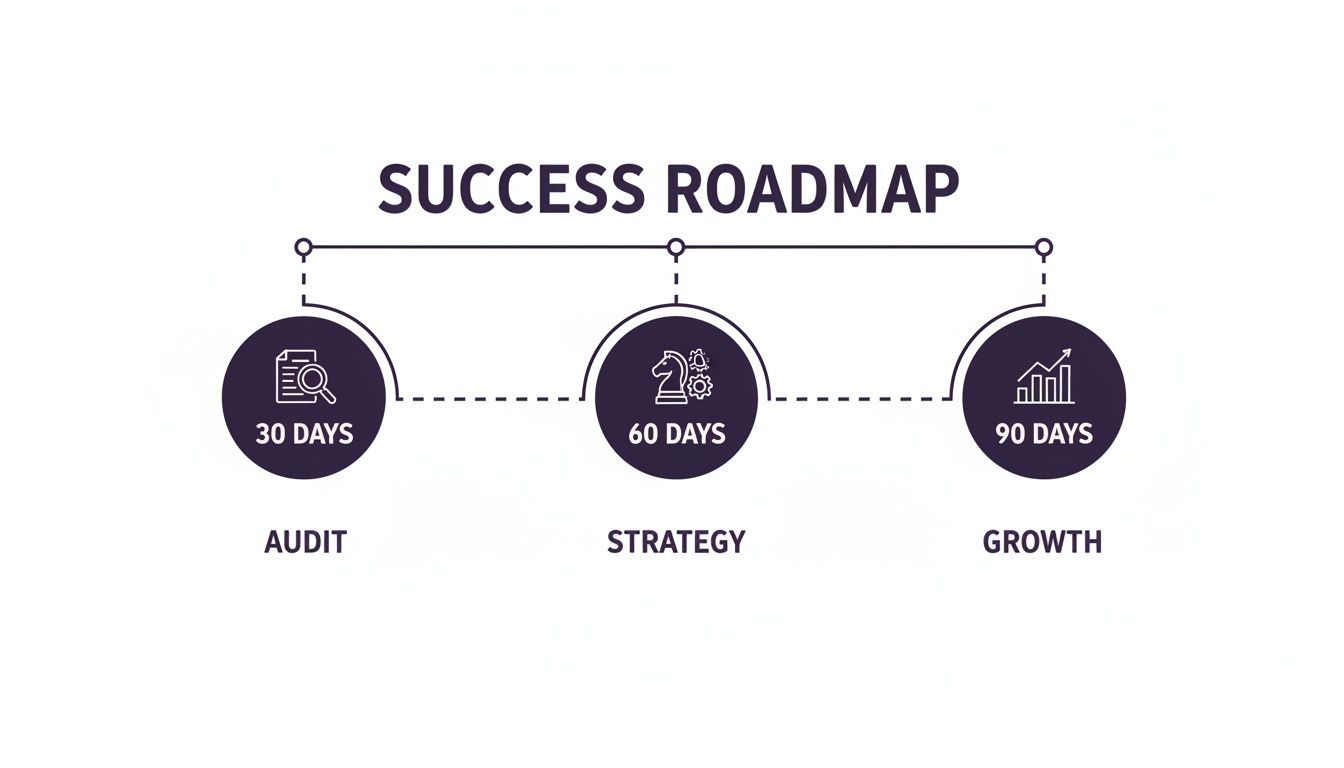
You can see the clear, phased approach—audit, strategy, and initial growth. That’s the hallmark of an effective fractional engagement.
Practical Examples and Language Choices
The words you choose matter. Words like "architect," "build," "implement," and "transform" are perfect for fractional roles. They signal a project-based, high-impact gig. For full-time roles, lean on words like "lead," "mentor," "oversee," and "develop." These convey a sense of long-term stewardship.
Choosing between fractional and full-time isn't about which is better, but which is right for your current stage. A fractional leader builds the machine; a full-time leader keeps it running and optimizes it for the long haul. Your job description must reflect which need is more urgent.
To make this even clearer, I've broken down the key differences to focus on when you're crafting the job post for each type of leader.
Job Description Focus: Fractional vs. Full-Time Sales Consultant
| Element | Fractional Sales Consultant Focus | Full-Time Sales Leader Focus |
|---|---|---|
| Role Title | Emphasize the advisory nature, e.g., "Fractional Head of Sales" or "Sales Strategy Consultant." | Use traditional titles like "VP of Sales" or "Director of Sales." |
| Primary Objective | Frame it as a project with a clear end state, e.g., "Build a repeatable GTM strategy for our new product line." | Describe a continuous leadership role, e.g., "Lead our sales organization to achieve consistent double-digit annual growth." |
| Key Responsibilities | List specific, high-impact deliverables, e.g., "Implement a MEDDPICC sales methodology." | Outline broad areas of ownership, e.g., "Manage day-to-day sales operations" or "Develop and mentor the sales team." |
| Time Commitment | Clearly state the part-time nature, e.g., "10-15 hours per week" or "2 days a week." | Specify it is a full-time, salaried position. |
| Success Metrics | Focus on project milestones and leading indicators, e.g., "Reduce sales cycle by 20% in 90 days." | Use a mix of leading and lagging indicators, emphasizing long-term growth like "Increase market share and customer LTV." |
By being this intentional, your job description transforms from a generic posting into a precision tool. It will attract candidates who are perfectly aligned with the leadership model your business needs to hit its next inflection point.
Your Job Description Is Your Beacon for Growth
Think of your sales consulting job description as more than just an HR formality. It’s your opening move, your first real shot at catching the eye of a leader who can genuinely change the game for your business. When you focus on the impact you need, define success clearly, and choose the right engagement model, you send a powerful signal that you’re serious about growth.
Finding that perfect fit—whether they’re with you for 10 hours a week or 40—can be the single most important decision for your company’s future. The right person doesn't just manage a team; they build the engine that creates predictable revenue. This is the real magic of fractional leadership: getting top-tier executive talent exactly when and how you need it most.
When you're ready to find a vetted, high-impact fractional sales executive who knows how to build and scale revenue engines, we can help. Explore our network of seasoned executives to find the leader who fits your unique business needs and get your growth on the fast track.
Frequently Asked Questions
When you're thinking about bringing on a sales consultant, a few key questions always seem to pop up. Getting straight answers is crucial—it helps you make sure you’re investing in the right kind of talent.
Here are the most common things founders and leaders ask.
What Is a Realistic Salary for a Sales Consultant?
Compensation varies widely depending on the model. For a full-time, senior-level sales consultant or VP, you can expect to pay anywhere from $150,000 to over $250,000 a year, plus performance bonuses.
For most startups and SMBs, the fractional model makes more financial sense. A fractional sales consultant usually works on a retainer, which typically runs from $5,000 to $15,000+ per month, depending on the project's scope and time commitment. This approach gives you access to A-list strategic minds without the hefty price tag of a full-time executive salary.
What Is the Difference Between a Sales Consultant and a VP of Sales?
While their skills often overlap, their roles are fundamentally different.
A VP of Sales is a full-time operational leader. They're in the trenches every day, managing the sales team, making sure quotas are hit, and driving the long-term growth of the department.
A Sales Consultant, especially a fractional one, is a strategic advisor or project-based specialist. You hire them to solve specific, high-stakes problems—like building your first sales playbook, overhauling a broken process, or cracking a new market. Their job is to deliver high-impact results, not manage people day-to-day.
Analogy: Your VP of Sales is the team's head coach, running drills on the field every single day. The Sales Consultant is the specialist you bring in to completely redesign the team's offensive strategy for the season.
Where Can I Find the Best Sales Consulting Candidates?
Finding truly elite sales talent means looking beyond the usual job boards. LinkedIn is a starting point, but the best candidates are often found in more focused circles.
Here’s where you should be looking:
- Niche Communities: Find private Slack groups or industry forums where seasoned sales leaders trade insights.
- Referral Networks: Your professional network is gold. Ask contacts at VC firms or leaders at other portfolio companies who they've worked with.
- Specialized Marketplaces: Platforms that connect companies with pre-vetted fractional executives are the most direct route. They have already curated a pool of high-caliber talent ready to make an impact.
Tapping into these channels helps you cut through the noise and get straight to proven leaders.
Finding the right strategic leader is the single most important step in scaling your revenue. At Shiny, we connect you with a vetted network of fractional sales executives who have the exact experience you need to build a powerful and predictable growth engine.