Small Business Marketing Consulting Services: Key Options
You're doing the marketing yourself between sales calls, customer problems, hiring decisions, and the work that keeps the company running. A campaign gets launched without a clear owner, the website collects leads without a reliable follow-up process, and each month ends with activity reports that don't explain whether marketing produced profitable growth.
Hiring a full-time marketing executive can solve part of the problem, but it also creates a large fixed commitment before you know exactly what kind of leadership your business needs. Small business marketing consulting services offer another path, one that combines strategic direction, practical execution, and flexible access to senior expertise.
The most useful distinction isn't whether you should outsource marketing. It's whether you need another vendor completing isolated tasks, or a marketing leader who can connect positioning, demand generation, sales alignment, and measurement. That distinction determines the quality of the outcome.
Why Small Businesses Need External Marketing Leadership
Founders usually don't struggle because they lack ideas. They struggle because marketing has no consistent decision-maker. One person manages paid ads, another writes occasional content, the founder approves the brand messaging, and sales follows up when someone has time. Each activity may look reasonable on its own, but no one is accountable for the system.
DIY marketing works for testing an offer or learning the basics. It becomes expensive when the business depends on it for sustained growth. Owners often switch channels before diagnosing the underlying problem, publish content without a defined buyer journey, or increase ad spend before confirming that the sales process can convert the resulting leads.
The underlying issue is leadership capacity. A business may have talented specialists, but specialists rarely replace someone who can decide which market to prioritize, how the offer should be positioned, what the team should stop doing, and how marketing connects to revenue.
The hidden cost of a full-time hire
A full-time executive hire carries more than salary. The business also takes on payroll taxes, benefits, insurance, recruitment time, onboarding, management overhead, and the risk that the hire won't fit the company's stage. A university business publication describes fractional executives as a way for small and medium-sized businesses to access specialized help without carrying the full cost of a permanent staff member, including the associated payroll and benefits burden, as discussed in this overview of fractional executive hiring.
Executive recruitment itself adds another layer of expense. One benchmark places executive cost-per-hire at $28,329, compared with roughly $4,700 for standard roles, while another source describes executive hiring costs as about seven times those of non-executive hires. These figures come from executive hiring cost benchmarks, and they illustrate why a permanent hire can be disproportionate for a company that needs senior judgment but not a full-time schedule.
What fractional leadership changes
A fractional marketing executive works inside the business without requiring a permanent executive structure. They can establish the strategy, clarify ownership, improve the funnel, manage specialists, and create reporting discipline. The company gets leadership attention where it matters, while retaining the ability to adjust the engagement as priorities change.
Practical rule: Hire senior marketing judgment before you hire a larger marketing workload.
The right consultant won't only produce more posts or launch another campaign. They'll determine whether the immediate constraint is weak positioning, poor lead quality, an unconvincing landing page, slow sales follow-up, or unattractive unit economics. That diagnosis prevents the common mistake of treating every growth problem as a traffic problem.
Fractional leadership is especially useful when a business has reached the point where informal marketing coordination no longer works, but a full-time chief marketing officer would be premature. You can bring in the experience needed to make important decisions, then build the internal team and processes around a strategy that has already been tested.
Common Types of Small Business Marketing Consulting Services
Marketing consulting is not one universal service. A business that needs a clearer market position requires a different intervention from one that has strong demand but weak conversion. Start by identifying the business constraint, then choose the capability that addresses it.
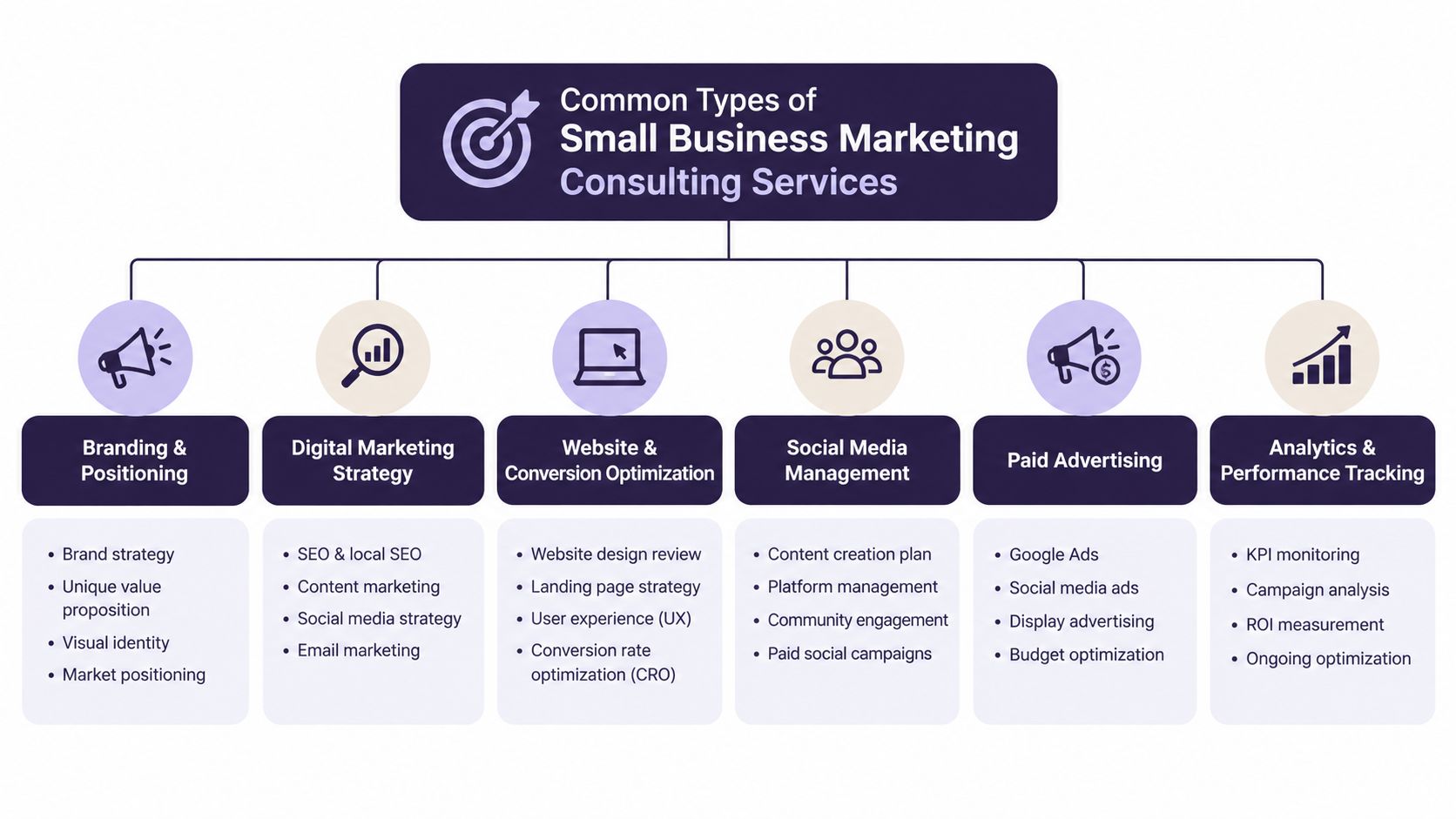
Marketing strategy and brand positioning
Strategy answers the questions that execution cannot fix. Who is the best customer? Which problem does the business solve better than alternatives? Why should a buyer choose this company now? What should the business be known for?
Branding gives those decisions a consistent expression across the website, sales material, email, social profiles, and customer experience. It isn't limited to a logo. A consultant may refine the value proposition, message hierarchy, category language, visual direction, and proof points that help buyers understand the offer quickly.
This work matters most when a company attracts the wrong prospects, competes mainly on price, or has several services that don't fit together into a clear story.
Growth marketing and demand generation
Growth marketing focuses on creating qualified demand and learning which channels produce commercially useful opportunities. The work may include search engine optimization, paid search, LinkedIn campaigns, content distribution, email nurturing, partnerships, local search, or review generation.
The best growth consultant doesn't treat every channel as mandatory. They select channels based on buyer behavior, sales capacity, time to value, and the company's ability to follow up. A local professional-services firm may need a stronger Google Business Profile and referral system, while a software company may need content that supports a longer evaluation process.
First-party audience development deserves attention here. A business that relies only on rented reach through advertising has less control over its relationship with prospects. CRM segmentation, email list growth, review collection, and useful subscriber content create assets the company can continue to use.
Conversion rate optimization
Conversion rate optimization, or CRO, improves what happens after someone arrives. A consultant examines the promise made in the ad or search result, the landing-page experience, the form, the call-to-action, the booking process, and the follow-up sequence.
A practical CRO review might find that the page explains features but not outcomes, asks for too much information, hides social proof, or sends high-intent visitors into a generic contact form. The fix may involve rewriting the offer, reducing friction, improving page structure, or aligning the sales response with the buyer's question.
Marketing operations and analytics
A fourth capability sits underneath all three: the operating system. Consultants may connect Google Analytics, CRM data, call tracking, advertising platforms, email analytics, and website conversion tracking so the team can see what happens from first interaction to closed revenue.
Without this layer, strategy becomes opinion and channel management becomes guesswork. A strong partner can also establish meeting rhythms, ownership rules, campaign documentation, and a reporting format that makes decisions faster.
Pricing Models Retainers, Projects, and Fractional Hiring
The engagement model should match the problem. Paying for a large package when you need a focused diagnosis wastes money. Choosing a short project when the business needs ongoing leadership creates a strategy that no one maintains.
A project engagement works well when the outcome has a defined beginning and end. Examples include a positioning workshop, website conversion audit, marketing plan, CRM cleanup, or launch strategy. Projects provide clear scope and make it easier to evaluate a specialist. Their limitation is continuity. Once the deliverable is complete, internal teams must implement it correctly or the work loses momentum.
A retainer provides recurring access to a consultant or agency. It can support content production, SEO, paid media management, social media, email campaigns, or ongoing advisory work. Retainers suit businesses with stable execution needs and a capable internal decision-maker. They're less effective when the company hasn't decided what it is trying to achieve, because recurring activity can continue without resolving the strategic issue.
A fractional leadership engagement is different. The executive participates in decisions, sets priorities, coordinates contributors, and owns the marketing direction for an agreed level of involvement. The business isn't just buying deliverables. It's adding experienced judgment to the leadership team.
A practical comparison
| Model | Best fit | Main strength | Common limitation |
|---|---|---|---|
| Project | A defined audit, launch, or strategic deliverable | Clear scope and outcome | Limited follow-through |
| Retainer | Recurring execution with established priorities | Predictable ongoing support | Can reward activity over leadership |
| Fractional executive | A company needing senior direction and team coordination | Strategic ownership with flexible capacity | Requires founder access and decision alignment |
Fractional work is often structured around 5 to 25 hours per week, allowing a company to secure meaningful executive involvement without creating a full-time position. The exact schedule should depend on the company's stage, the complexity of the funnel, the size of the existing team, and the urgency of the business problem.
Why flexibility matters
A growing company's needs change quickly. It may need intensive positioning work at the start, hands-on demand generation during a launch, and lighter oversight once the internal team is operating well. A fractional agreement can expand or contract with those needs more naturally than a permanent hire.
That flexibility doesn't mean the executive is a casual adviser. The relationship works when the leader has a defined mandate, access to the necessary data, authority to make recommendations, and a clear route for resolving disagreements. Founders should agree on priorities, meeting cadence, decision rights, and success measures before work begins.
The strongest arrangement often combines models. A fractional marketing leader might define the strategy and supervise a specialist retained for SEO, paid media, or content. That structure avoids paying an executive to perform every production task while ensuring that specialists work toward a coherent commercial objective.
The Rising Market for Marketing and Fractional Consulting
Marketing consulting is an established professional-services market, not a temporary workaround for companies that can't hire properly. In the United States, one analysis reports 50,025 establishments in NAICS 541613, a category larger than advertising agencies, public-relations firms, media buyers, and other marketing subsectors combined. The broader marketing industry employed 832,978 people across 93,241 establishments in 2022, according to the same small business marketing industry analysis.
The category also expanded materially. Marketing consulting establishment counts grew 33.6% from 2017 to 2022, which signals a larger and more developed supply of specialist providers. For buyers, that creates choice. It also creates a filtering problem, because more providers make it harder to distinguish strategic leadership from packaged execution.
A mature service category
A separate census-based benchmark reports that the average U.S. marketing consulting services business generates about $880,000 in annual revenue, with 47,043 businesses employing 262,204 workers and an average profit margin of 22.0%. The same marketing consulting services benchmark records official industry revenue of $41,333.51 million in 2017, while the U.S. Small Business Administration size standard for the industry is $16.50 million in annual revenue.
Those figures matter because they show that consulting can support both specialized boutiques and larger firms. A small business doesn't have to choose between an individual freelancer and a giant agency. It can select a provider based on the required level of strategic involvement, industry familiarity, and operating model.

Why fractional leadership is gaining ground
Fractional work is expanding alongside consulting. A 2026 Lightcast analysis found at least 34,000 workers with “fractional” in their current job title, up 265% from 2019, while the number of fractional profiles globally increased 313% over the same period. The analysis also found that 97% of fractional job postings in 2026 came from medium and small companies, as reported in this analysis of fractional leaders and small business growth.
The pattern makes operational sense. Smaller companies often need an experienced executive to establish priorities, manage change, and coach a team, but they don't need that executive performing the role every working day. Fractional leadership gives them access to a broader talent pool while keeping the commitment aligned with actual workload.
This is not a substitute for building internal capability. It's a way to make better decisions while that capability develops.
How to Choose the Right Marketing Partner for Your Goals
Start with the business outcome, not the service menu. “We need SEO” may mean the company lacks relevant visibility, has weak conversion paths, targets the wrong audience, or has no way to tell which leads become customers. A capable partner will investigate the commercial problem before recommending a channel.
Use this evaluation sequence.
1. Define the constraint
Write down what is currently limiting growth. Is the company struggling to explain its value, generate qualified demand, convert inquiries, retain customers, or coordinate an existing team? Choose the most consequential constraint rather than listing every marketing task that feels unfinished.
A consultant who promises to fix everything at once is usually selling activity. A stronger candidate will prioritize the constraint that affects the rest of the funnel.
2. Test relevant experience
Ask whether the partner has worked with similar buyers, sales cycles, price points, or regulatory conditions. Industry experience can shorten the learning curve, but it shouldn't replace evidence of clear thinking. Someone with direct category experience may still rely on outdated assumptions, while an excellent generalist may quickly understand a new market through disciplined research.
Request examples of decisions they made, not just a gallery of deliverables. You want to hear how they diagnosed the issue, selected an intervention, handled trade-offs, and measured progress.
3. Inspect the measurement system
Marketing performance should be measured across the funnel. A useful reporting stack can bring together qualified leads, conversion rate, cost per lead, customer acquisition cost, booked calls, close rate, revenue, repeat purchases, and return on ad spend. The small business marketing consultant measurement framework explains why each metric points to a different failure mode.
Use the standard ROI calculation when the necessary data is available:
ROI = (gross profit attributable to marketing − total marketing cost) ÷ total marketing cost × 100
The formula is simple. The hard work is agreeing on attribution and ensuring that sales, CRM, advertising, call, email, and website data connect accurately.
Ask this before signing: “Which number would tell you that our current strategy is failing, and what decision would you make if it moved in the wrong direction?”
4. Choose the operating model
A defined project suits a contained problem. A retainer suits recurring production. Fractional leadership suits a business that needs a senior operator to set direction and coordinate execution.
Before selecting, clarify how much founder involvement is available, who will execute recommendations, which decisions the executive can influence, and how quickly the company needs results. A fractional leader can be the wrong choice if nobody inside the company will implement decisions or provide access to the information required.
For a fuller explanation of the role and responsibilities, review this guide to what a marketing consultant does. Then ask candidates to propose a first phase with specific decisions, deliverables, reporting responsibilities, and review points.
5. Establish a baseline
Record the current state before changing campaigns. Independent guidance on small business marketing consulting services and KPI baselining emphasizes tying reporting to traffic, leads, sales growth, and marketing efficiency over a defined engagement cycle.
The baseline doesn't need to be perfect. It needs to be honest enough to show whether the business is improving lead quality, conversion economics, sales follow-up, or revenue attribution. Without it, both the founder and consultant can claim success based on selective evidence.
Unlocking Growth Through Fractional Marketing Leadership
Small businesses don't always need more marketing labor. They often need better prioritization, stronger commercial judgment, and someone senior enough to connect marketing decisions with sales and finance.
That's the practical value of fractional leadership. A marketing executive can clarify the offer, choose the right acquisition priorities, improve the path from inquiry to sale, and manage specialists without requiring the company to make a permanent executive commitment. The business gains speed without locking itself into an oversized structure.
The model also creates a useful transition path. A fractional leader can document the strategy, establish reporting, coach internal staff, and identify the capabilities the company should eventually hire. That's more valuable than outsourcing tasks indefinitely without building organizational knowledge.
Companies considering this route should evaluate fractional marketing services according to the problem they need solved, the authority the executive will have, and the evidence they'll use to judge progress. The right engagement is neither a hands-off agency arrangement nor an informal adviser relationship. It's accountable leadership with a flexible time commitment.
For founders, that combination can remove a persistent source of friction. You don't have to choose between managing marketing alone and carrying the full cost and risk of a permanent executive hire. You can bring in the expertise required now, create a stronger operating system, and adjust the arrangement as the business develops.
Shiny connects businesses with experienced fractional executives for flexible, part-time leadership across functions including marketing. Visit Shiny to explore available executives or discuss the marketing leadership your business needs next.