Temporary CFO Service: A Guide for Growth Firms
You're reviewing cash at night because the bank balance doesn't explain what's happening. Investors want a forecast your team can't defend, the board is asking why margins moved, and a CFO vacancy has turned routine decisions into escalations. The plan to “hire someone full-time next quarter” suddenly feels too slow.
That's where a temporary CFO service earns its keep. It isn't a cheaper executive title or an emergency replacement. Used properly, it's a decision diagnostic. The right finance leader enters with a defined problem, establishes the operating facts, improves the metrics that matter, and helps you determine whether the business needs a permanent CFO, a controller upgrade, or ongoing fractional leadership.
The market reflects that shift. Requests for interim CFOs rose 103% year over year in 2023, while interim CFO requests represented 51% of all interim C-suite requests and overall demand for interim leaders had risen 310% since 2020, according to CFO's coverage of interim CFO demand. This guide focuses on the more useful question: what business problem justifies temporary CFO support, and which KPI should prove the engagement worked?
The Moment a Founder Realizes They Need a CFO
A Series A founder opens the cash dashboard before a board meeting. The balance looks acceptable, but collections are slowing, hiring commitments are rising, and the forecast changes every time someone updates a spreadsheet. An investor asks how many months of runway remain under a slower-growth scenario. Nobody has a reliable answer.
The founder has a capable bookkeeper and an accounting manager. Neither person owns the forward-looking questions. Bank statements show transactions, but they don't explain the company's cash conversion cycle, hiring capacity, or exposure to missed renewals. The board pack contains numbers, yet it doesn't create confidence.
Three signals the gap is real
The first signal is that bank statements no longer tell the story. Revenue may be growing while cash falls because receivables, implementation costs, inventory, or project timing are absorbing working capital.
The second is a board question the team can't answer without a week of manual work. Questions about forecast variance, gross margin by customer, covenant headroom, or fundraising readiness require judgment, not just bookkeeping.
The third is personal. The founder is reconciling reports at midnight, chasing invoices, or rebuilding a forecast before every investor conversation. That's not strategic finance. It's executive time being consumed by a control failure.
Practical rule: Hire for the operating problem, not the title. If the business needs a finance leader in thirty days, a permanent search can run in parallel with temporary coverage.
A temporary CFO can stabilize reporting, impose a cash cadence, prepare investors or lenders for scrutiny, and document the finance function for the eventual permanent hire. The engagement should also answer a harder question: does the company need full-time strategic leadership, part-time oversight, or better accounting execution?
That distinction matters because temporary support is no longer a niche crisis tactic. 45.6% of fractional CFO engagements last one to two years, while 42% run for several months, showing that companies often use flexible finance leadership as an operating model, not merely as a bridge, according to the same CFO industry report.
What a Temporary CFO Service Actually Does
A temporary CFO is a senior finance leader embedded in one company for a defined engagement. The assignment usually has a start date, a business objective, decision rights, reporting expectations, and an exit condition. The word temporary describes the engagement length, not the executive's seniority.
The label overlaps with “interim,” “fractional,” and “virtual,” but those terms shouldn't be treated as interchangeable.
- Temporary CFO: A defined-term engagement focused on stabilization, transition, a transaction, systems work, or a specific operating reset.
- Interim CFO: Usually a full-time executive replacement during a vacancy, transition, turnaround, or transaction. Interim CFOs are commonly engaged for three to nine months, according to BluWave's overview of interim CFO engagements.
- Fractional CFO: Part-time strategic leadership that may continue across multiple planning cycles. The executive can support several clients and typically works through a recurring retainer.
- Virtual CFO: Often a service packaging or delivery label. It may include a CFO, controller, accounting team, or software-enabled reporting, so you need to inspect the actual people and responsibilities behind the name.
The operating sequence
A strong temporary CFO doesn't begin by producing another dashboard. They first establish whether the underlying numbers are complete, consistent, and decision-ready.
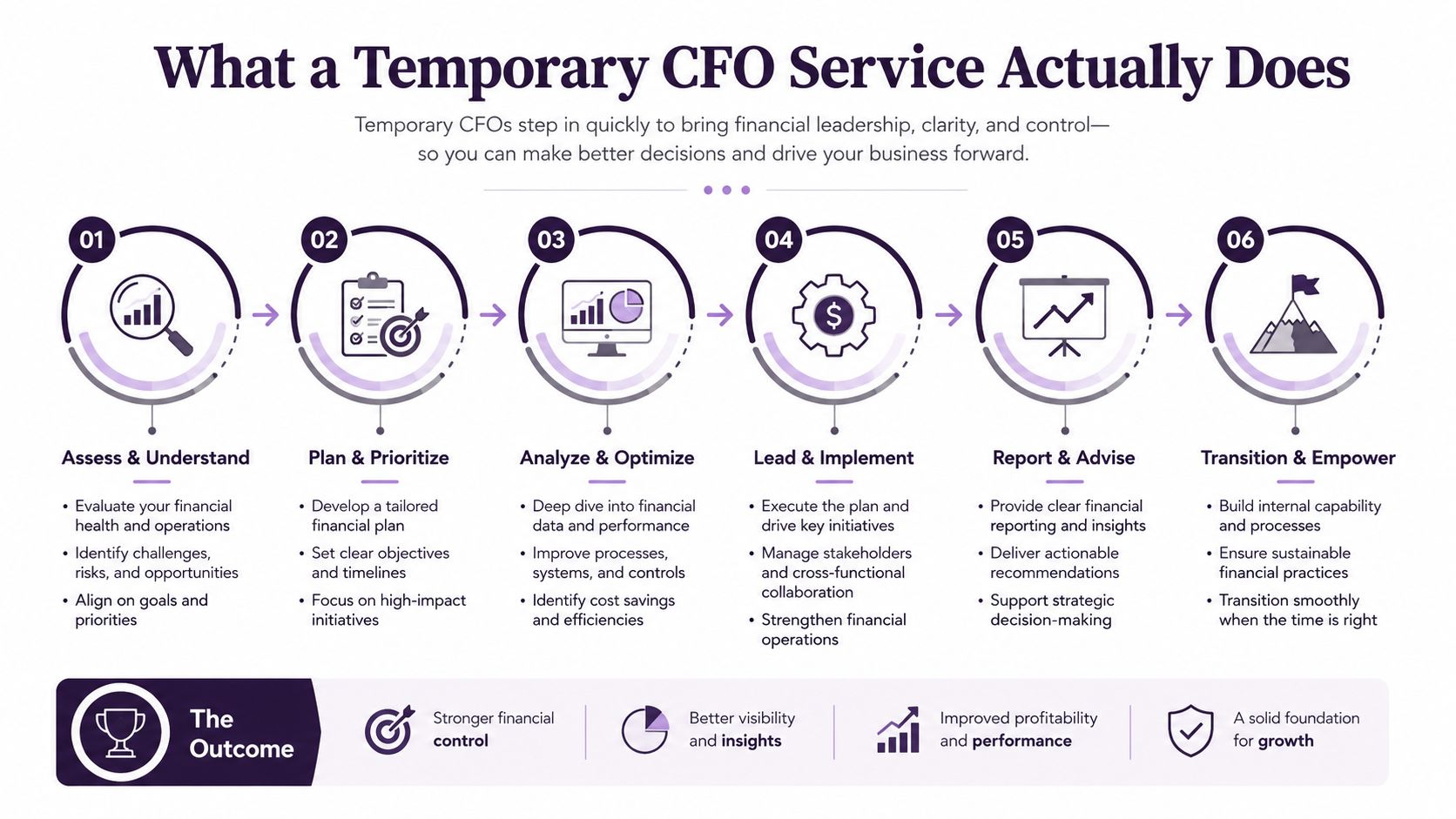
The work normally moves through six practical stages:
- Diagnose: Review the close process, cash position, forecast logic, contracts, debt, and finance team capacity.
- Stabilize: Set ownership for close, collections, approvals, cash reporting, and variance review.
- Build visibility: Create usable cash forecasts, KPI definitions, management reporting, and board materials.
- Lead the event: Manage fundraising preparation, lender reporting, due diligence, integration, or turnaround execution.
- Develop the team: Upgrade processes, clarify roles, and identify whether the company needs a controller, analyst, or permanent CFO.
- Hand over: Document assumptions, workflows, open risks, and next steps for the incoming leader.
The service sits inside a broader move toward flexible executive staffing. Companies can access senior judgment for the period in which the judgment has the highest value, without immediately committing to a permanent executive structure. That flexibility works only when the provider owns outcomes, not just meeting hours.
Temporary, Fractional, Interim, or Full-Time
The choice becomes easier when you compare the models against the actual need. A company preparing for a sale shouldn't use the same structure as a stable business that needs monthly planning support.
| Model | Time Commitment | Typical Duration | Best Fit |
|---|---|---|---|
| Temporary CFO | Project-based, often focused on a defined initiative | Defined term, commonly several months | Fundraising, systems implementation, integration, turnaround, or a leadership gap |
| Fractional CFO | Part-time support across recurring planning and leadership needs | Ongoing retainer, potentially one to two years | Growth firms that need strategic finance without a full-time seat |
| Interim CFO | Full-time commitment to one company | Commonly three to nine months | CFO replacement, transaction leadership, restructuring, or urgent stabilization |
| Full-time CFO | Exclusive, permanent executive role | Indefinite employment | Scaled companies with sustained complexity and a mature finance function |
The table is a starting point, not a substitute for diagnosis. A temporary CFO makes sense when the need is event-driven and the company can define what completion looks like. A fractional CFO fits better when the company needs recurring forecasting, board support, pricing analysis, or lender communication but doesn't require daily executive presence.
An interim CFO is the right answer when the company has lost leadership and needs someone fully embedded while the business continues operating. That distinction matters during a transaction or turnaround, where fragmented attention can create avoidable risk.
A full-time CFO becomes more defensible when finance leadership is a permanent operating requirement. The company may have multiple entities, complex debt, demanding investors, a substantial finance team, or a business model that requires daily executive involvement.
The wrong engagement model creates the wrong expectations. A part-time advisor can't repair a full-time leadership vacancy, and a permanent CFO is wasteful if the need is a clearly bounded project.
For a plain-language explanation of the ongoing part-time model, review Shiny's guide to fractional CFO meaning. Then map your situation to three questions: Is the need temporary or recurring? Does the CFO need to be embedded full-time? What must be different when the engagement ends?
How Temporary CFO Pricing Works
Temporary CFO pricing should follow the work, not a provider's preferred package. The common structures are a monthly retainer, a day rate, and a project fee. Retainers suit recurring reporting, cash oversight, and leadership meetings. Day rates fit concentrated transaction or turnaround work. Project fees make sense when the deliverable, decision points, and timeline are clear.
The ranges are broad because scope varies. Fractional or temporary CFO engagements commonly cost $3,000 to $10,000 per month, while stronger-growth or transaction-heavy companies often pay $6,000 to $20,000 per month, according to OpsFi's analysis of fractional CFO cost. The same analysis places practical workloads at 8 to 25 hours per month for stable firms and 15 to 40 hours per month during fundraising, M&A, or turnaround work.
| Pricing Model | Typical Range | Hours / Duration | Best Fit |
|---|---|---|---|
| Monthly retainer | $3,000 to $15,000 per month | Recurring monthly support | Forecasting, board reporting, cash management, and strategic finance |
| Growth or transaction retainer | $6,000 to $20,000 per month | Higher-touch monthly engagement | Fundraising, M&A, lender work, or a turnaround |
| Full-time CFO comparison | $200,000 to $450,000 annual fully loaded cost | Permanent employment | Ongoing executive ownership |
Use the price to test the operating case. A stable company should connect the retainer to reporting speed, forecast accuracy, cash visibility, or board readiness. A transaction-focused engagement should connect cost to a reliable model, diligence preparation, lender communication, or a completed transaction process.
The market itself is substantial. A 2026 market report estimates that the North American fractional CFO market reached $1.2 billion in 2023, with the United States representing about $850 million. The same report projects a U.S. fractional CFO total addressable market above $3.2 billion in 2026, reaching $6.4 billion by 2028, according to the C-Suite Support market report. These are market estimates, not a quote for your engagement.
A temporary arrangement can produce 60% to 80% lower cash outlay than a full-time CFO when the scope is focused, based on OpsFi's cost analysis. Compare equity, benefits, recruiting costs, and unused capacity alongside the invoice.
For a practical breakdown of engagement economics, review Shiny's guide to part-time CFO cost. Require every provider to tie price to hours, deliverables, access, response times, and a defined change-order process.
When Hiring a Temporary CFO Is the Right Move
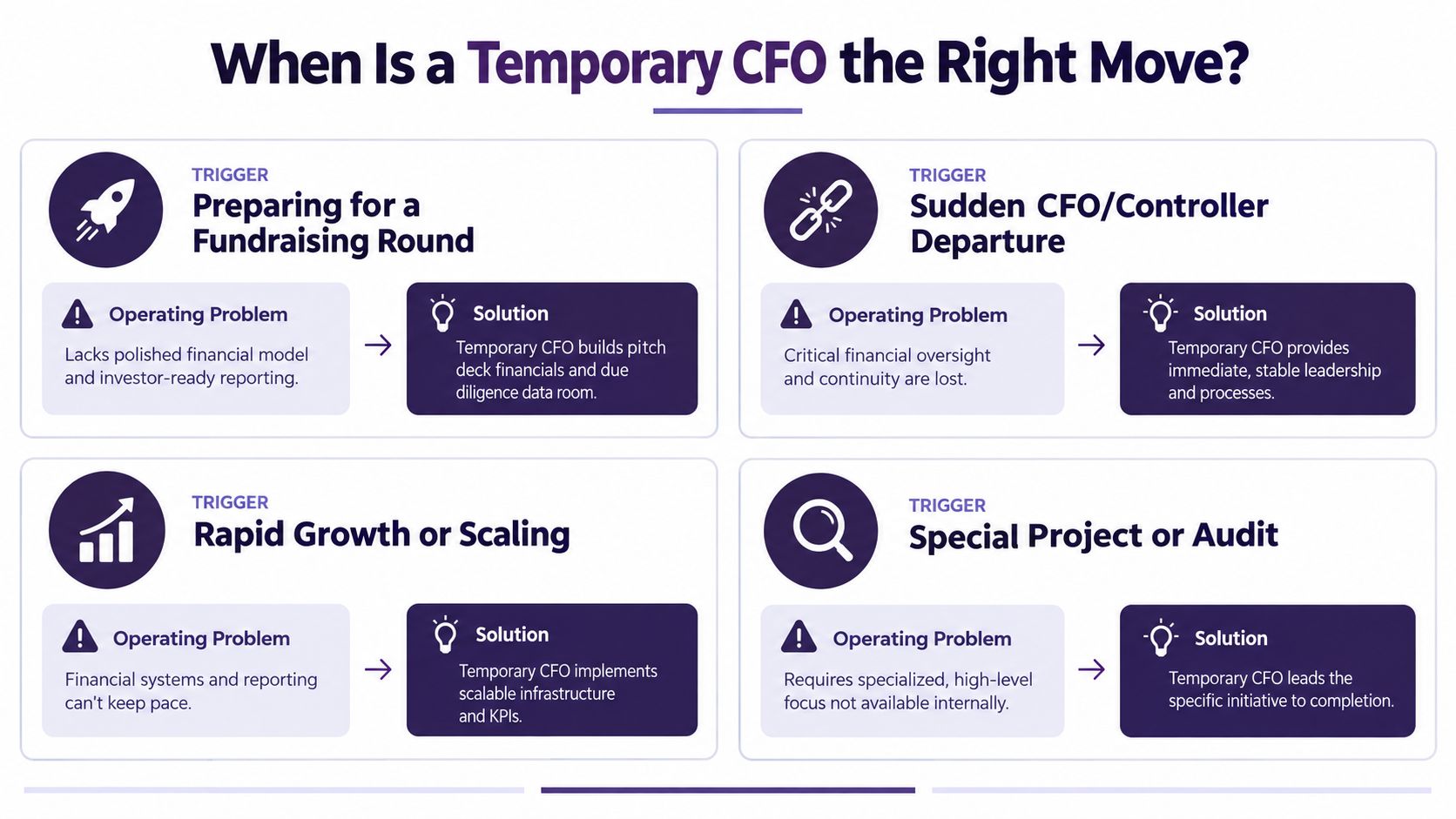
The best trigger is a business event that creates financial risk faster than the existing team can absorb it. Don't hire a temporary CFO because the title sounds mature. Hire one because a specific operating failure or strategic opportunity needs senior ownership now.
Fundraising readiness
A fundraising process exposes weak financial architecture quickly. Warning signs include inconsistent revenue definitions, a model that depends on undocumented assumptions, delayed monthly reporting, and a data room that finance can't explain.
A temporary CFO should build an investor-ready model, reconcile historical results, establish a credible cash forecast, and prepare management for diligence questions. The test isn't whether the deck looks polished. It's whether the leadership team can explain the bridge from bookings to revenue to cash.
A sudden CFO or controller departure
A resignation creates more than a vacant seat. It can interrupt lender communication, delay the close, weaken approval controls, and leave the finance team unsure who can make decisions.
An interim CFO is usually more appropriate than a light fractional arrangement when continuity requires full-time presence. A temporary leader should preserve the reporting calendar, protect cash, document open issues, and support the permanent search without pretending that a short-term fix is a long-term operating design.
Acquisition integration or rapid scaling
After an acquisition, finance may need to align charts of accounts, reporting calendars, controls, cash processes, and management definitions. A temporary CFO can own that integration while the CEO stays focused on customers and employees.
Rapid growth creates a similar problem without a transaction. The founder may still approve spending personally, while the accounting system can't produce reliable unit economics or department-level accountability.
Turnaround or covenant pressure
Cash pressure often appears first as a visibility problem. The company needs a short-horizon cash forecast, spending controls, collections ownership, and a clear view of lender obligations.
A temporary CFO is the wrong answer for a business still validating product-market fit with no meaningful finance complexity. It's also the wrong answer when the gap is a competent controller who can close the books accurately. The earlier the company defines the operating problem, the more options it retains.
Outcomes and KPIs a Temporary CFO Should Move
A temporary CFO earns the fee by improving decisions, not by producing more reports. Define the operating problem first, then select the KPIs that will prove whether the engagement is working and set a fixed review cadence.
For service businesses, the strongest diagnostic signals usually sit in pricing, work in progress, collections, and delivery capacity. According to Omniga's discussion of fractional CFO agency profitability, CFO oversight in these areas has been associated with 10% to 20% billable utilization improvements, DSO reductions of 5 to 10 days, and project-margin gains of 5 to 10 points within about 90 days.
| Outcome Bucket | KPI | Six-Month Target Move | Why It Matters |
|---|---|---|---|
| Cash and liquidity | DSO, cash forecast variance, runway visibility | Reduce DSO by 5 to 10 days from baseline and keep cash forecast variance within ±10% of actuals | Converts revenue into usable cash and exposes risk early |
| Reporting quality | Days to close, board-pack completeness, audit readiness | Establish a repeatable close and reporting cadence | Gives leaders dependable information for decisions |
| Growth economics | Utilization, contribution margin, project write-offs | Improve the drivers under management control | Shows whether growth creates cash or consumes it |
| Governance | Covenant headroom, cleared audit findings, policy compliance | Close or assign every material control gap | Protects lender, investor, and board confidence |
For recurring-project and professional-services firms, practical guardrails include contribution margins of 55% to 70%, write-offs below 2% to 4% of revenue, and aged work in progress above 30 days below 15%, based on the same Omniga operating benchmarks. Use these as management guardrails, not universal targets. The temporary CFO should adjust them for pricing, delivery model, customer mix, and the company's starting point.
Use a fixed review rhythm
- Weekly cash pulse: Review collections, disbursements, hiring commitments, and forecast changes.
- Monthly board pack: Explain actuals, variance, cash, operating KPIs, and decisions required.
- Quarterly forecast refresh: Rebuild assumptions for demand, pricing, headcount, working capital, and financing.
A report is not an outcome. If cash visibility, close discipline, forecast credibility, or operating economics do not improve, the engagement has not demonstrated value. Tie the fee to decisions that would otherwise remain delayed, unclear, or exposed, and end the work when those decisions become repeatable inside the company.
How to Choose the Right Temporary CFO Provider
Resume prestige is a weak selection criterion. Context fit matters more. A CFO who has led a large public company may not know how to build control without a large team, while a hands-on operator may be exactly right for a founder-led services business.
Start with four filters:
- Stage and sector: Look for experience with your revenue model, finance team size, customer contracts, and reporting expectations.
- Transaction exposure: Confirm direct work on fundraising, M&A, lender relations, diligence, or restructuring when those events matter.
- Systems fluency: Ask about QuickBooks, Xero, NetSuite, Sage Intacct, and the business intelligence tools your team uses.
- References: Speak with former clients who can discuss the executive's judgment, communication, follow-through, and behavior under pressure.
| Criterion | What to Look For | Disqualifier |
|---|---|---|
| Stage fit | Comparable growth pattern and finance maturity | Experience only in companies with much larger teams |
| Operating depth | Evidence of improving cash, reporting, controls, or margins | Strategy language without implementation examples |
| Transaction experience | Direct ownership of relevant diligence or financing work | Has only supported transactions from the sidelines |
| Systems capability | Can work within your current stack and improve it pragmatically | Wants to replace systems before diagnosing the process |
| Commercial clarity | Written scope, rate, hours, and change-order terms | Vague pricing or unlimited expectations |
| Trust and risk | References, insurance, confidentiality, and liability paperwork | Refusal to provide basic documentation |
Ten interview questions for operators
- What would you review in your first week?
- How would you build a cash-runway scenario plan?
- What makes a board pack decision-ready?
- How do you test the audit trail behind reported revenue?
- Which finance process have you repaired most often?
- Tell me about a forecast you got materially wrong. What changed afterward?
- How do you separate a controller problem from a CFO problem?
- Which decisions require your approval, and which should stay with the CEO?
- How do you prepare a finance team for a new permanent leader?
- What would make you recommend ending the engagement early?
Five red flags should stop the process: vague pricing, no sample deliverables, refusal to name past clients, promises of instant results, and missing insurance or limited-liability paperwork.
For an additional perspective on the role itself, review Shiny's guide to the fractional chief financial officer.
A sample job brief
Scope: Lead the finance function through a defined stabilization and reporting program, including cash forecasting, close improvement, board reporting, KPI design, and support for fundraising or lender requests.
Hours: Agree on a monthly hour band, with a written process for approving additional work.
Reporting line: Report to the CEO, with scheduled access to the board chair or finance committee when appropriate.
Decision rights: Own finance priorities, reporting standards, forecast assumptions, and finance-team workflows. The CEO retains authority over strategy, hiring, financing, and material spending.
Confidentiality: Protect company, customer, employee, investor, and lender information under a signed confidentiality agreement.
Deliverables: Provide a baseline diagnostic, cash forecast, monthly management pack, KPI definitions, risk register, and handover documentation.
Exit criteria: End the engagement when the agreed reporting cadence is stable, the priority project is complete, and the company has selected its next finance structure.
Making the Hire With Confidence
A temporary CFO should create visible progress during the first month. Don't wait until the end of the engagement to discover that access, authority, or success criteria were never defined.
The first thirty days
Week one sets the baseline. Grant access to the accounting system, bank information, contracts, debt documents, payroll data, board materials, and existing forecasts. The CFO should identify data gaps, reporting risks, cash commitments, and the people who own each finance process.
Week two produces a refreshed cash forecast. The forecast should show expected inflows, committed outflows, hiring plans, financing assumptions, and downside scenarios. Its value comes from the assumptions and ownership behind it, not from the spreadsheet's formatting.
Week three delivers the first board pack. It should explain actual performance, material variances, cash movement, operating drivers, and decisions that require leadership attention. The board should spend less time debating which number is correct and more time deciding what to do.
Week four surfaces three high recommendations. Those recommendations might address collections, pricing, project margin, spending controls, systems, or team structure. Each one should have an owner, a measure, and a decision date.
A temporary CFO is a strategic rental, not a substitute for permanent finance leadership.
Solo practitioners can move quickly and provide direct access, but capacity may be limited. Boutique firms can offer specialized coverage and backup, while marketplaces can widen the candidate pool and structure comparison. Each model trades speed, depth, continuity, and selection rigor differently.
Your agreement should state the scope, hours, reporting line, decision rights, KPIs, confidentiality terms, and exit conditions on day one. A structured fractional executive marketplace can help founders compare vetted candidates against pricing, sample deliverables, and stage-specific fit without adding unnecessary search time.
Shiny connects companies with vetted fractional and interim executives, including finance leaders, through a marketplace that supports candidate matching, interviews, and onboarding. Visit Shiny to compare temporary CFO options and find a finance leader matched to your company's stage, operating problem, and required hours.