
Head of Sales: The Practical Guide for Growing Companies
A head of sales is best understood as the operator who builds the revenue system, pipeline, process, people, and metrics, rather than the top closer. For most companies below $20 million in ARR, a fractional head of sales is usually the smarter default, not a compromise.
You've probably seen the failure pattern. The founder closes the first customers, hires a strong account executive, and expects that person to “scale sales.” A few months later, reps are waiting for decisions, forecasts are based on instinct, late-stage deals still need the founder, and nobody can explain why pipeline converts inconsistently.
The problem usually isn't effort. It's role design.
A head of sales should build the machine that makes revenue repeatable. That means creating pipeline visibility, defining how opportunities move, coaching the team, and exposing uncomfortable truths through reliable metrics. If you hire a closer for a builder's job, you'll get individual heroics where you need an operating system.
What a Head of Sales Actually Does
A head of sales owns the conditions that allow a sales team to perform repeatedly. They don't carry a large quota or rescue difficult deals. They turn founder-led selling into a process that other people can execute.
Think of the difference between a builder and a closer. A closer wins the deal in front of them. A builder asks why similar deals aren't appearing consistently, why opportunities stall, which qualification signals matter, and whether a new rep could follow the same path without personal intervention.
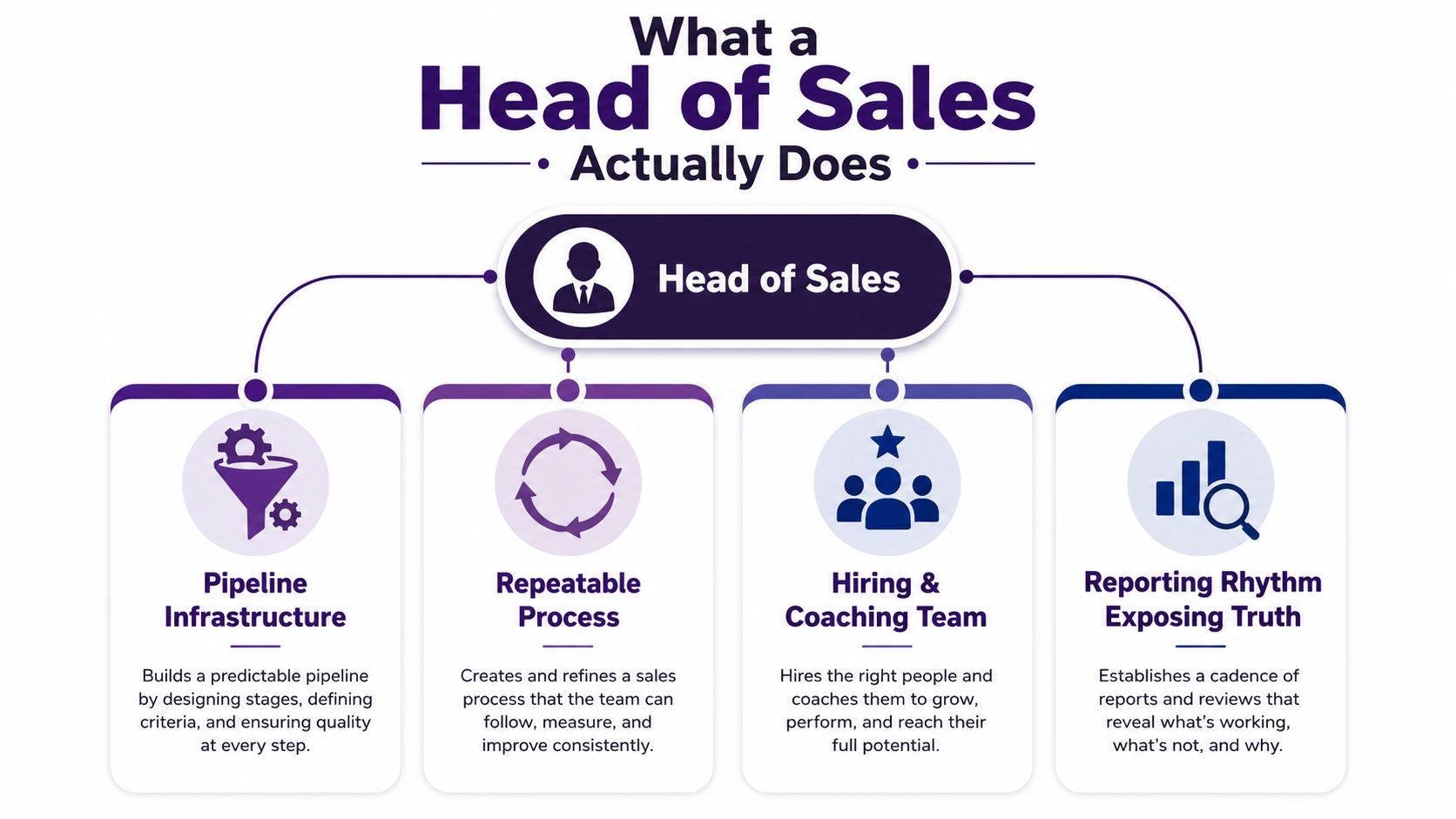
The four assets that compound
The role creates four durable assets:
- Pipeline coverage: A clear view of where qualified opportunities come from, how much coverage exists, and where future revenue may fail.
- Sales playbooks: Documented discovery, qualification, messaging, objection handling, and close processes that reduce dependence on individual talent.
- A trained team: Hiring profiles, onboarding, call reviews, deal coaching, and performance expectations that help reps improve.
- Forecast accuracy: A reporting rhythm that separates hope from evidence and gives the founder an honest view of likely revenue.
Founder-led sales often stores the company's learning in scattered inboxes, call recordings, and personal memory. That can work while one person owns every important relationship. It breaks when several reps need consistent answers at the same time.
A practical head of sales builds a weekly operating cadence. The team reviews pipeline movement, deal risks, next steps, qualification quality, and rep development. The point isn't to create more meetings. The point is to make the company's revenue logic visible enough to improve.
Practical rule: If the candidate's strongest example is a personal closing win, keep interviewing. You need evidence that they can make other people better and make the process clearer.
The failure mode this role exists to prevent is simple: a company has revenue but no revenue system. It can't scale beyond the founder's calendar because nobody has converted hard-won lessons into repeatable infrastructure.
Core Responsibilities and the KPIs That Prove Them
A head of sales without metrics is a hired closer. A head of sales with metrics is a system operator.
Start by assigning each responsibility a proof point. The exact target depends on deal size, market, sales motion, and maturity. Don't copy benchmarks blindly. Use them to expose missing instrumentation and force a useful operating conversation.
Six responsibilities, six accountability tests
Pipeline generation should show whether the team can create enough qualified demand. Track meetings booked, lead-to-opportunity movement, and the quality of opportunities entering the funnel. Pipeline coverage is a useful signal, with 3x coverage commonly used as a planning reference, but only if the underlying opportunities are qualified.
Forecasting requires more than a CRM dashboard. Track forecast variance, commit quality, pushed deals, and the reasons opportunities leave a period. A forecast that stays within 10 percent variance can serve as a practical benchmark signal, provided the company defines the period and forecast category consistently.
Hiring and ramp belongs to sales leadership, not only people operations. Measure time to first deal, progression through onboarding milestones, and quota attainment by the third month. A candidate who can't explain how they diagnose a slow ramp probably hasn't managed the system behind one.
Process design becomes visible through stage conversion rates and sales cycle length. If deals remain in one stage or cycle length expands without explanation, the problem may be qualification, messaging, approval friction, or poor next-step discipline.
Team coaching should connect observed behavior to outcomes. Win rate, deal slippage, call quality, and opportunity progression reveal whether coaching changes execution.
Cross-functional alignment needs a shared definition of a qualified handoff. Track customer handoff quality, post-sale feedback, and expansion sourced from sales. A head of sales shouldn't be rewarded for closing accounts that customer success can't retain.
| Responsibility | Primary KPI | Benchmark Signal |
|---|---|---|
| Pipeline generation | Qualified opportunities created | 3x pipeline coverage, with quality verified |
| Forecasting | Forecast variance | Within 10 percent variance |
| Hiring and ramp | Time to first deal | Clear progress toward third-month quota attainment |
| Process design | Stage conversion and cycle length | Stable movement through defined stages |
| Team coaching | Win rate and deal slippage | Coaching changes rep behavior and deal control |
| Cross-functional alignment | Handoff quality and expansion sourced | Customer success receives complete, usable context |
The broader control model matters too. A meta-analysis of sales control systems covering 39 empirical studies and 6,678 respondents found that both behavior-based and output-based controls improve revenue outcomes, while behavior-based control has the larger average effect. Set outcome targets, then inspect the behaviors that produce them.
Head of Sales vs VP of Sales vs CMO
Titles create confusion when authority doesn't match the work. A head of sales usually owns revenue execution for a focused team or segment. A VP of sales generally carries broader organizational responsibility, including multiple segments, layers of management, and a larger budget. The CMO owns demand generation, brand, positioning, and the top of the funnel.
The fault line appears when teams argue about lead quality. Marketing may count an MQL as success while sales sees no buying intent. The head of sales then gets blamed for weak conversion even though the team received poorly defined opportunities.
Set the handoff in writing. Marketing owns the path up to MQL. The head of sales owns SQL through closed-won and account expansion. Both leaders should agree on qualification criteria, acceptance rules, feedback timing, and the reporting fields that make attribution credible.
| Dimension | Head of Sales | VP of Sales | CMO |
|---|---|---|---|
| Primary ownership | Revenue execution and team performance | Larger sales organization and segment strategy | Demand, brand, positioning, and top-of-funnel |
| Core metrics | Pipeline, conversion, forecast, attainment | Revenue across teams, capacity, budget, strategic segments | MQL volume, campaign contribution, positioning, demand quality |
| Typical authority | Sales process, coaching, hiring input | Organization design, management layers, sales budget | Marketing budget, messaging, channels, brand |
| Main handoff | Accepts qualified opportunities and closes them | Coordinates multiple sales motions | Supplies and improves qualified demand |
| Best fit | Growing team needing an operating system | Larger organization needing scale and structure | Company needing market demand and category clarity |
The chief sales officer role sits further up the hierarchy and usually implies company-wide revenue authority. Don't use it to make a small sales team sound more mature than it is.
Title inflation creates expensive mis-hires. Give the candidate authority that matches the title, then judge them against the metrics they can control.
When to Hire a Head of Sales
Don't hire because the calendar says your company has reached a particular stage. Hire when the founder-led system starts breaking in visible ways.
Five signals deserve immediate attention:
- Reps wait for strategic decisions. Ask, “How many deals are blocked because only the founder can approve messaging, pricing, or commercial exceptions?”
- Forecasts depend on gut feel. Ask, “Can the team explain why each committed deal will close, or are you repeating what the rep hopes will happen?”
- The process stays undocumented after repeated wins. Ask, “Could a new rep run discovery and advance an opportunity without sitting beside the founder?”
- Win rate or churn is mysterious. Ask, “Do you know which customer traits, use cases, or sales behaviors predict a healthy account?”
- The founder remains in every late-stage deal. Ask, “Is the founder adding strategic value, or compensating for a team that hasn't learned how to close?”
Don't assign precise financial damage to every symptom without your own data. A stalled rep ramp can create meaningful opportunity cost, but the amount depends on compensation, territory, deal size, capacity, and the value of the missed pipeline.
Run a 30-day diagnostic first
Before opening the search, collect a clean baseline:
- Pipeline coverage ratio: Compare qualified pipeline with the period's target.
- Average sales cycle: Separate new business from expansion and identify where time accumulates.
- Rep-to-deal ratios: See how many active opportunities each rep carries and which reps receive founder support.
- Stage conversion: Find the first stage where opportunities consistently degrade.
- Forecast history: Compare previous commitments with actual outcomes.
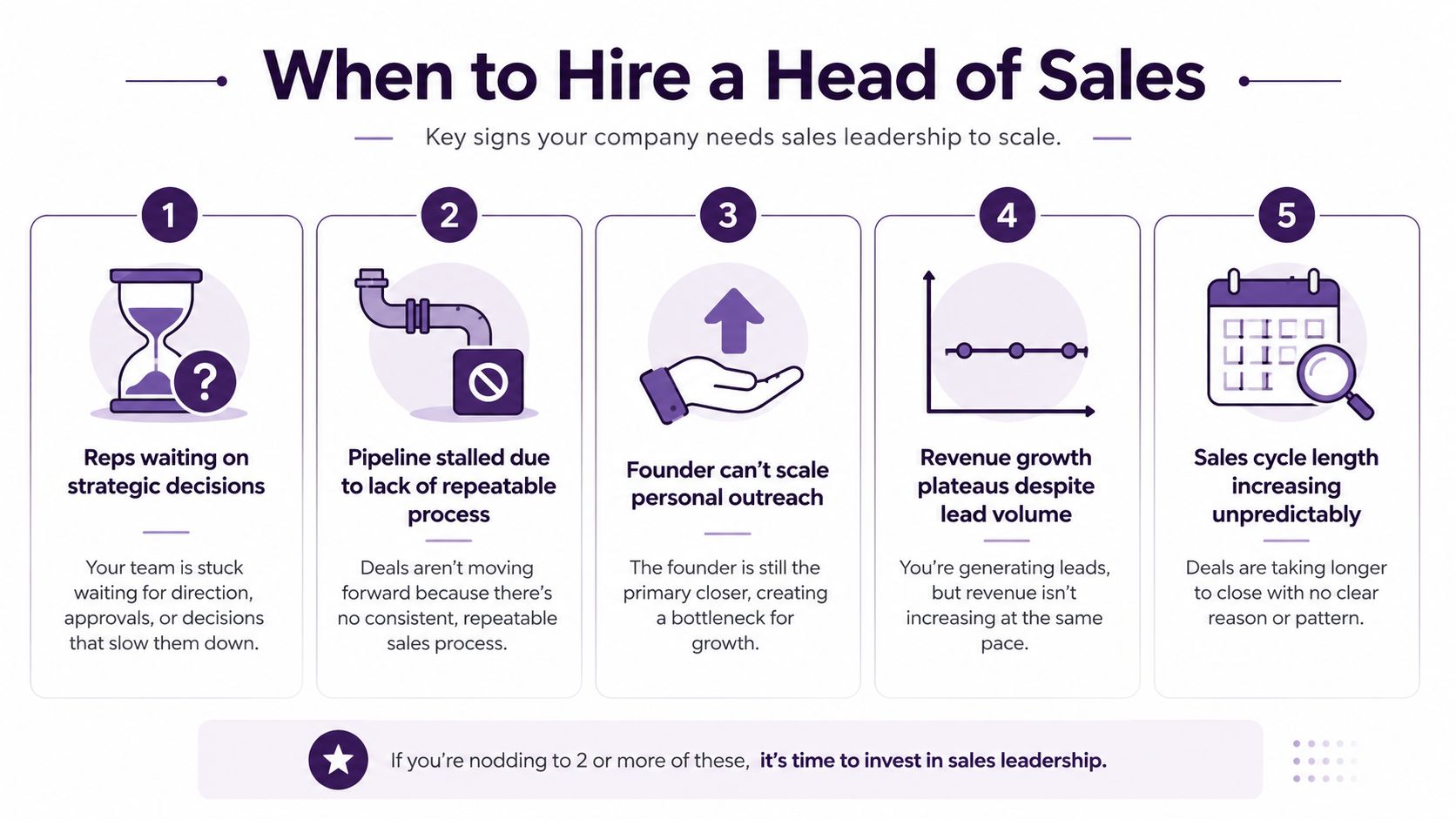
The right hiring window is when the system breaks, not when revenue plateaus. If you wait for a plateau, you may be asking the new leader to repair pipeline, process, team confidence, and founder dependency at the same time.
For a broader comparison of senior sales leadership scope, review this guide to the VP of Sales role. Then decide whether your immediate need is a permanent executive, a builder who can install the system, or temporary capacity while you make the decision.
Full-Time vs Fractional Head of Sales
You have three credible options: hire a permanent executive, engage a fractional leader, or bring in an interim consultant for a defined transition.
A full-time hire makes sense when the team needs daily management, the sales motion is already substantial, and the company can support the risk of a senior mis-hire. A fractional leader is better when the founder needs operating-system design, coaching, and accountability before committing to a permanent executive. An interim consultant fits a specific gap, such as leadership leave, a search period, or a transformation project.
| Dimension | Full-Time | Fractional | Interim Consultant |
|---|---|---|---|
| Cost profile | Higher fixed commitment, plus benefits and equity | Monthly commitment tied to time and scope | Project or transition-based |
| Speed to impact | Search and onboarding take time | Experienced operator can begin quickly | Fast start for a defined need |
| Skill depth | Deep company-specific ownership | Broad pattern recognition across businesses | Focused expertise for a specific problem |
| Cultural integration | Highest day-to-day integration | Deliberate integration through cadence | Limited by project duration |
| Failure risk | Expensive and difficult to reverse | Easier to resize or end | Scope limits exposure |
A first-line manager's span of control isn't a universal rule, but empirical benchmarks converge around 6 to 10 reps, with 8 reps commonly cited for B2B SaaS inside or hybrid teams, according to Pulse RevOps' span-of-control guidance. If your team requires that level of daily coaching, full-time leadership may be justified. If the bigger problem is missing process and unreliable reporting, fractional leadership can create more benefit before you add permanent overhead.
Fractional leaders don't need an equity package to be motivated, but they do need a clear mandate, access to the CRM, founder availability, and agreed deliverables. An interim-to-full-time conversion works when the leader has demonstrated cultural fit and the company now has enough recurring management demand to justify permanent capacity.
The rule of thumb is straightforward: below $10 million ARR, start by testing fractional leadership; between $10 million and $20 million, choose based on management intensity; above $20 million, evaluate full-time leadership first.
Salary and Compensation Benchmarks
Compensation conversations need a clean distinction between verified market evidence and internal planning assumptions.
A 2024 sales leadership salary guide reported an average US base salary of $205,036 for a head of sales, with a range of $179,263 to $235,078 and average total cash compensation of $284,345. A UK job-trends analysis covering vacancies posted in the six months leading to 15 October 2025 reported a median salary of £100,000 for the role.
Those figures describe a high-value revenue seat. They don't validate every startup compensation package. A Series A company may need a builder with a different mix of cash, variable pay, and equity than a growth-stage company hiring a leader for an established organization.
| Stage | US Base | US OTE | UK Base | Fractional Monthly |
|---|---|---|---|---|
| Early growth | Use role scope and verified market range | Tie variable pay to controllable outcomes | Use local market evidence | Scope-dependent |
| Scaling organization | $179,263 to $235,078 reported range | $284,345 reported average total cash | £100,000 reported median | Scope-dependent |
| Mature sales function | Calibrate to organization size and authority | Include team and revenue accountability | Calibrate to local role scope | Scope-dependent |
The compensation design should follow the operating problem. A leader building process needs meaningful base pay and a variable component tied to team outcomes. A leader inheriting a functioning machine can carry more variable risk because the inputs are already instrumented.
Don't attach pay to a number the leader can't control. If marketing owns lead generation but sales is judged only on pipeline volume, the plan will create conflict. Use a balanced scorecard covering qualified pipeline, forecast discipline, team attainment, sales cycle health, and retention-related outcomes.
Public data also points to a gap between target compensation and realized performance. A 2025 Canadian sales compensation analysis reported that only 38% of VPs and Directors of Sales hit quota, while another 2025 benchmark cited in the same verified context reported average quota attainment of 74% across organizations. Design the plan for the actual operating environment, not an imaginary year in which every forecast converts.
Job Description, Interview Questions, and Onboarding
Your job description should filter for a system builder before the first interview. Don't lead with “rockstar closer.” State the stage, sales motion, team scope, founder relationship, and outcomes the person must create.
A job description you can adapt
Role summary: We're hiring a head of sales to build a repeatable revenue system across pipeline, process, people, and reporting. This leader will establish operating cadence, coach the sales team, improve forecast visibility, and create a sales motion that doesn't depend on the founder.
Must-haves:
- Experience building or repairing a sales process in a comparable market.
- Evidence of coaching reps, not only personal quota attainment.
- Strong CRM discipline and comfort diagnosing pipeline data.
- Ability to work directly with the founder and challenge assumptions.
- Clear understanding of qualification, stage design, and forecast management.
Stage fit: Include your current ARR, sales motion, average buyer profile, team size, and the specific systems that already exist. Candidates should know whether they're inheriting structure or creating it.
Questions that expose operating ability
- How would you instrument pipeline visibility during your first 30 days? Look for fields, definitions, inspection cadence, and a plan to validate data quality.
- Describe a forecast you caught and corrected. Strong candidates explain the evidence, the conversation with the rep, and the process change that followed.
- How would you split a $500,000 quota across two reps? Listen for territory potential, capacity, ramp, account distribution, and the assumptions behind the allocation.
- Tell me about a deal where the founder was the bottleneck. The candidate should show how they transferred authority without damaging the customer relationship.
- Which metrics would you refuse to report on, and why? This tests whether they can distinguish useful leading indicators from activity theatre.
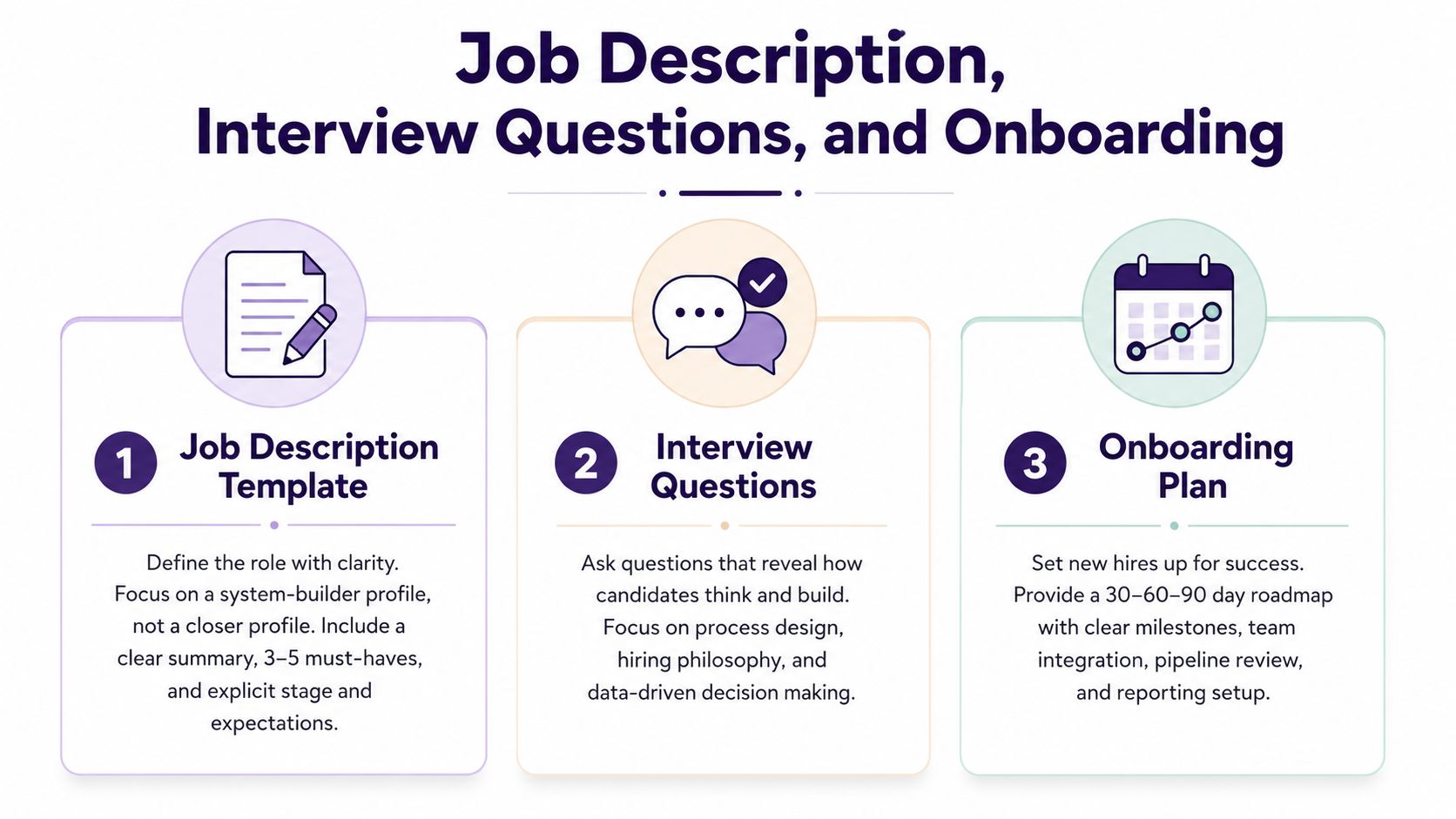
Make the first quarter produce artefacts
Days 1 to 30, pipeline: Audit CRM data, define opportunity stages, inspect qualification, and produce a baseline pipeline report.
Days 31 to 60, process: Publish the sales playbook, establish deal reviews, clarify handoffs, and document the forecast method.
Days 61 to 90, people: Complete rep assessments, create coaching plans, set hiring requirements, and run a consistent operating cadence.
The deliverables matter more than the presentation. By the end of the first quarter, you should have clearer pipeline definitions, a usable forecast rhythm, documented process, and a team-specific coaching plan.
Why Fractional Leadership Often Wins for Growing Companies
For companies between roughly $2 million and $20 million ARR, fractional leadership is often the sensible default. The company usually needs senior judgment, but it may not need a full-time executive spending every working day on management, especially when the immediate assignment is to install the revenue system.
The economic case is direct. A fractional engagement for 1 to 3 days per week can cost 30% to 50% of a full-time base plus variable compensation, before equity dilution, according to the verified planning benchmark supplied for this topic. That leaves room to fund reps, demand generation, enablement, and the tooling needed to make the system work.
Speed matters just as much. An experienced fractional operator can often begin within weeks, while a senior search may take 4 to 6 months, according to the same verified benchmark. That difference matters when reps are already waiting, the founder is still approving every deal, and the CRM contains more opinion than evidence.
Objectivity is the third advantage. A fractional leader has less incentive to build a personal fiefdom. Their job is to make the system work well enough that the company can later choose whether to retain them, expand the engagement, or hire a permanent executive. The fractional sales management model works best when the mandate includes tangible systems, not vague executive presence.
| Factor | Full-Time Head of Sales | Fractional Head of Sales |
|---|---|---|
| Best fit | Sustained management demand and established scale | System design, coaching, and focused execution |
| Cash commitment | Larger fixed commitment | Adjustable to scope and time |
| Time to start | Longer search and onboarding | Faster access to experienced leadership |
| Founder dependency | Can reduce it after ramp | Can attack it immediately through defined work |
| Main risk | Costly mismatch or premature hiring | Insufficient capacity if daily management is required |
Full-time is correct in two cases. The company has sustained $20 million-plus ARR and needs permanent organizational ownership, or the founder has personally carried every major deal and now needs a true peer in the room.
Fractional leadership isn't a lesser version of the job. For a growing company, it can be the most disciplined way to build the job before making it permanent.
If your company needs a head of sales who can install pipeline discipline, create a repeatable process, and coach the team without adding premature fixed overhead, Shiny can connect you with experienced fractional executives. Explore the marketplace or schedule a consultation to define the leadership scope your next stage requires.