Virtual Chief Technology Officer: Role, Cost and Fit
Your lead developer resigned on a Tuesday. By Friday you're the person who approves database changes, decides whether to move to a cheaper cloud plan and answers an investor's question about your security posture. You also run sales, hiring and payroll. None of that is technology leadership, but all of it landed on your desk.
Founders in that position usually pick one of two bad options. They hire a full-time chief technology officer long before the workload justifies an executive salary, or they keep absorbing every decision themselves until a release slips, a security review fails or a cloud bill doubles.
A virtual chief technology officer is the third option. You buy a defined slice of senior technology judgment, a few days a week, and you get decisions written down, owners named and a plan you can act on. The questions worth answering are what that person does with the hours, what the arrangement costs, where it stops making sense and how it ends.
What a Virtual CTO Does Each Week
A virtual chief technology officer is an experienced technology executive who leads strategy part time and is accountable for agreed outcomes rather than for office presence. Published industry estimates put a typical client commitment at 10 to 25 hours per week, according to Sci-Tech Today's fractional executive hiring statistics. You're buying judgment, written decisions and accountability, not attendance.
The closest comparison is a ship's navigator. The navigator doesn't row. They step onto the bridge two or three days a week, set the course against the chart, check the instruments and say when the weather has changed the plan. The crew still does the rowing. Someone with sea miles is watching the heading.
What the hours actually produce
Ask for the artifact, not the activity. Every area of responsibility should end in a document or a decision you can act on that week.
- Roadmap planning: a quarterly roadmap with priorities, owners and dates, reviewed at a fixed session.
- Architecture and build-or-buy calls: a short written decision record for each major system, naming the options considered and the cost of reversing.
- Vendor and tool selection: a scored shortlist, pricing comparison and contract review before you sign anything.
- Engineering hiring and team design: role scorecards, interview panels and an org chart that shows who owns what.
- Security and risk: a risk register with named owners and target dates, updated monthly.
- Cloud spend: a report that lists what each service costs, who owns it and which actions cut the bill.
- AI governance: an approved-tool list, data rules for prompts and human-review thresholds.
The table below is the version to keep visible.
| Responsibility area | What the client receives | Typical cadence |
|---|---|---|
| Technology roadmap | Quarterly technology roadmap with priorities, owners and dates | Quarterly review |
| Architecture and build-or-buy decisions | Written decision records for major systems | As decisions arise |
| Vendor and tool selection | Shortlist, scoring criteria and contract review | Per purchase |
| Engineering hiring and team design | Role scorecards, interview panels and org chart | Monthly while hiring |
| Security and risk oversight | Risk register with named owners and target dates | Monthly |
| Cloud and infrastructure cost | Spend report with savings actions | Monthly |
| AI tool governance | Approved-tool list, data rules and human review thresholds | Quarterly |
The test that separates work from talk: name the document and the date it landed. If you can't, you paid for conversation.
This arrangement sits inside a much larger shift toward fractional executive leadership. The Over 50 Pros fractional work market report estimates the global fractional executive market reached $5.7 billion in 2025 and is expanding at a 14% compound annual growth rate. Its data also shows that 72.8% of fractional professionals have at least 15 years of experience, which is why a part-time executive can outrank a full-time hire on judgment. Treat the market figure as directional, since it comes from an industry report rather than a government statistical agency. The direction is plain: technology is among the most active fractional categories because AI forces every company to decide what to build, buy, integrate or govern.
How a Virtual CTO Differs From Other Tech Leaders
Four options come up once a founder accepts that technology decisions need an owner: a full-time CTO, a virtual CTO, a technical co-founder and a project consultant. The skills overlap. What differs is hours, who carries the outcome and what the company gives up.
| Option | Time commitment | Who owns the outcome | Best fit | Typical cost basis |
|---|---|---|---|---|
| Full-time CTO | Full-time, 40 or more hours a week | Employee accountable for the whole technology function | Companies with steady, large technology workloads | Salary, benefits and equity |
| Virtual CTO | 10 to 25 hours a week | Contracted executive accountable for agreed outcomes | Growth-stage firms that need senior decisions without a full-time hire | Monthly retainer or hourly rate |
| Technical co-founder | Full-time, equity-based | Shared ownership of the company | Founders building the first product | Equity and early salary |
| Project consultant | Fixed scope with a set end date | Deliverable only, not ongoing operations | One-off audit or migration | Fixed project fee |
Read the third column before the fifth. A fractional leader joins the leadership team part time for a minimum period rather than a single sprint and stays directly accountable for outcomes, which is how one New Zealand market analysis of fractional leadership describes the model. That accountability is the piece a consultant's statement of work usually leaves out.
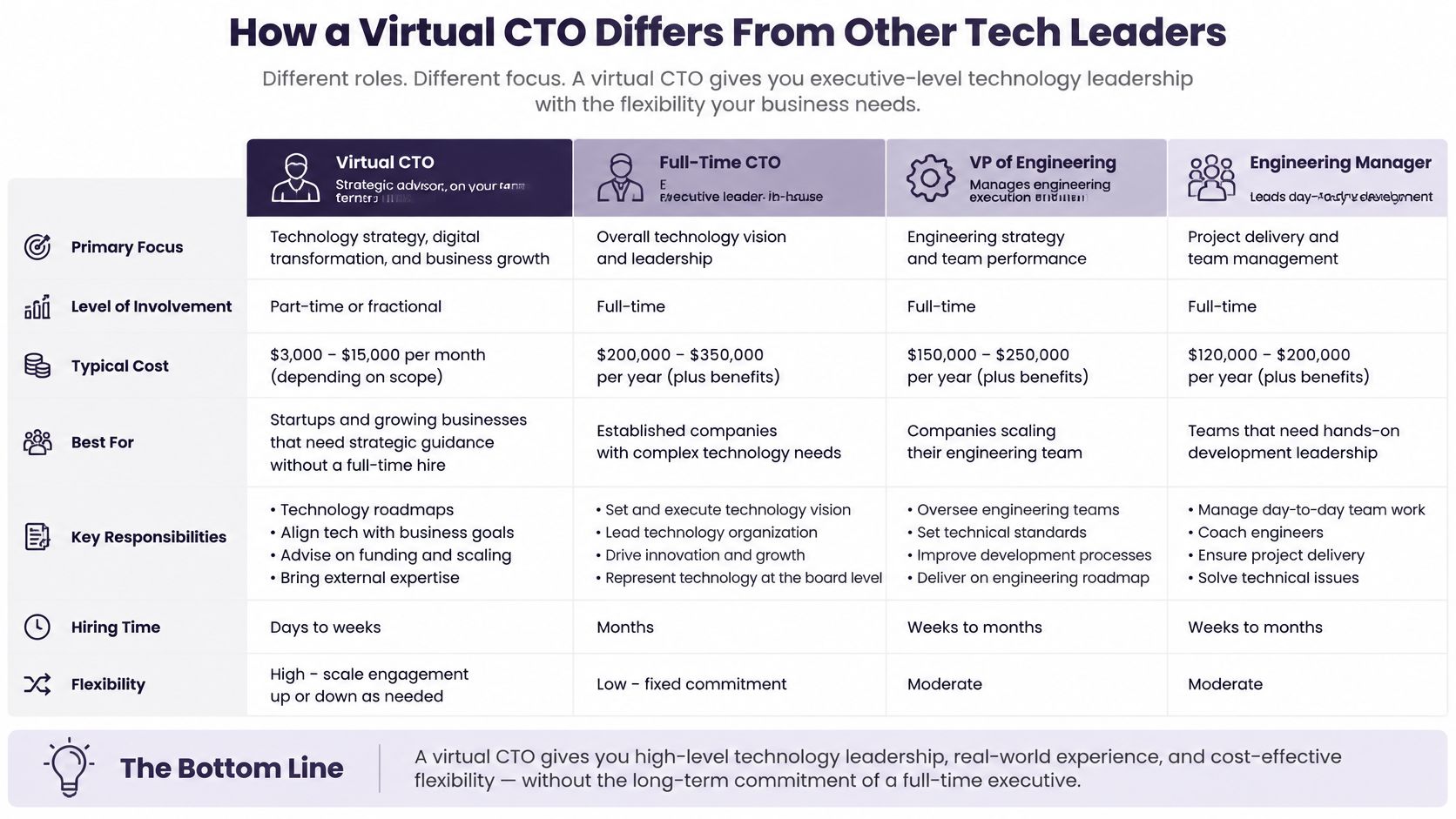
The four roles above sit at different altitudes, and the chart makes the split visible: the virtual CTO holds the strategic seat, while engineering management holds the delivery seat.
The cost benchmark makes the trade-off concrete. The U.S. Bureau of Labor Statistics puts the median annual wage for computer and information systems managers at $175,140 as of May 2025, as Frontline Source Group's analysis reports, and that's wages alone. Add employer-paid benefits, payroll taxes, equity, recruiting and overhead, with benefits adding 46.3% to civilian-worker compensation, and the total sits well above the headline.
A three-part test for placing your own gap
- One delivery with a clear end: an audit, a migration, a platform selection. Hire a project consultant and let the engagement close.
- Recurring decisions across quarters: hiring, budgets, security risk, architecture, board reporting. A virtual CTO fits because the work doesn't finish.
- One person permanently owning the whole function: a full-time CTO, once workload and budget carry it.
Demand is moving toward the second option. Requests for interim CIO, CTO and CISO executives increased 67% in 2024, according to Business Talent Group's 2024 report, which shows how many companies now buy slices of senior technology leadership instead of whole executives.
The chief information officer title overlaps with the CTO enough to muddle a hiring conversation, and this explanation of the chief information officer role separates the internal-systems focus from the product focus.
Answer one question in writing before you interview anyone: is the gap a project, a recurring leadership need or a permanent function?
Three Composite Cases Where a Virtual CTO Helped
The three cases below are composites built from patterns that repeat in part-time technology leadership. They aren't named clients, and the figures are the scale a small company sees rather than audited results.
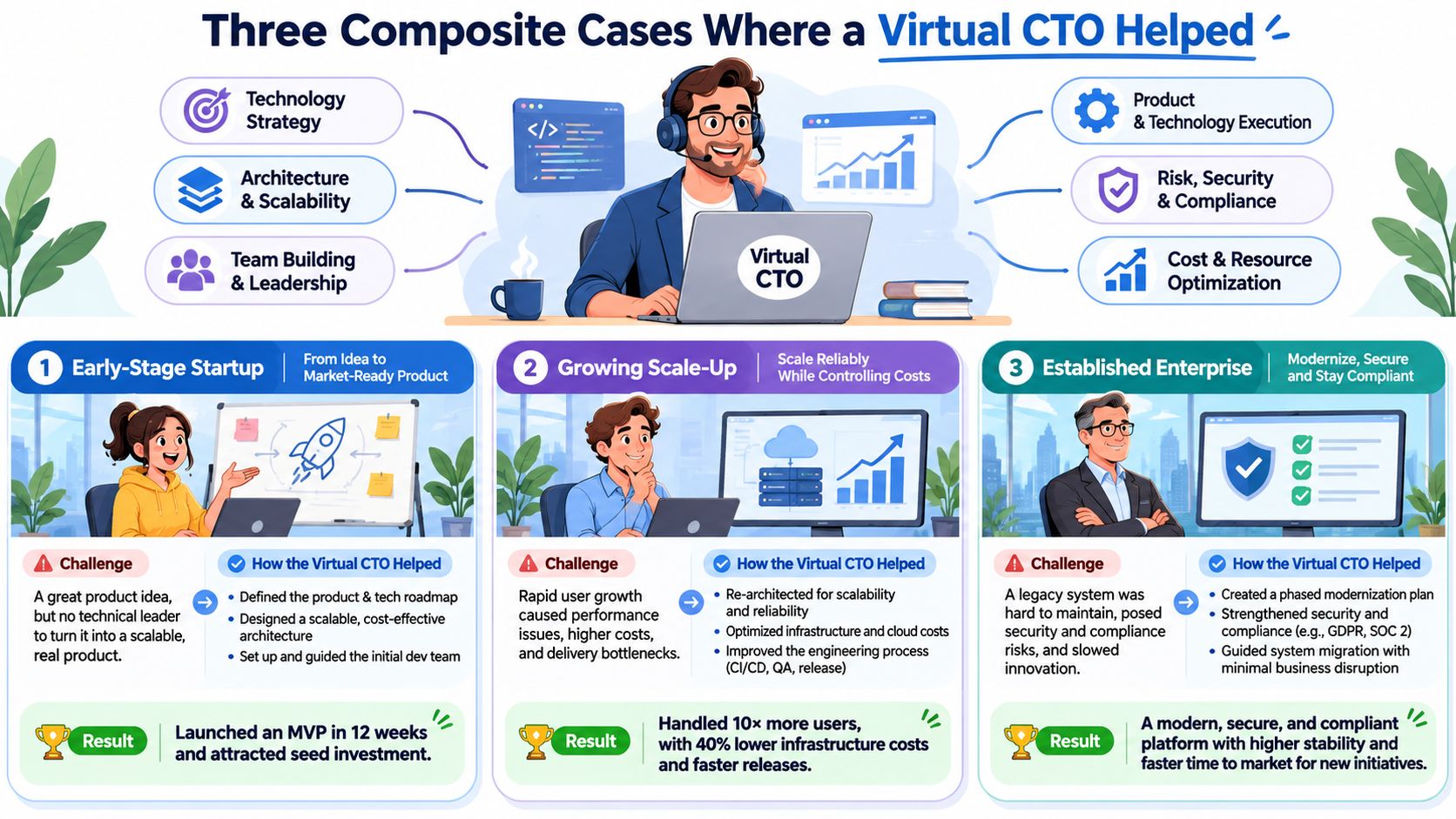
The SaaS company that lost its lead developer
A 14-person SaaS company lost its only senior engineer. Releases stalled for six weeks, and when an investor asked how the platform was structured, nobody could answer without guessing. The trigger wasn't the resignation. It was the discovery that the architecture lived in one person's head.
The first 30 days produced a one-page system map from an architecture audit, a backlog reordered by revenue risk, and interviews run against a written scorecard for the replacement lead. The founder could see releases moving again and could answer the investor with a diagram instead of a shrug.
The services firm using AI tools without rules
At a 60-person professional services firm, consultants had added AI writing tools to client work without telling anyone. Nobody knew which tools, which clients or what text had been pasted in. The risk wasn't the tool. It was that 60 people were making policy decisions alone, in real time.
Within a month the virtual CTO delivered a one-page approved-tool list, a rule naming the data that may never enter a prompt (client identifiers, contracts, personal records) and a human-review threshold for anything leaving the firm. Client deliverables gained a reviewer, and the informal tools lost their cover.
The manufacturer with a rising cloud bill
A manufacturing firm watched its cloud bill climb every quarter and couldn't say which product line caused the increase. No single person owned the spend.
The fix was unglamorous: monthly cost reporting by service, a named owner for every resource and a standing list of savings actions reviewed each month. Over two quarters the waste came out, and the bill stopped being a mystery line on the P&L.
The common thread isn't a rescue. It's conversion. A vague worry becomes a written decision with a named owner and a date to check it, which is what a founder needs from an executive.
What a Virtual CTO Costs at Different Hours
Virtual CTO pricing comes from hours, not from a salary band. The fractional work report puts the average rate for fractional finance and engineering executives at $229 per hour. Multiply that rate by the hours your roadmap needs, and each commitment level produces a clear annual figure.
| Hours per week | Annual cost at $229 per hour | Typical workload |
|---|---|---|
| 5 | $59,540 | Architecture reviews and quarterly planning |
| 10 | $119,080 | Roadmap, security oversight and hiring support |
| 15 | $178,620 | Active product build alongside an engineering team |
| 20 | $238,160 | Multi-team oversight with hiring and vendor work |
| 25 | $297,700 | Highest typical commitment for a single client |
Read the table as capacity, not tiers. Five hours a week buys oversight of decisions your team makes. Twenty hours buys leadership across several teams, vendors and a hiring pipeline. Pick the row that matches the work you listed, not the row that feels safe.
At $119,080 a year for 10 hours a week, the annual figure typically lands well below the fully loaded cost of a full-time technology leader. Many engagements also run on monthly retainers rather than ad hoc invoices, so the spend stays predictable from month to month.
A well-run engagement should also get cheaper over time. As your team absorbs the roadmap discipline, security reviews and AI rules the virtual CTO installs, the hours you need should shrink. Price the role as a capability-building engagement with an end date, not a permanent line item.
Three steps to a defensible number
- List the recurring work: roadmap reviews, architecture decisions, hiring support, security oversight, cost reporting, AI governance.
- Estimate weekly hours per item: a quarterly roadmap might average two hours a week, while an active hiring round can take five.
- Total the hours and multiply by 52 weeks at the agreed rate, then ask whether a retainer lowers it.
Watch the thin end of the range. Two hours a week rarely buys decisions. It buys reports about decisions someone else should have made, and the role quietly turns into an expensive newsletter.
Then compare it to the alternative
Set the annual figure against the fully loaded cost of a full-time technology leader: salary, benefits, equity, recruiting and the months of searching. When the workload doesn't fill a full-time role, the fractional comparison usually wins on total cost, not only on flexibility.
AI Governance and Security a Virtual CTO Must Own
Founders tend to treat AI rules as something to write after the pilot proves out. The adoption numbers say the pilot already shipped. AI use reached 87.3% of small businesses while only 45.6% of organizations had formal AI-use guidelines, according to the 2026 Small Business Cybersecurity Awareness and Practices Survey. That leaves more than half of them relying on employees to make real-time calls about confidential data, model outputs and acceptable tools.
The same survey found 25% of small businesses had no formal procedure for reviewing AI-generated content, with reliability and accuracy a concern for 45% and data security or privacy for 42%. Those aren't abstract worries. They're the two routes by which an AI tool becomes a client complaint or a breach notification.
What the virtual CTO owns
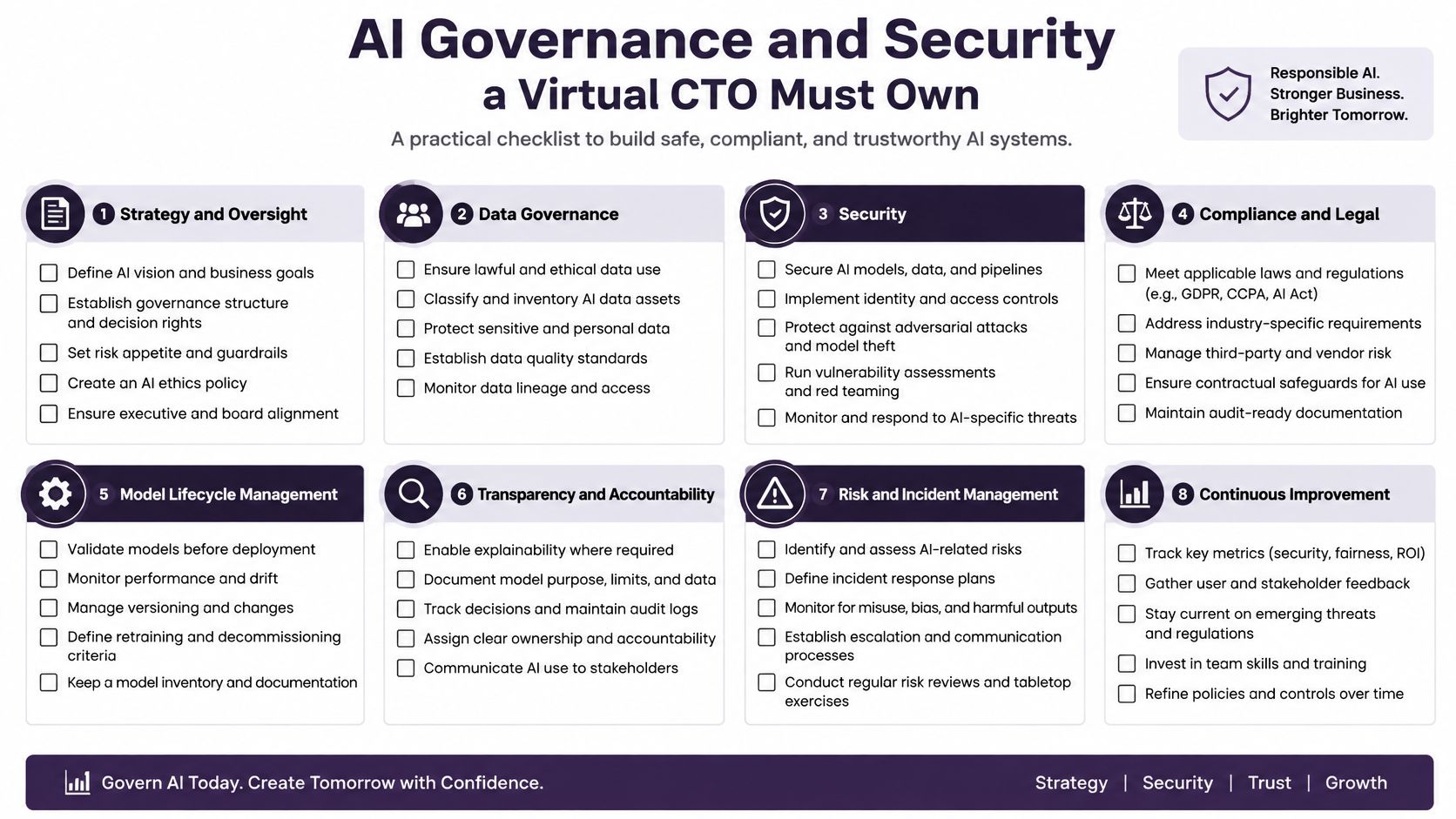
The checklist above holds up as a quarterly review agenda. Each item below is an operating responsibility with a named owner, not a paragraph in a policy document.
- Approved-tool inventory: one list of what staff may use, with vendor and version named.
- Data classification for prompts: a short rule for what may never be pasted into a model, such as client identifiers, contracts and personal records.
- Human review thresholds: set by output type, so an internal draft and a client-facing report don't share the same rule.
- Vendor due diligence: where data is stored, whether prompts train the model, retention periods and what happens on exit.
- Audit logs: who used which tool on what data, kept long enough to investigate a leak.
- Leak response: a one-page plan for a pasted client list, naming who calls whom.
- Training: a 30-minute session that repeats the rules, rather than a policy nobody opens.
Security follows the same logic. NIST's Cybersecurity Framework 2.0 is built for organizations of any size, sector or maturity, and it gives you a vocabulary for assessing and communicating risk. Start with a risk register covering critical assets, identities, suppliers and recovery dependencies, each with an owner and a target date. Then harden identities with multifactor authentication and least privilege, centralize logging, encrypt backups and test restoration, because an untested backup turns a recoverable incident into a long interruption.
The pressure is real. Technology leaders rank security of IT systems and information as their top priority, and 75% of CIOs expected to spend more time on AI or machine-learning initiatives in the following year, with cybersecurity at 65%, per Robert Half's cybersecurity skills gap research. If you sell into the EU or your AI features reach EU users, the governance question gains a legal layer, and you may need to appoint an EU AI Act representative so a named entity answers to regulators on your behalf.
Judge the engagement by exposure, not by launch. Success is fewer unapproved tools, fewer unresolved critical findings and a decision process your team can repeat without the executive in the room.
Signs a Business Needs a Virtual CTO and How to Choose One
Run this yes-or-no list before you take a single call.
- No one owns technology decisions: the founder decides by default, usually late at night.
- Engineering output is unpredictable: some months ship three releases, some ship none, and nobody can explain the swing.
- Security and AI choices have no named owner: tools appear, data moves, nobody signs off.
- The work recurs across quarters: hiring, budgets, architecture and risk keep coming back.
- A full-time hire isn't justified yet: the workload doesn't fill the seat or the budget.
Two yes answers usually mean the gap is leadership rather than labor.
How to vet one in a single conversation
Look for hands-on experience at companies your size and stage, references from clients with recurring engagements, and a habit of writing decisions down instead of presenting slide decks. When the answer to a build-or-buy question lands on an outside vendor, Galliot's vendor selection guide is a useful second opinion on how to score them.
Ask four questions and listen for specifics:
- Which decisions would you make in your first 30 days?
- How do you handle a disagreement with the engineering lead?
- What will you need from me every week?
- How do you hand the work over at the end?
Before signing, agree on weekly hours, the retainer or hourly basis, which decisions stay with the founder, what authority is delegated, and what documentation must be left behind. Our guide to how to hire a CTO walks through the same vetting steps for a full-time search, which helps you see what changes when the role is part-time.
Metrics, a 90-Day Plan and an Exit Plan That Prove the Role Works
A virtual CTO earns the retainer when the company can see delivery, risk and ownership moving in the same direction. Start with a small set of delivery metrics, pull them from version control, CI/CD, incident and deployment systems, and review them on a fixed calendar by product or team. DORA's 2023 report is useful because elite teams showed lead times under one day and change-failure rates around 5%; DORA's performance framework defines the metrics those benchmarks refer to.
| Metric | 2023 DORA reference point | How to use it locally |
|---|---|---|
| Deployment frequency | Higher frequency is better | Track the trend by team, then remove the queue that slows releases |
| Change lead time | Elite teams were under one day | Find where work waits: review, testing, environment or approval |
| Failed-deployment recovery time | Shorter recovery is better | Practice rollback before an incident forces the lesson |
| Change-failure rate | Elite teams were around 5% | Investigate causes in batch size, test coverage and release gates |
The mechanism is practical: smaller batches and better automated testing shorten lead time and recovery, while release gates, observability and rollback automation cut failure rates. Include AI system changes in the same review, with a named owner for model, data and vendor decisions.
Where teams misuse the numbers
Treat the metrics as a diagnosis of the system, never as a score for a person. A long lead time usually points to an approval queue, thin test coverage, an unreliable environment or unclear ownership. Name the constraint, assign the fix and recheck next month.
The first 90 days follow a fixed order.
- By day 30: a baseline of current metrics, one throughput objective, one stability objective and a written map of the systems.
- By day 60: a prioritized roadmap and a security risk register with named owners and target dates, including AI tools that touch customer data.
- By day 90: a measurable improvement in at least one delivery metric, connected to something a customer feels, such as release responsiveness, uptime or support-ticket volume, plus an internal successor named for each key function.
Hours logged and meetings held prove nothing. The evidence is a metric that moved, a risk that closed and a person inside the company who can run the review without you.
Set the exit trigger before you need it
Write the decision down at the start: hire internally, keep the virtual CTO on a reduced retainer, or hand the work to a specialist. Some engagements run months and some run years, and both are healthy when the plan says why. The exit plan is what separates a capability-building engagement from an open-ended expense.
A healthy engagement ends with a successor already running the review. If nobody inside the company can run it by month nine, knowledge stayed outside the company.
The rhythm is simple: a monthly metric review by team, a quarterly reset of the roadmap and risk register, and one page of notes to the founder each month. A useful KPI set for that review is covered in our guide to software development KPIs, which keeps the discussion on delivery and cost rather than activity. Shiny is a marketplace of vetted fractional executives across CFO, CTO, CMO, COO, CHRO, CSO and CIO roles, and only vetted C-level executives join the platform. Write a one-page scope covering the problem, the hours you can fund and the 90-day outcomes you want, then use Shiny to match a technology leader to that scope.