What Does a COO Actually Do for a Growing Company
You're searching for “what does a COO do” because the business has started asking questions you can't answer between investor updates, hiring decisions, customer problems, and operational fires. The company may still look small on paper, but the work no longer fits neatly inside the founder's calendar.
A chief operating officer, or COO, translates strategy into execution. The role connects priorities to plans, plans to owners, and owners to measurable results. But there isn't one universal COO job description. The right scope depends on the CEO, the company's stage, and the complexity of the operating model.
The Moment a Founder Starts Asking What a COO Does
It's late on Sunday. The board deck is half-finished, two offers need to go out by morning, the retention dashboard shows a worrying churn spike, and a senior engineer has hinted they may leave. None of these problems is glamorous. Together, they consume the attention that should be going toward product direction, fundraising, customers, and the next major decision.
The questions piling up are operational:
- Who owns the hiring process from approval to onboarding?
- Why does sales promise work that product can't deliver?
- Which metric should the leadership team review every week?
- Why do important decisions keep returning to the founder?
- How can the company grow without adding confusion?
That's the moment the COO question becomes useful. A COO is typically the executive responsible for daily operations, often serving as the second-in-command after the CEO and translating strategy into execution across people, resources, and logistics. Investopedia's COO overview describes the position as an operational control point responsible for planning, process improvement, staffing, and performance management.
A founder doesn't need a COO because they're a bad CEO. They may need one because the company's operating system is outgrowing one person. The founder can still own the vision, customer narrative, and major external relationships while another executive makes sure the organization can deliver consistently.
Practical rule: Hire for the operating problem you have, not for the title you think a growing company should have.
The rest of the decision depends on definition and fit. You need to understand what a COO owns each day, how the role differs from the other executive seats, why its shape changes across companies, and when a fractional COO gives you the capability without the permanent commitment.
What a COO Actually Owns Day to Day
The simplest definition is this: the CEO decides where the company is going, and the COO builds the system that helps it get there. That doesn't mean the CEO writes a score and the COO plays every instrument. Think of the COO as a conductor. Sales, product, finance, engineering, and customer success still lead their own sections, but the COO keeps the timing aligned.
A COO's work usually falls into four connected areas.
Turning goals into team plans
The CEO may say, “We need to improve retention and prepare for the next growth phase.” The COO turns that direction into clear owners, milestones, dependencies, and review points. A founder-to-COO handoff might sound like: “Take this company priority and turn it into a plan that every functional leader can execute.”
Running the operating cadence
The COO creates the rhythm that keeps execution visible. That can include weekly leadership meetings, monthly performance reviews, quarterly planning, and board preparation. Instead of the founder chasing updates in scattered messages, the COO establishes one reliable place to review progress and make decisions.
Removing cross-functional blockers
Most execution problems sit between departments. Sales may close a deal before implementation confirms capacity. Product may prioritize a feature without understanding support volume. The COO brings the relevant leaders together and resolves the dependency. The handoff is practical: “The teams are waiting on one another. Find the constraint, decide who owns it, and keep the commitment on track.”
Protecting the CEO's highest-value time
A COO absorbs recurring coordination so the CEO can focus on decisions that require the founder's authority, market perspective, or relationships. That doesn't mean hiding bad news from the CEO. It means presenting the issue with context, options, and a clear recommendation instead of transferring every unfinished problem upward.
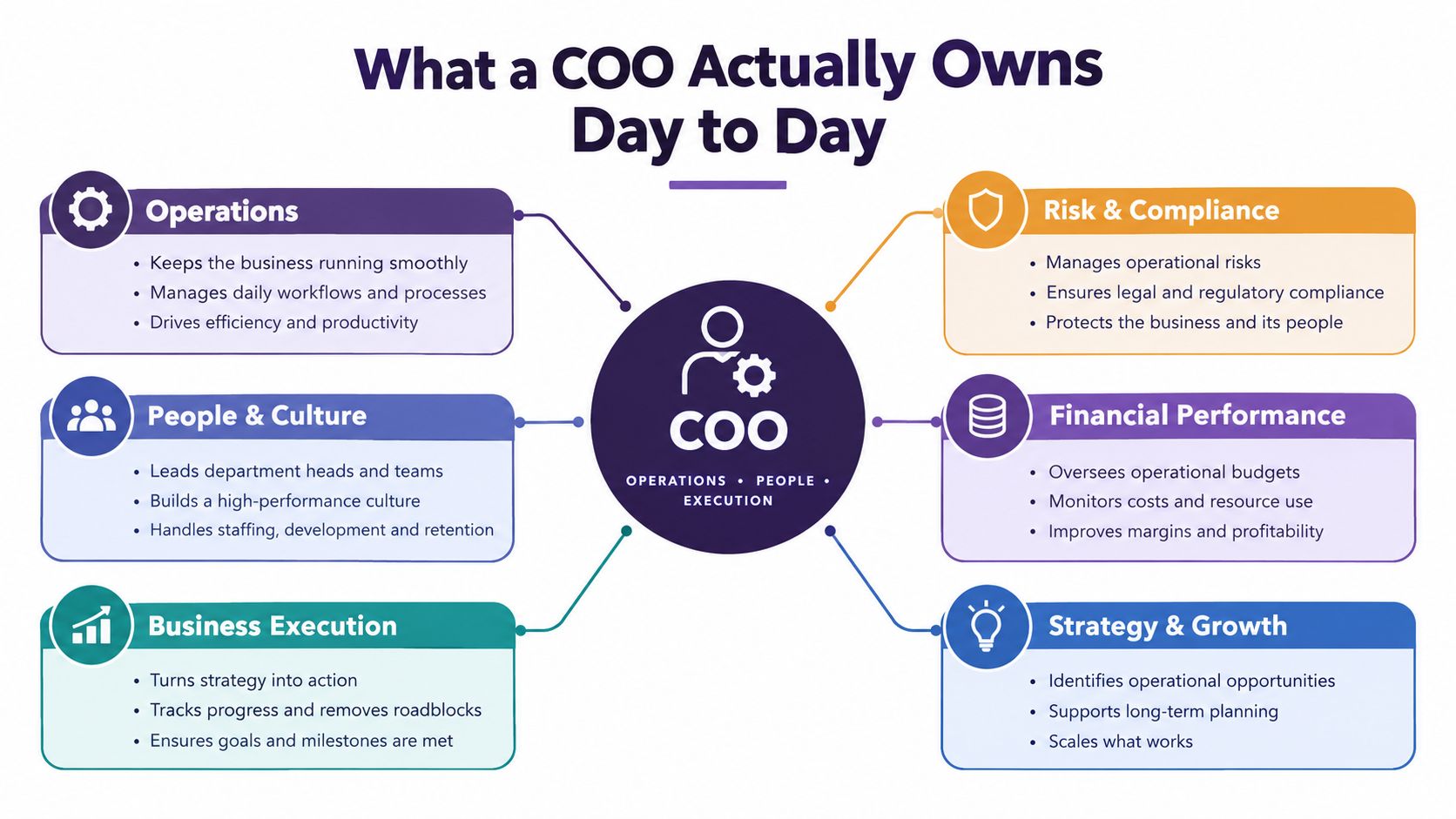
A COO isn't an office manager or an executive assistant. Those roles may improve logistics and administrative flow. The COO has authority over outcomes, often including operating priorities, organizational design, hiring plans, budgets, and performance expectations. The exact authority varies, but the position exists to make the business execute, not merely to keep the calendar tidy.
How a COO Differs from a CEO, CTO, and CFO
These four executives aren't steps on a ladder. They're different lenses on the same company. Confusion starts when leaders share accountability without writing down who has decision rights.
| Role | Primary Mandate | Key Metrics | Authority Scope | Common Conflict Zone |
|---|---|---|---|---|
| CEO | Company direction, external narrative, capital, and major relationships | Company performance, strategic progress, stakeholder confidence | Enterprise-wide direction and final decisions | Strategy versus execution capacity |
| COO | Internal execution, operating systems, coordination, and organizational performance | Delivery reliability, operating health, cross-functional progress | Day-to-day operations and execution mechanisms | Priorities that departments can't deliver together |
| CTO | Product technology, engineering, architecture, and technical quality | Product reliability, delivery quality, technical progress | Technical direction and engineering decisions | Engineering prioritization versus roadmap commitments |
| CFO | Financial planning, controls, cash management, and risk | Cash position, forecasts, margins, financial controls | Financial governance and resource discipline | Headcount and investment versus burn |
The CEO owns the why. They define the company's ambition, communicate the narrative externally, recruit senior leaders, and make choices that shape the market position.
The COO owns much of the how. They determine how priorities move through the organization, where accountability sits, and what operating rhythm keeps execution on track.
The CTO owns the technical system. They decide how the product is built, maintained, secured, and evolved. The COO shouldn't dictate architecture, just as the CTO shouldn't accept delivery commitments without discussing operational consequences.
The CFO owns the financial system. They provide the controls, forecasts, and financial context that determine what the company can responsibly fund. The COO then works with the CFO to convert resources into execution.
Two tension points deserve explicit attention. The first is CTO versus COO on engineering prioritization and roadmap delivery. The CTO may protect technical quality and platform stability, while the COO presses for commitments to customers or the board. The second is CFO versus COO on headcount and burn. The COO may see a leadership gap that threatens execution, while the CFO sees a cost that requires proof.
Overlap is healthy when scopes are written down. It becomes destructive when two executives believe they own the same decision and the founder has to referee every disagreement.
Why the COO Role Keeps Reshaping Itself
The COO is a contingent role, meaning its shape changes according to the operating context. An asset-heavy manufacturer may need a COO focused on production, supply chain, safety, and logistics. A SaaS company may need one focused on customer delivery, hiring systems, recurring revenue operations, and coordination between product and go-to-market teams.
The CEO's profile changes the role too. A visionary founder may need an internal integrator who turns broad direction into repeatable execution. An operator-CEO may keep more operational control and use a COO for a narrower mandate, such as international expansion, service delivery, or organizational transformation.
Stage matters. During a period of rapid scaling, the company may need someone to coordinate functions that previously worked through informal founder decisions. In a steadier business, the COO may manage complexity, succession, or a large operating portfolio.
McKinsey's discussion of why organizations have COOs describes the role as a counterweight to the external-facing CEO, with value that extends beyond daily operations into resilience and supporting employees. The role's prevalence has changed rather than followed a fixed pattern: 48% of Fortune 500 and S&P 500 companies had a COO in 2000, 32% did in 2018, and 40% of leading companies did by 2022. Financial and energy firms reached 48% in that later comparison. The referenced COO overview captures that variation.
| Industry | Firms With COO | Average Tenure | Reports To |
|---|---|---|---|
| Technology | Not established in the verified data | Not established in the verified data | Often CEO, structure varies |
| Manufacturing | Not established in the verified data | Not established in the verified data | Often CEO, structure varies |
| Services | Not established in the verified data | Not established in the verified data | Often CEO, structure varies |
The requested industry averages aren't available in the verified data, so they shouldn't be presented as facts. The important conclusion remains clear: there's no universal COO job description. Companies centralize or distribute operational authority according to complexity, leadership preferences, and the work that needs a single owner.
Core Responsibilities Every COO Touches
A COO may inherit different departments, but several responsibility patterns appear repeatedly. The weight shifts by stage. A young company may need planning discipline, while a larger one may need organizational design, controls, and coordination across multiple operating units.
Strategic planning translation
A board-approved annual plan is too broad to run a company by itself. The COO translates it into quarterly objectives, team commitments, weekly rituals, and decision points. The founder's handoff might be: “The board approved the direction. Turn it into a plan that leaders can review every week.”
Process and systems design
Process design becomes visible at the handoffs. Suppose sales closes a customer, but implementation receives incomplete information and support learns about the account only after launch. The COO maps the sales-to-onboarding workflow, defines the required information, assigns ownership, and creates an escalation path. The objective isn't bureaucracy. It's preventing the same avoidable failure from appearing in every new account.
For a practical breakdown of the position, see this guide to chief operating officer duties and responsibilities.
People and organizational structure
A flat startup structure can work while everyone knows every decision-maker. As the company grows, leaders need clearer spans of responsibility, reporting lines, hiring priorities, and escalation routes. The founder may tell the COO, “The team is now too large for informal coordination. Design the structure that preserves speed without keeping every decision with me.”
Performance and metrics
The COO often owns the operating cadence dashboard, not every departmental metric. That dashboard should show whether company priorities are moving, where dependencies are blocked, and which commitments need a decision. Finance may own the forecast, product may own roadmap measures, and sales may own pipeline, but the COO connects the signals to execution.
Cross-functional coordination
The COO is the person who asks whether the company can deliver what it has promised. That may involve coordinating product capacity with sales commitments, staffing with service demand, or finance assumptions with hiring plans. The role is less about personally performing each function and more about ensuring that the functions work as one operating system.
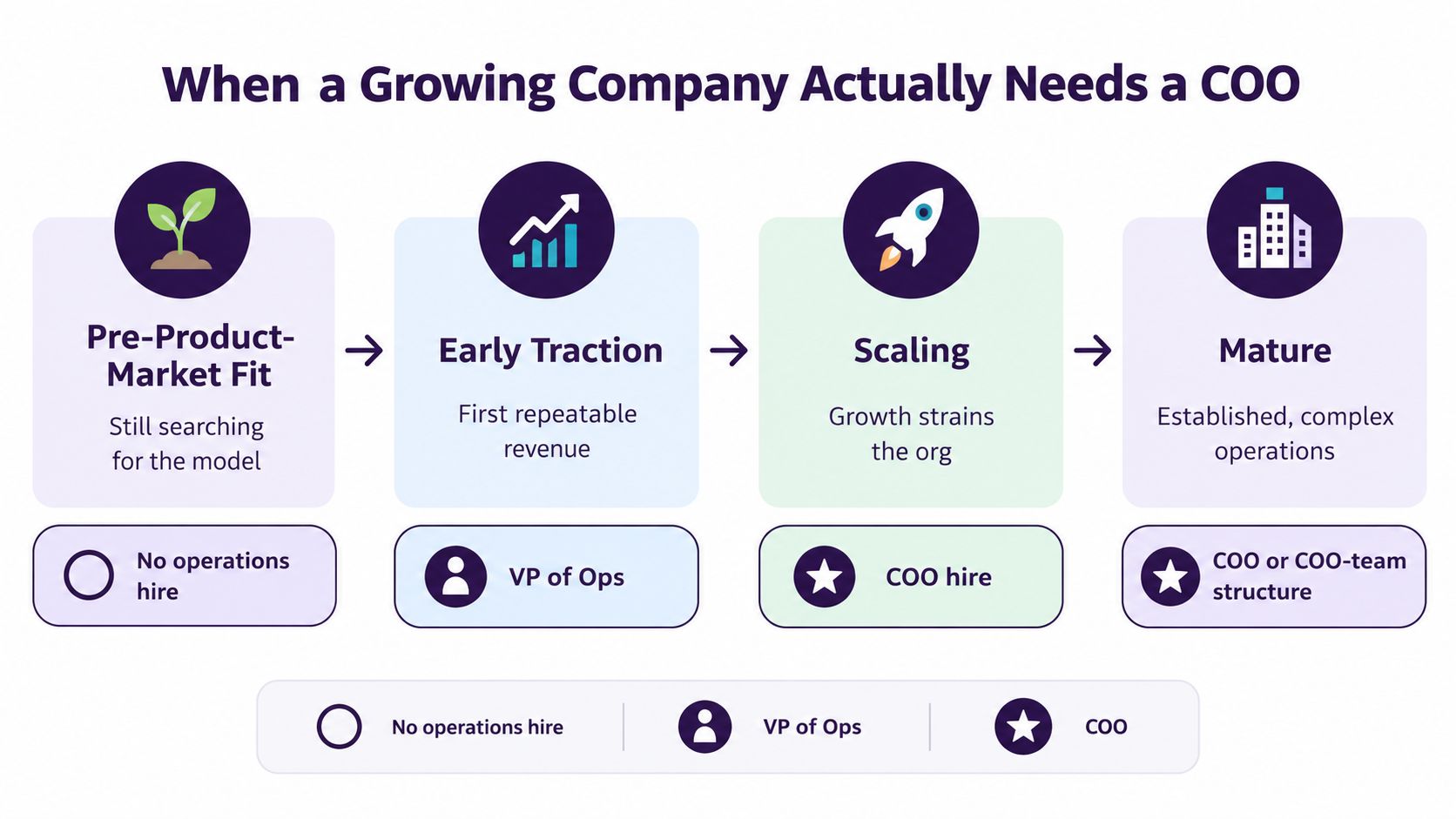
A COO shouldn't own every process just because the word “operations” appears in the title. The right question is, which recurring execution problems require enterprise-level authority and coordination? That answer should determine the scope.
When a Growing Company Actually Needs a COO
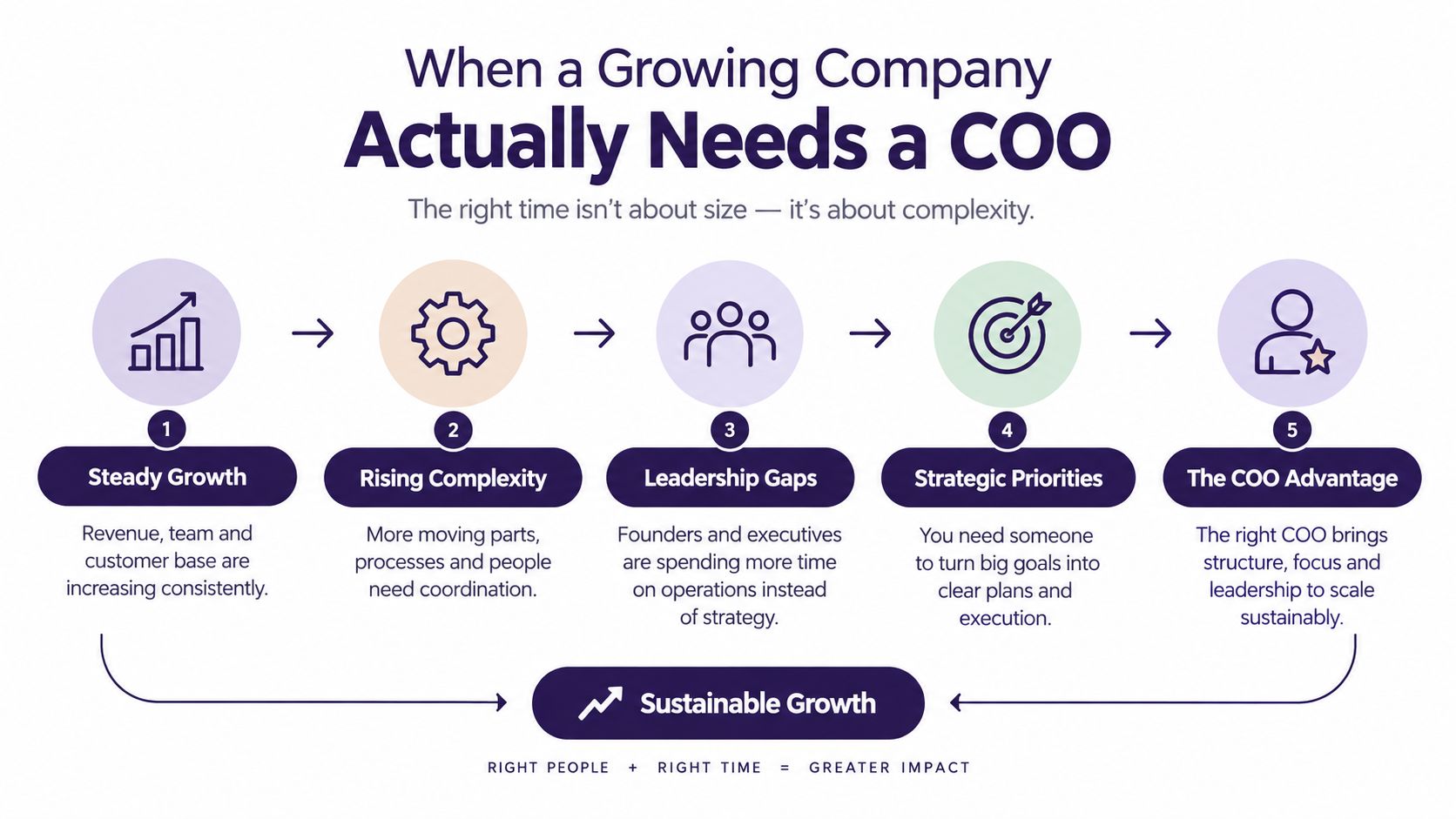
Not every startup needs a COO. Hiring one before the business has a repeatable model can add hierarchy before there's enough operating complexity to justify it.
Pre-product-market fit
At this stage, the founder is usually the chief experimenter and the chief operator. Customer discovery, product iteration, pricing, and distribution still change quickly. A full-time COO may formalize processes that the company needs to discard next month. The better choice is often no operations hire, with the founder retaining direct control until the operating pattern becomes clearer.
Early traction
Once the company has repeatable revenue, a strong operations leader, chief of staff, or VP of Operations may cover the gap. The handoff could be narrow: “Build a dependable onboarding process and give me a weekly view of customer delivery.” That creates operating discipline without immediately adding a company-wide executive layer.
Scaling
When growth strains the organization, the COO role becomes more valuable. The founder may hand over a problem such as, “Sales, product, and customer success are making locally sensible decisions that conflict with one another. Create one operating plan and establish who decides.” A COO can then remove bottlenecks, clarify accountability, and give the CEO back time for customers, capital, and strategy.
Mature operations
A mature company may add a COO when its complexity requires a central integrator, when the CEO needs a successor or counterpart, or when several operating units need coordinated leadership. The handoff might involve integrating acquisitions, standardizing performance management, or managing a broad service network.
The expensive mistake is treating the title as a growth milestone. A COO hired too early can create bloated reporting lines, premature process, and distance between the founder and the operating reality. Before hiring, identify the recurring problems, the decisions that need a single owner, and the authority the role would have.
Why a Fractional COO Often Beats a Full-Time One
A founder may know the company needs stronger operations but still be unsure whether that means hiring a permanent COO. A fractional COO offers senior operating support while the company is still defining the role, its authority, and the problems it must own. Learn what a fractional COO does and how the engagement is typically structured.
The financial case can be meaningful. One analysis of fractional leadership cost savings reports that UK SMEs may reduce costs by 40% to 60% compared with full-time executive roles, because they pay for the leadership capacity required rather than a complete package of salary, benefits, and overhead. Treat that range as an indication, not a guaranteed saving for every engagement. The analysis of fractional leadership cost savings explains the comparison.
Research on fractional executive speed and cost advantages makes a related argument. Fractional executives may contribute sooner because they avoid the longer onboarding process associated with permanent hires, and the research cites 50% to 80% lower cost than a full-time equivalent for comparable expertise. The figures come from different methods, so use them as directional context rather than a quote for your company. Research on fractional executive speed and cost advantages examines both points.
The bigger advantage is learning before committing. A fractional COO can assess the operating model, establish a working cadence, address one defined bottleneck, and show whether the company needs permanent executive ownership later.
| Dimension | Fractional COO | Full-Time COO |
|---|---|---|
| Cost | Pay for agreed leadership capacity | Fund a permanent executive package |
| Commitment | Flexible and scoped | Long-term employment commitment |
| Speed | Can begin with a defined operating problem | Requires recruiting, selection, and onboarding |
| Scope | Diagnostic, transformation, or targeted execution | Broad and continuous operating ownership |
The market also suggests that fractional executive work is becoming more established, although estimates vary. One 2026 projection places the global market at $5.7 billion, with a projected reach of $19 billion by 2033, while another source reports $9.4 billion in 2025. The 2026 market comparison presents both estimates and explains why methodology affects the totals.
Flexibility also limits the cost of a wrong decision. A hiring-cost analysis reports that a bad hire can cost an average of $17,000, with some cases reaching $240,000, or 30% to 150% of annual salary. The hiring-cost analysis gives that range. A fractional COO cannot remove hiring risk, but a defined engagement can reveal sooner whether the scope, working relationship, or timing is wrong.
Making the Right Call for Your Stage
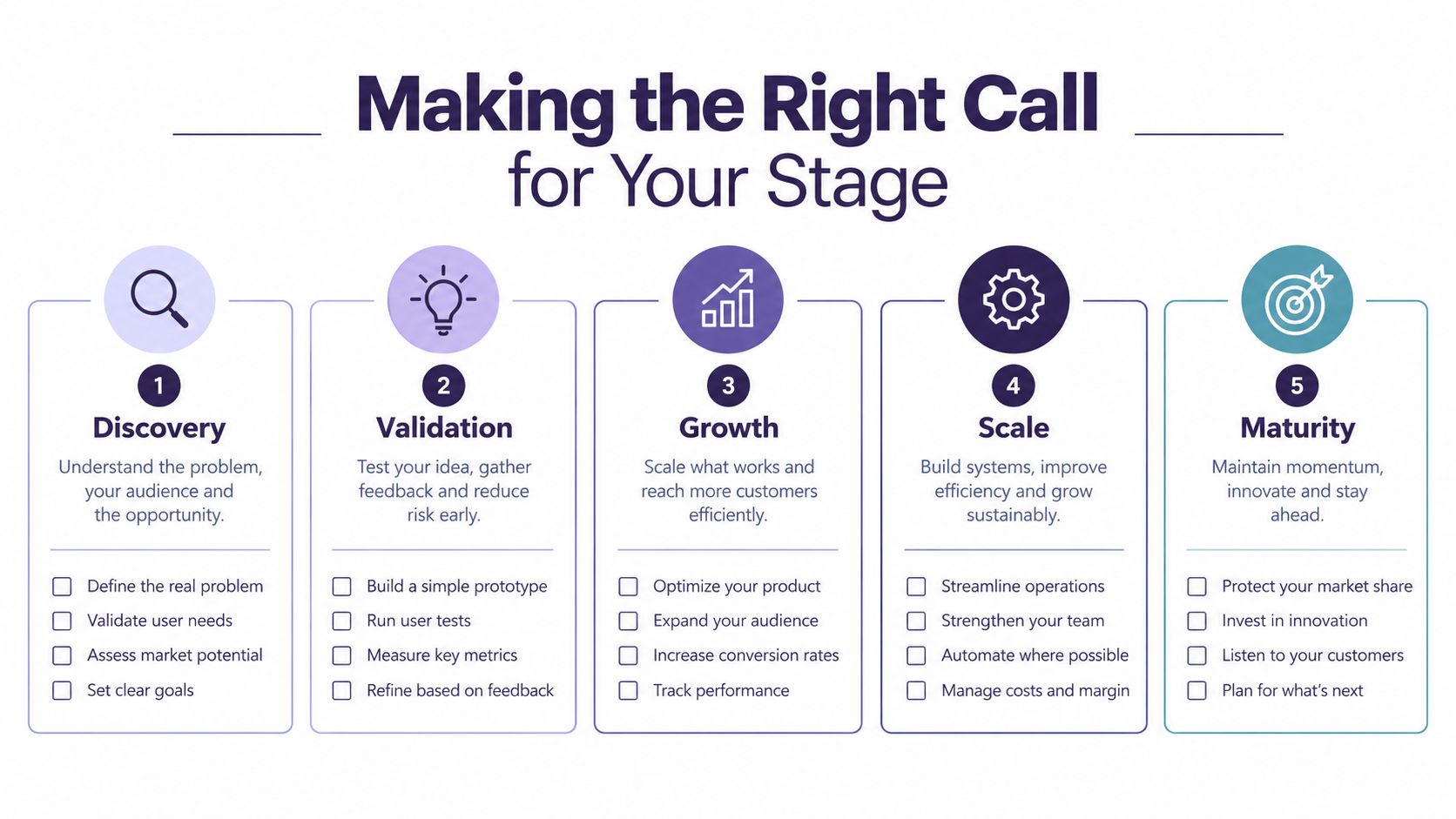
Use three questions to test whether the COO problem is real.
- Is the CEO losing 15 or more hours each week to internal coordination? If the founder spends that time chasing updates, resolving ownership disputes, and translating decisions, the company may need an operating integrator. The time threshold is a diagnostic prompt, not a universal hiring rule.
- Do cross-functional gaps appear in the metrics? Look for missed commitments, recurring handoff failures, inconsistent customer delivery, stalled hiring, or decisions that repeatedly return to the CEO.
- Is the complexity permanent or temporary? A restructuring, launch, integration, or turnaround may need executive operating support without justifying a permanent C-suite role.
If the answer is yes across all three, start with a fractional COO diagnostic. Define the operating problem, grant enough authority to solve it, and set clear measures for progress. If the scope stabilizes into a permanent need, you can then hire a full-time COO with better evidence about the mandate and the leadership profile.
The warning signs point the other way when the company is still searching for its model, the founder hasn't documented the actual problem, or the proposed COO would attend meetings without decision rights. A practical next step is a 30-day diagnostic sprint that maps the operating cadence, identifies bottlenecks, clarifies ownership, and recommends whether to hire, restructure, or wait.
For a deeper framework, use this guide to hiring a fractional COO for strategic success.
Shiny connects growing companies with vetted fractional executives, including COOs, for flexible engagements of 5 to 25 hours a week, supported by a marketplace of over 3,000 executives across industries. Visit Shiny to define your operating need, review matched executive candidates, and explore a lower-commitment path to stronger execution.