What Is CPG in Marketing: A Practical Guide for 2026
CPG marketing is the discipline of driving repeat demand for frequently repurchased consumer products across retail, digital, and omnichannel touchpoints. The global CPG market was estimated at USD 5,467.51 billion in 2024 and is projected to reach USD 7,799.43 billion by 2033, making it a distinct operating model rather than a small branch of generic marketing. (Polaris Market Research)
You may be in the familiar position of a founder whose product gets enthusiastic reactions online but moves slowly in stores. Your packaging looks good, early customers like the product, and an ad campaign generates attention. Then a retailer asks about velocity, promotional support, margin, and replenishment, and the marketing plan suddenly feels incomplete.
That gap explains what CPG marketing really is. It isn't only advertising food, beverages, toiletries, cosmetics, or household cleaners. It's the coordinated system that helps a shopper notice a product, choose it from a crowded shelf or digital listing, buy it, remember it, and buy it again. The difficult work sits between those moments, in retail execution, working capital, data integration, and leadership judgment.
What CPG Means in a Marketing Context
A shopper compares your snack with five similar packs, chooses one, and may decide differently next week. That everyday shelf moment captures the operating reality of CPG marketing. CPG means consumer packaged goods, products people consume or use up and replace regularly, such as toothpaste, coffee, shampoo, laundry detergent, and packaged beverages. Because these products are often affordable, widely distributed, and easy to substitute, the marketing system must win both attention and repeated preference.
The work follows a repeat-purchase loop:
- Create recognition. The shopper understands what the brand represents and recalls it during a buying occasion.
- Win consideration. Packaging, price, claims, reviews, and placement make the product seem right for that need.
- Convert at the point of purchase. The item is available and easy to find in a store, marketplace, or retailer app.
- Earn the next purchase. Product performance, value, availability, and the overall experience give the shopper a reason to return.
A useful analogy is a supermarket checkout: a brand must be visible on the shelf, convincing in the shopper's hand, available at payment, and good enough to make the next trip familiar. CPG marketing therefore combines broad awareness and retail activation at the same time. BCG describes the model through connected brand-building and commercial activities, including promotions, displays, and pricing. (BCG's CPG analysis)
Practical rule: If your product needs repeated replenishment, your marketing plan must explain both the first purchase and the next one.
Why the market's scale forces a velocity model
Market-size estimates can conflict because they count different parts of the category. Polaris Market Research sizes the global CPG market broadly at $5,467.51 billion in 2024, including packaged consumer goods across categories, and projects $7,799.43 billion by 2033, with a 4.1% CAGR from 2025 to 2033. (Polaris Market Research) A narrower outlook focused on food and beverage puts the market at about $3.45 trillion in 2025, rising to $4.24 trillion by 2030 at a 4.2% CAGR. These figures describe different scopes, so they should not be added or treated as contradictory readings of one identical market.
The scale still creates the same commercial pressure: brands compete through repeat buying, distribution, and availability, not through one isolated conversion. A low unit price leaves limited room for acquisition costs, so the business needs velocity, meaning enough units moving through each store, marketplace, and replenishment cycle.
Founders rarely hear the trade-off early. Marketing must win the shelf, the algorithm, and the repurchase loop while the company handles retailer fees, slotting charges, promotions, inventory commitments, and margin pressure. Creative work attracts demand, but operating decisions determine whether that demand becomes profitable repeat sales.
Start with the buying situation, not the channel list. A snack for school mornings needs different audiences, positioning, pack logic, and distribution from a premium evening treat, even when both products occupy the same aisle. A practical market segmentation framework connects those occasions to the people, messages, and channels most likely to produce trial and repurchase.
How CPG Differs from FMCG and Other Consumer Goods
Founders often use CPG, FMCG, and consumer goods as interchangeable labels. They overlap, but the labels signal different commercial realities.
Consumer goods is the broad family. It includes products bought by individuals or households, from packaged food to appliances. CPG, or consumer packaged goods, usually refers to packaged products that consumers use and replace regularly. FMCG, or fast-moving consumer goods, describes the faster-moving end of that group, where short consumption cycles, high turnover, and frequent shopping trips dominate.
Durable goods sit at the other end. A refrigerator, sofa, or washing machine lasts much longer and usually requires more research, a higher purchase commitment, dealer support, financing, installation, or service. The marketing system changes because the customer isn't making a habitual replenishment decision.
The labels imply different budgets
An FMCG brand might prioritize weekly store velocity, trade promotions, sampling, displays, and retailer execution. A premium CPG brand may put more weight on brand equity, packaging, education, storytelling, and selective distribution. A durable-goods company may focus on dealer networks, product demonstrations, reviews, and after-sales support.
The distinction doesn't create rigid boxes. A premium skincare product can move quickly, while a packaged food brand can be highly considered. The point is to identify the purchase behavior that determines the operating model.
| Category | Typical buying pattern | Marketing emphasis |
|---|---|---|
| Consumer goods | Broad household consumption | Category and customer demand |
| CPG | Packaged, used-up, and replaced | Brand memory, availability, and repeat |
| FMCG | Rapid turnover and frequent purchase | Velocity, trade activation, and replenishment |
| Durable goods | Longer replacement cycle | Research, dealers, service, and trust |
A sauce founder who calls the business FMCG signals that distribution depth, turnover, and trade planning are central. A founder selling a one-off gift set may technically use packaging, but the marketing problem is closer to seasonal or specialty retail than repeat CPG.
That vocabulary matters in retailer conversations, investor pitches, and executive hiring. Trade buyers want to know whether you understand shelf productivity. Investors want to know whether growth comes from repeat demand or temporary promotion. A fractional marketing or operations leader listens for the same distinction because it determines the first priorities, the right data, and the risks hidden in the plan.
The Core Marketing Mechanics Behind Every CPG Brand
A CPG marketing system works in layers. Treating channels as isolated line items creates confusion because each layer performs a different job in the path to purchase.
At the top, brand marketing creates memory and relevance. Advertising, social content, creators, public relations, partnerships, and experiential activity can associate a product with a need state, such as breakfast, recovery, cleaning, convenience, or self-care. The purpose isn't always to trigger an immediate transaction. It gives the shopper a reason to recognize the brand later.
The next layer is trade activation. Retailers decide where a product appears, how much inventory they hold, whether it receives a display, and when it gets promotional support. Slotting arrangements, feature pricing, end caps, retailer circulars, and sales-team relationships affect whether the shopper can find the SKU and whether the retailer has a reason to support it.
The digital shelf adds another layer. Product pages, reviews, retailer search, Amazon SEO, sponsored listings, retailer media networks, and availability information influence shoppers before and during the store decision. A brand can generate strong social engagement and still lose if its product page is weak, its pack claims are unclear, or the item is unavailable.
Connect discovery to replenishment
Shopper marketing connects the layers. A social campaign can introduce a use case, a retailer ad can reach someone searching the category, a shelf display can close the sale, and an email, loyalty offer, or DTC subscription can prompt replenishment. CRM is particularly useful when the brand can identify purchase timing without annoying the customer or discounting every order.
The difficult trade-off is that every channel draws from the same finite working capital. More awareness spend may leave less money for inventory. A large promotion may increase shipments while weakening margin. A retailer launch may look attractive until the brand accounts for production, freight, displays, sampling, and payment timing.
The right question isn't “Which channel should we add?” It's “Which constraint is stopping the next profitable purchase?”
Sequence matters. First establish a clear product promise and reliable supply. Then make the product easy to find, support the launch with focused demand generation, and measure whether trial turns into repeat. A small team usually learns more from a disciplined hero-SKU test than from spreading a thin budget across every available platform.
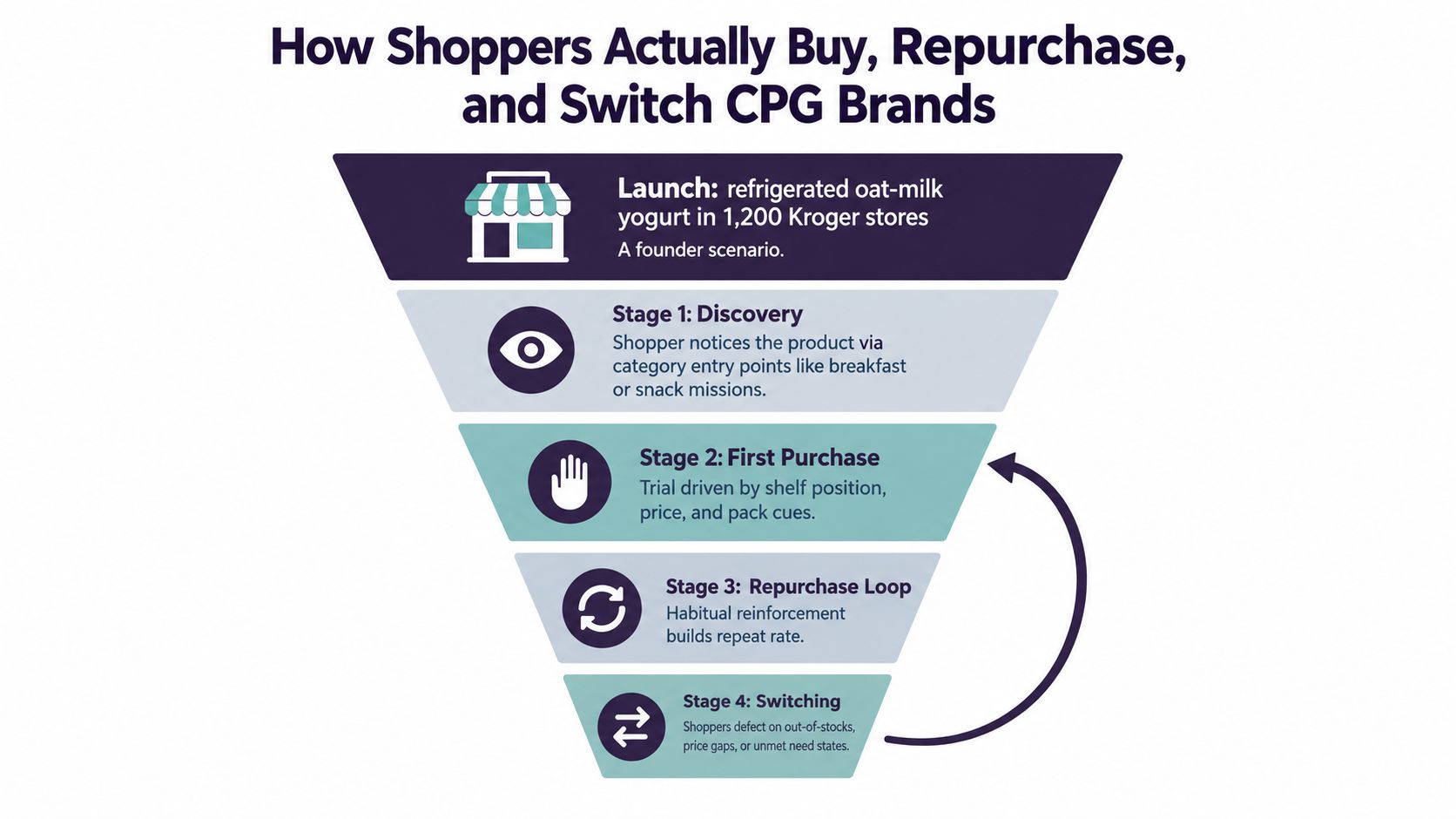
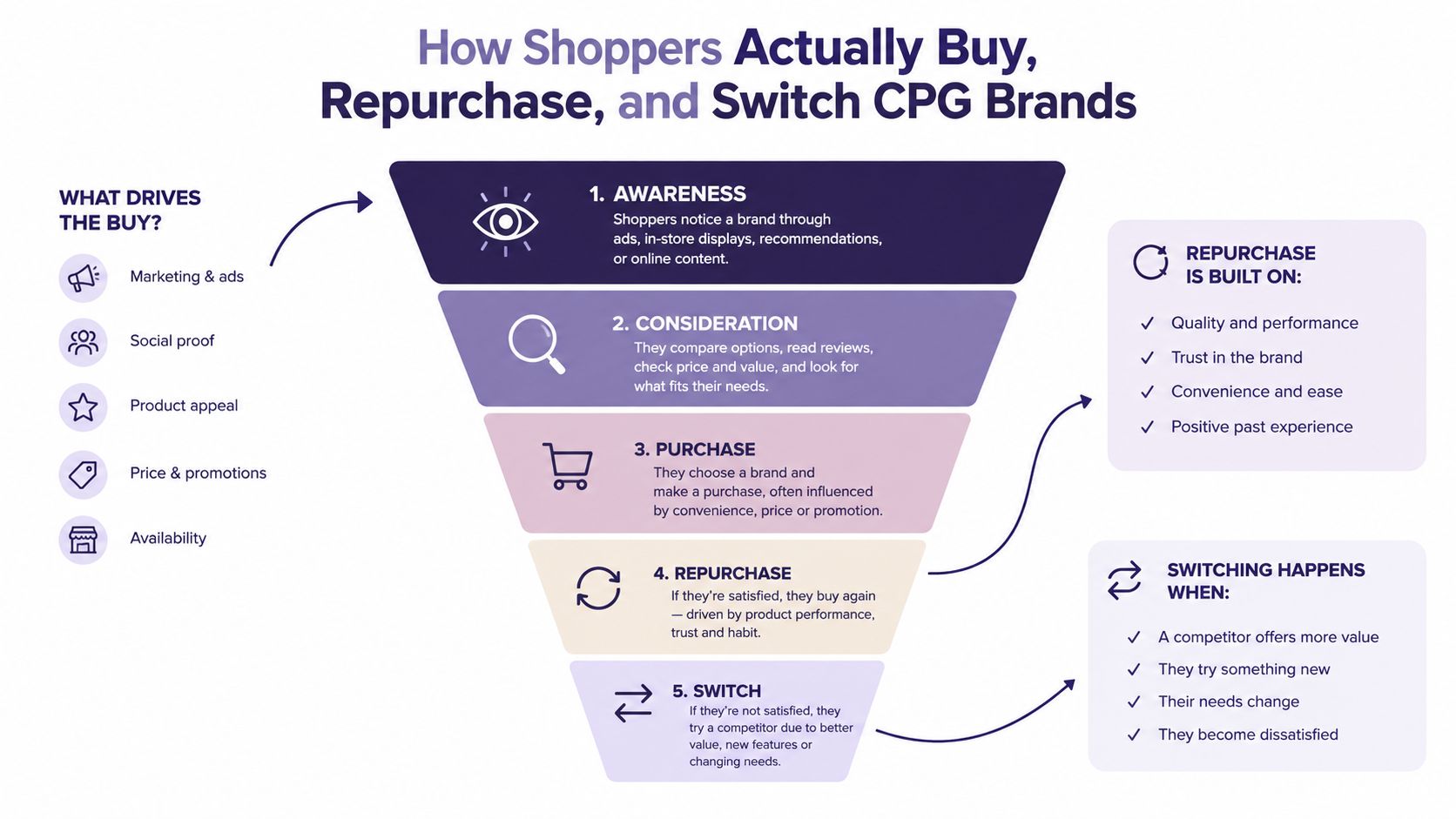
How Shoppers Actually Buy, Repurchase, and Switch CPG Brands
Consider a representative launch: a founder places refrigerated oat-milk yogurt in 1,200 Kroger stores. Distribution creates opportunity, not demand. The product now has to survive the shopper's rapid decision process, the retailer's replenishment expectations, and the founder's cash constraints.
The first challenge is discovery. A shopper may enter the category through a breakfast mission, a snack mission, a search for a dairy alternative, or a specific nutrition need. The brand needs recognizable packaging and a simple reason to belong in that moment.
Next comes first purchase. The shopper scans the shelf quickly, comparing price, pack size, flavor, claims, color, and familiarity. A product with a compelling story can still lose if its package doesn't communicate the benefit at a glance or if it sits outside the shopper's normal sightline.
Trial has to become habit
After trial, the product earns a place in the household routine. Flavor consistency matters because a disappointing second experience can erase the promise created by advertising. Packaging recognition matters because the shopper may need to find the product again without searching. Loyalty programs, subscriptions, recipes, replenishment reminders, and useful post-purchase content can reinforce the use case.
A loyal shopper won't necessarily switch because another product costs 10% less. That price gap can matter, but loyalty, availability, taste, convenience, and perceived value often shape the decision together. A stronger threat may be an out-of-stock, a confusing shelf reset, or a competitor that offers a more compelling answer to a new need.
New entrants can take share through novelty, stronger nutrition claims, better macros, a sharper package, or a louder shelf story. They don't need to replace the incumbent for every shopper. They only need to become the obvious choice for a meaningful use case and then deliver a satisfactory repeat experience.
Measure the loop, not the applause
A launch report filled with impressions and first orders can flatter a weak product. The operating question is whether stores sell through inventory, whether households return, and whether availability holds as distribution grows.
For the yogurt founder, useful questions include:
- Discovery: Which breakfast or snack situations generate qualified attention?
- Trial: Does the shelf position and pack architecture convert interest into purchase?
- Repeat: Do households buy the same SKU again without heavy discounting?
- Switching: Are out-of-stocks, price gaps, or unmet needs causing defection?
Marketing budgets should therefore give increasing weight to retail velocity and repurchase signals, not only one-time awareness lifts. Awareness fills the funnel, but repeat demand protects the shelf.
The CPG Lifecycle, Key Metrics, and the Role of Data and AI
A shopper picks up a new yogurt, compares the pack with familiar brands, and places it in the basket. Six weeks later, the same shopper either buys it again, chooses a competitor, or finds the shelf empty. Those moments mark different stages of the CPG lifecycle, and each stage requires a different operating question.
At concept and validation, the team tests the problem, target shopper, product promise, pack, price, and category entry point. Trial intent and qualitative feedback show whether shoppers understand the offer. Compliments are useful evidence, but they are not proof of demand. The stronger test is whether interest becomes a purchase and then a second purchase.
During launch and velocity, retail access and shelf movement take priority. ACV, or all-commodity volume distribution, indicates how broadly the product is available across retail. Velocity per point of distribution shows how efficiently it sells in the stores carrying it. A founder should ask whether the product moves well enough to justify its space, because distribution without sell-through can create inventory pressure and retailer resistance.
Scale and distribution bring a wider set of measures into view. Household penetration, repeat rate, category share, and channel-level economics show whether growth reflects adoption or temporary promotional support. At maturity and defense, the brand monitors switching, innovation response, price-pack architecture, and the strength of its repurchase base. The metric stack should change as the commercial job changes.
A focused metric stack
| Lifecycle Stage | Primary Marketing Goal | Leading Indicator | Lagging Indicator | Highest-Impact AI Use |
|---|---|---|---|---|
| Concept and validation | Prove the shopper problem and offer | Trial intent and product feedback | Early repeat evidence | Analyze research themes and test messages |
| Launch and velocity | Earn productive distribution | Velocity per point of distribution | Sustained retail sales | Forecast demand and flag inventory risk |
| Scale and distribution | Expand without losing efficiency | ACV and household penetration | Category share and repeat rate | Model assortment and regional expansion |
| Maturity and defense | Protect loyalty and margin | Switching and repurchase signals | Durable category share | Optimize promotion and creative variation |
The data plumbing behind these measures matters as much as the dashboard. POS and retailer full-basket data show what sold. Shopper panels add household-level repeat and demographic context. Loyalty-card and coupon-redemption data help connect exposure, trial, and purchase behavior. McKinsey's data and analytics guide describes combining these sources to distinguish trial from loyalty and improve assortment, promotion, and media decisions.
Retailer feeds, syndicated sources such as Circana and NielsenIQ, and Shopify cohorts can extend the view across stores and DTC. AI can assist with demand forecasting, assortment modeling, creative iteration, and trade-promotion decisions. It cannot repair disconnected definitions, missing records, or an unclear owner for each decision.
A useful operating cadence: Choose one north-star metric for the current lifecycle stage, review it weekly, and assign a named owner to every action.
McKinsey reports that scaled data-driven marketing can deliver 3% to 5% net sales growth and improve marketing efficiency by 10% to 20% when supported by an AI engine, a 360-degree consumer view, and a fit-for-purpose martech stack. (McKinsey's marketing model for CPG growth) The practical lesson is to connect identity, retail data, activation, and decisions before adding more software. That operating model is often easier for a lean team to run with focused senior guidance than with disconnected tools and dashboards.
Fractional Leadership as a CPG Growth Lever
A growth-stage CPG founder can reach a familiar shelf-shopping problem inside the company. One person is handling retailer meetings, agency briefs, trade calendars, inventory decisions, and fundraising, while the brand still needs senior judgment about what to prioritize. A full-time VP of Marketing or CMO may eventually fit, but hiring too early can fix a structure that is still changing.
A fractional leader offers a different arrangement. The executive works part time, often around one to two days per week for an early growth brand, sets a 90-day roadmap, and owns outcomes such as velocity, repeat rate, channel economics, or launch readiness. The work may cover retailer negotiations, agency oversight, trade planning, positioning, and executive reporting. Founders can learn more about the model in this guide to fractional leadership.
Full-time versus fractional
| Consideration | Full-time CPG executive | Fractional CPG executive |
|---|---|---|
| Cost structure | Higher fixed commitment | Variable senior support |
| Scope | Continuous internal ownership | Focused strategic and operating mandate |
| Speed to impact | Depends on hiring and onboarding | Can begin with a defined roadmap |
| Network | Built through the role | Pattern recognition from multiple categories |
| Best fit | Complex, late-stage, multi-retailer operations | Validation, launch, and growth-stage execution |
The trade-off is coverage. A fractional leader brings experience from multiple categories but cannot attend every Tuesday standup. The founder must provide a clear brief, make decisions promptly, and assign someone to execute between working sessions. That arrangement can reveal unclear ownership early, much like a shelf audit exposes missing price tags or weak placement.
Fractional leadership can reduce executive compensation by about 40% to 60% versus a full-time equivalent while avoiding equity dilution and severance risk, according to International Finance on fractional executives. The figures are not a universal CMO price list. Founders should compare scope, decision rights, time commitment, and expected outcomes rather than titles alone.
The right partner may be a marketing leader, operations executive, sales specialist, or temporary guide toward a full-time hire. Shiny provides a marketplace that connects businesses with fractional executives, including CMO roles, through vetted professionals and a structured matching process. Its model serves companies seeking experienced leadership without committing immediately to a full-time executive.
A Practical Go-to-Market Playbook for Lean CPG Teams
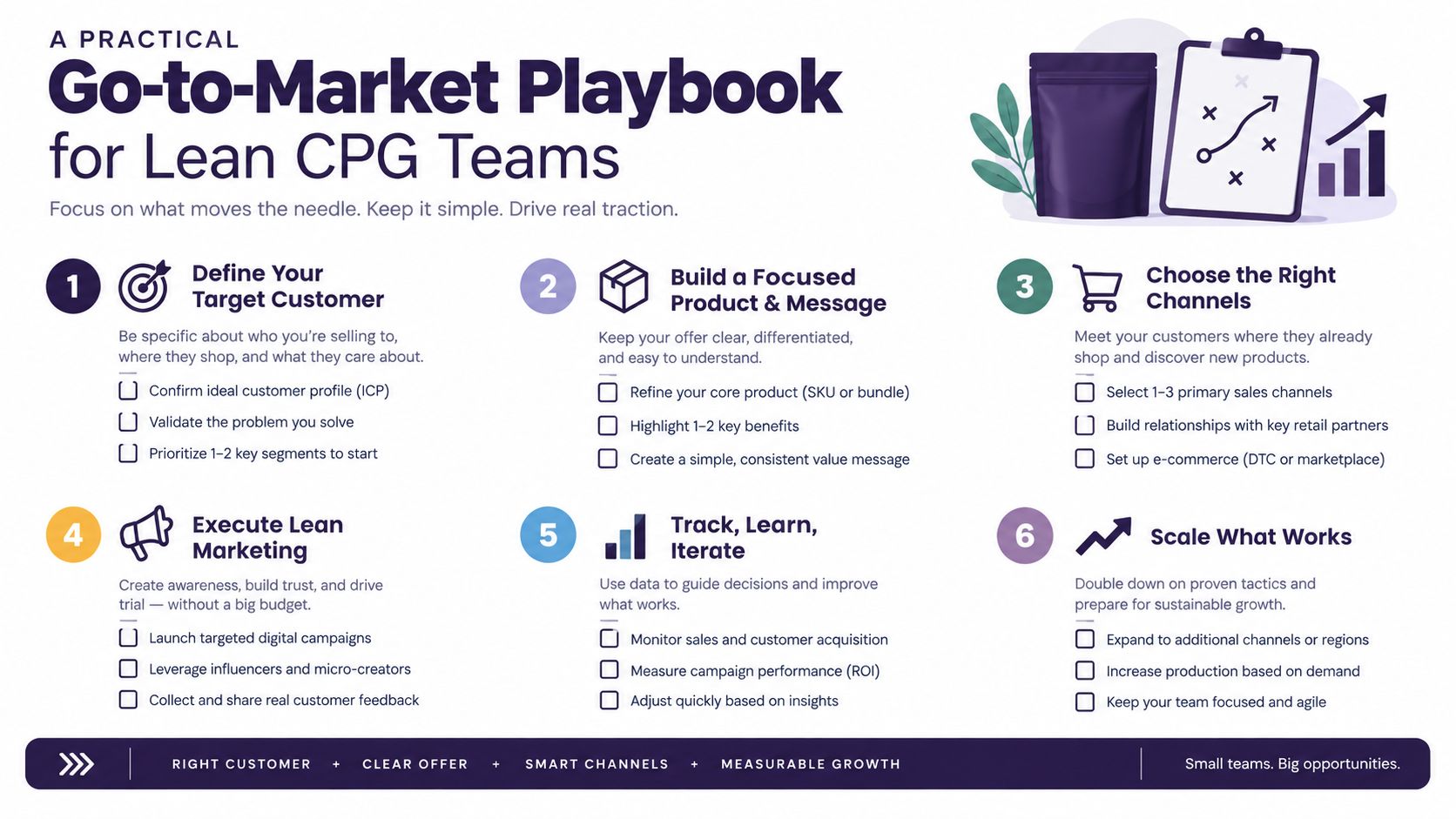
A lean CPG team doesn't need a longer channel list. It needs a sequence that protects cash and creates evidence.
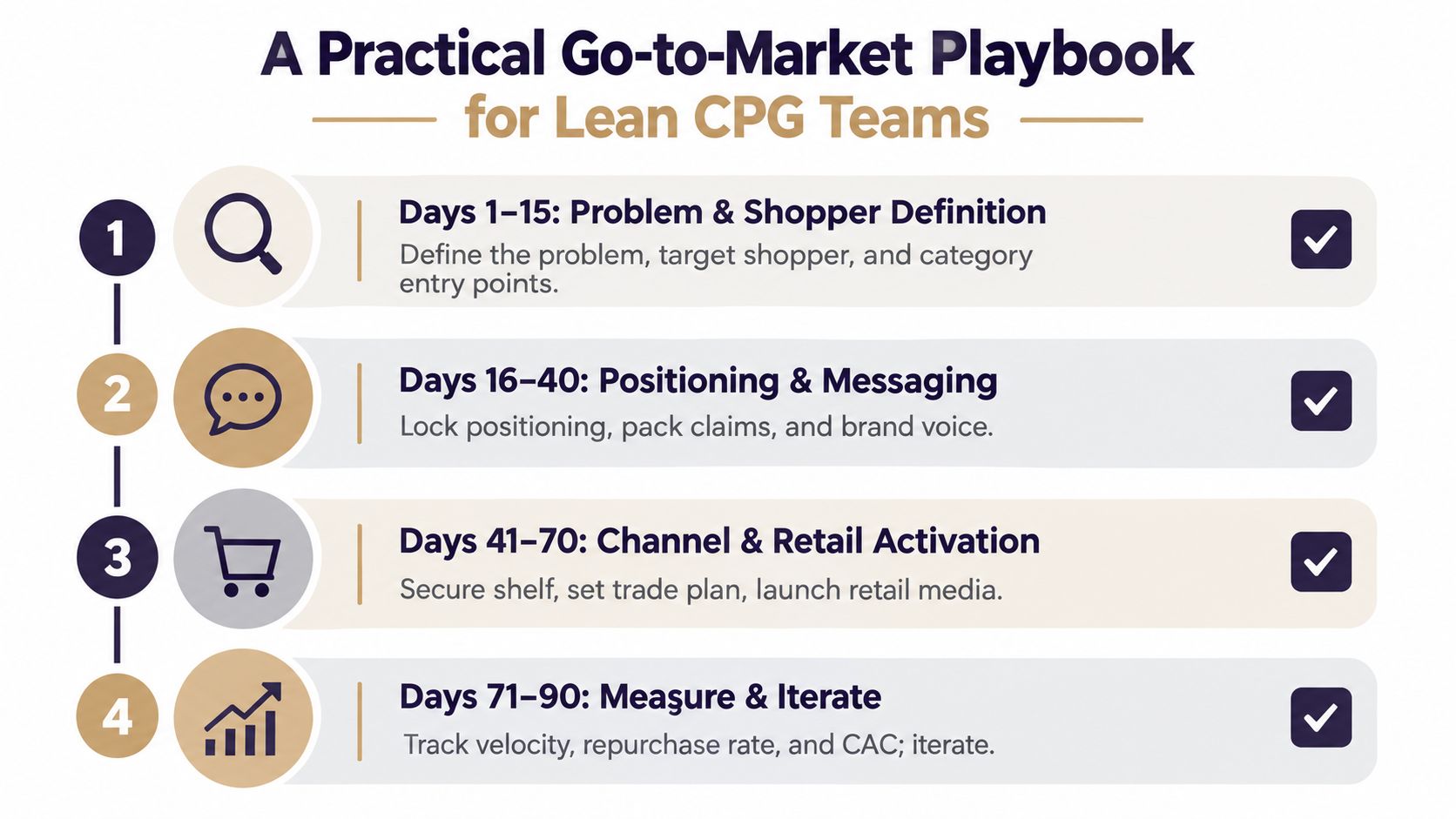
Days 1 to 15
Start with the problem and shopper definition. Identify the category entry points, the occasions that trigger purchase, and the reason a shopper would choose the product instead of a familiar alternative. Define one hero SKU before expanding the assortment.
Write down the product promise, pack claims, price architecture, and retail margin assumptions. If the packaging needs a paragraph to explain the product, fix the communication before buying media.
Days 16 to 40
Test positioning through sampling, founder-led selling, customer interviews, and focused creative. Sampling is valuable because it exposes the difference between stated interest and actual product experience. Use paid social only to test specific messages, audiences, and use cases, not to create the appearance of scale.
A regional retailer can provide a more useful learning environment than broad distribution. The founder can observe store execution, speak with buyers, inspect shelf placement, and connect feedback to velocity.
Days 41 to 70
Build the retail activation plan around availability and visibility. Confirm inventory, product content, retailer search terms, shelf placement, promotional timing, sampling support, and retailer media tests. Tie each activity to the hero SKU and a defined commercial question.
Bring in fractional support where the team lacks senior ownership. A fractional CMO can lead positioning and channel choices, while fractional operations or creative support can improve forecasting, retailer readiness, packaging, and execution.
Days 71 to 90
Review velocity, repurchase behavior, acquisition economics, stockouts, and retailer feedback every week. Stop activities that create attention without useful movement. Expand only when the evidence supports the next operational commitment.
Use the go-to-market strategy framework to keep the plan connected from customer problem through channel execution and measurement.
Before scaling into DSD, expanded distribution, or a national launch, confirm:
- Assortment: The hero SKU has a clear role and the pack architecture supports the buying mission.
- Velocity: Store movement justifies the shelf space and promotional support.
- Rebuy data: Repeat behavior provides evidence that growth can continue after trial.
- Operations: Supply, replenishment, retailer requirements, and working capital can support expansion.
- Leadership: A named executive owner can manage the next stage, whether fractional or full time.
If your CPG brand needs senior direction across positioning, retail activation, data, or repeat-purchase growth, Shiny can connect you with fractional executives who fit the stage and scope of the business. Explore the marketplace or schedule a consultation to define the leadership support your next retail milestone requires.