10 Powerful Business Model Innovation Examples to Drive Growth
In a market defined by rapid change, the difference between scaling and stagnating often comes down to one core element: your business model. Sticking with traditional structures can cap your potential, leaving you vulnerable to more agile competitors. An outdated model isn't just inefficient; it's a strategic liability that makes attracting investment, retaining key personnel, and responding to market shifts nearly impossible.
This is precisely why we've compiled this comprehensive list of business model innovation examples. We move beyond surface-level descriptions to provide a deep, strategic breakdown of how pioneering companies are rewriting the rules. For each example, you will find a clear analysis of how the model works, the specific business pain points it solves, and actionable insights you can apply.
We will explore 10 powerful models reshaping industries from SaaS and FinTech to Professional Services. Crucially, we will highlight the pivotal role visionary leadership plays in executing these transformations. For many small to mid-sized businesses, the key to unlocking this level of innovation isn't a full-time hire but the targeted expertise of a fractional executive. They bring the specific experience needed to guide complex change without the long-term cost. This article will equip you to re-evaluate your strategy and build a more resilient, growth-oriented business. Let's dive in.
1. Fractional Executive Model – Shiny's Marketplace Approach
The Fractional Executive Model fundamentally changes how businesses access top-tier leadership. Instead of a costly full-time hire, companies engage seasoned C-suite executives on a part-time, "fractional" basis, typically for 5-25 hours per week. This approach democratizes strategic expertise, making it accessible for startups, scale-ups, and SMBs that need senior guidance without the full-time financial commitment.
Shiny has pioneered a marketplace platform that perfects this model. It connects a vetted network of over 3,000 executives with companies needing specialized leadership. By using algorithmic matching and streamlined onboarding, the platform significantly reduces the friction and time associated with traditional executive searches, delivering strategic impact on demand.

Why It's a Top Business Model Innovation Example
This model thrives by aligning the modern needs of both companies and executives. Businesses gain immediate access to specialized skills for specific challenges, such as a fractional CMO for a go-to-market strategy or a fractional CFO to navigate a fundraising round. Executives, in turn, gain the flexibility to build a portfolio career, applying their expertise across multiple exciting companies. This symbiotic relationship creates a highly efficient market for strategic talent.
Actionable Insights
For businesses considering this innovative approach, success hinges on structure and clear expectations.
- Define Clear KPIs: Before engagement, outline specific, measurable deliverables and success metrics.
- Start Small: Test the fit with a 5-10 hour weekly contract before committing to a larger scope.
- Integrate Intentionally: Use a structured onboarding process to connect the fractional leader with your existing team and culture. For more guidance on this, you can learn about the fractional C-suite advantage in this strategic guide.
- Maintain Momentum: Schedule regular check-ins to ensure continuous alignment and progress toward goals. This model is ideal for companies needing rapid, targeted expertise to overcome growth plateaus or navigate complex projects.
2. Talent Marketplaces with AI-Powered Matching
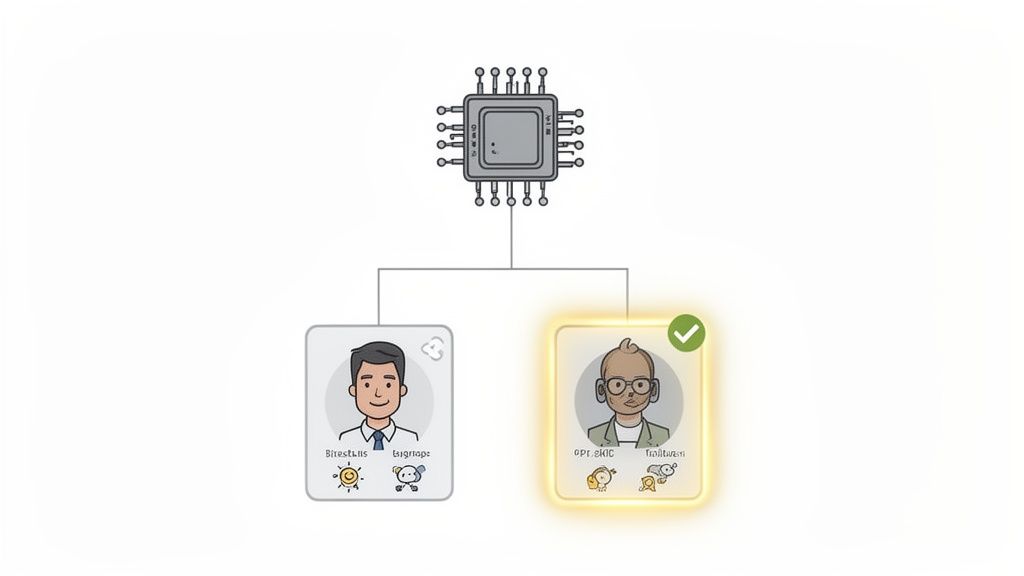
The traditional hiring process is often slow, biased, and inefficient. The AI-powered talent marketplace model disrupts this by using machine learning algorithms to connect companies with the ideal candidates. Instead of manual screening, AI analyzes vast datasets of skills, experience, and project success to provide highly accurate matches. This innovation drastically cuts down hiring timelines and improves placement quality.
Platforms like Upwork and HiredScore use this technology to move beyond simple keyword filtering. They create a dynamic ecosystem where companies can find specialized expertise on demand. For instance, Shiny's platform leverages AI to automatically match businesses with fractional executives, ensuring a precise fit for specific strategic needs, from fundraising to market expansion.
Why It's a Top Business Model Innovation Example
This model is a prime business model innovation example because it creates immense value by solving a core business pain point: finding the right talent quickly. For companies, it means faster access to a global talent pool with reduced risk of a bad hire. For skilled professionals, it provides direct access to opportunities that perfectly align with their expertise. The AI layer serves as a highly efficient and objective intermediary, fostering a more fluid market for skills.
Actionable Insights
For businesses looking to leverage AI-driven talent platforms, precision and process are key.
- Provide Detailed Inputs: The algorithm's effectiveness depends on the quality of your job specifications. Clearly define the role, key responsibilities, and success metrics.
- Maintain Human Oversight: Use AI recommendations to create a shortlist, but always conduct human interviews for the final decision.
- Give Feedback to the Algorithm: Regularly update the platform on which candidates were successful. This helps the AI learn and improve future matches for your company.
- Prioritize with AI Rankings: Use the algorithm's confidence scores to structure your interview process, starting with the most promising candidates to maximize efficiency.
3. Subscription-Based On-Demand Services Model
The Subscription-Based On-Demand Services Model transforms how businesses access expertise by shifting from one-off project fees to recurring revenue. Companies pay a predictable subscription for continuous, on-demand access to services or specialized talent. This approach fosters deeper client relationships and provides predictable revenue for the service provider.
Pioneered by SaaS giants like Salesforce, this model is now revolutionizing professional services. Instead of hiring a consultant for a single project, a business can subscribe to ongoing strategic guidance. This ensures the expert advice is consistently aligned with the company's evolving needs, turning transactional relationships into long-term strategic partnerships.
Why It's a Top Business Model Innovation Example
This model's power lies in its ability to create a win-win scenario. For clients, it offers budget predictability and consistent access to high-caliber talent without the overhead of a full-time hire. For service providers, it ensures a stable revenue stream and allows them to gain a much deeper understanding of their clients' businesses, leading to more impactful results. This continuous engagement is a key differentiator in a crowded market.
Actionable Insights
For companies looking to adopt a subscription model for services, success depends on clearly demonstrating ongoing value.
- Define Tiered Offerings: Create flexible subscription tiers (e.g., Basic, Pro, Enterprise) to match the needs and budgets of different client sizes.
- Establish Clear Value Metrics: Use quarterly business reviews (QBRs) and performance dashboards to track impact and prove the return on investment.
- Communicate ROI Upfront: Clearly outline the expected outcomes a client will receive from their subscription. For example, a fractional executive subscription should detail how it drives growth, efficiency, or strategic clarity.
- Build-in Usage Tracking: Implement systems to monitor service usage, ensuring clients are actively benefiting from their investment.
4. Network Effects and Marketplace Liquidity Model
The Network Effects and Marketplace Liquidity Model is a powerful innovation where a platform's value increases as more users join. In a two-sided marketplace, more participants on one side (e.g., supply) attract more participants on the other (e.g., demand), creating a self-reinforcing loop of growth. This dynamic, seen in platforms like Uber and Airbnb, builds a strong competitive moat.
Platforms like Shiny leverage this model by creating deep liquidity in the market for executive talent. As Shiny’s network grows to over 3,000 vetted executives (supply), it becomes an increasingly valuable resource for companies seeking specialized leadership (demand). This density of high-quality talent attracts more businesses, which in turn makes the platform more attractive for top-tier executives.
Why It's a Top Business Model Innovation Example
This model's brilliance lies in its ability to create a virtuous cycle that generates immense value for all participants. For businesses, a liquid marketplace means faster access to a wider pool of vetted, high-caliber talent. For executives, it means a steady stream of compelling opportunities. The platform itself becomes more valuable and defensible with each new participant, creating a powerful blueprint for scalable growth.
Actionable Insights
Building a successful two-sided marketplace requires a deliberate strategy to solve the "chicken-and-egg" problem.
- Seed One Side First: Focus initial efforts on building a critical mass of high-quality supply. For instance, directly recruit and vet top-tier executives before launching to businesses.
- Hyper-Focus Your Niche: Start within a specific industry to build initial density and prove the model before expanding.
- Incentivize Early Adopters: Offer referral bonuses or reduced fees to the first users on both sides of the marketplace to spark initial momentum.
- Maintain Quality Control: Implement a rigorous vetting and review system. The long-term value of your network is directly tied to the quality of its participants.
5. Flexible Labor Model – Rise of the Portfolio Career
The Flexible Labor Model marks a significant shift away from traditional, single-employer careers. In this model, highly skilled professionals build "portfolio careers" by maintaining concurrent engagements with multiple clients. This approach allows seasoned experts to diversify their impact and income while granting companies on-demand access to premium talent without the overhead of a full-time hire.
This innovation is driven by a workforce that increasingly values autonomy and varied challenges. For example, a veteran CTO might advise several FinTech startups, or a CMO could manage go-to-market strategies for a portfolio of SaaS companies. This model creates a dynamic, efficient marketplace for specialized expertise.
Why It's a Top Business Model Innovation Example
This model creates a powerful win-win scenario. Businesses can tap into an elite talent pool for specific strategic needs, gaining C-suite-level guidance precisely when it's needed most and avoiding a long, costly executive search.
For professionals, it offers an escape from the constraints of a single role. They gain autonomy, financial diversification, and the intellectual stimulation of solving diverse business challenges. This symbiotic relationship fosters a more agile and resilient workforce.
Actionable Insights
To successfully leverage the portfolio career model, companies must prioritize clarity and structure.
- Define Clear Commitments: Explicitly outline time commitments, availability expectations, and key deliverables before the engagement begins.
- Establish Communication Cadence: Use asynchronous tools and schedule predictable meeting windows to accommodate multiple client schedules.
- Build Efficient Processes: Develop strong internal processes and onboarding to maximize the value delivered during limited engagement hours. If you're exploring how to best integrate this talent, you can find more insights on flexible staffing solutions in this guide.
- Manage Potential Conflicts: Implement non-compete clauses where appropriate and maintain open communication to navigate any competing client priorities.
6. Industry-Specialization Strategy – Vertical Focus Model
The Industry-Specialization Strategy, or Vertical Focus Model, shifts a company from a generalist "serve-all" approach to a specialist one. Instead of casting a wide net, businesses concentrate their expertise on specific industries or "verticals" like SaaS, FinTech, or HealthTech. This deep specialization creates a powerful competitive advantage.
Companies employing this model develop a nuanced grasp of the industry's unique challenges, regulatory landscapes, and success metrics. This allows them to tailor their products, services, and talent solutions with precision. For instance, a firm specializing in HealthTech understands HIPAA compliance, making its offerings inherently more valuable to clients in that space.
Why It's a Top Business Model Innovation Example
This model is a prime example of business model innovation because it trades breadth for depth, creating a moat of expertise that generalists cannot easily cross. This focus builds trust, shortens sales cycles, and often commands premium pricing due to the specialized value provided.
In the executive services space, verticalization ensures a far better match. An executive with a deep background in AI can provide immediate, relevant strategic guidance to an AI startup, bypassing the steep learning curve a generalist would face.
Actionable Insights
For companies seeking to leverage a vertical focus, success depends on commitment and authentic expertise.
- Select Verticals Strategically: Choose industries with sufficient market size and a clear need for specialized solutions.
- Build Authentic Expertise: Invest in training, hire industry veterans, or partner with established experts. Your team must speak the language of the vertical fluently.
- Tailor Your Marketing: Create industry-specific case studies and marketing campaigns that address the unique pain points of each vertical.
- Customize Your Offerings: Adapt your services or products to solve the specific challenges of each vertical. A one-size-fits-all approach undermines the entire strategy.
7. Asynchronous-First Work Model for Distributed Teams
The Asynchronous-First Work Model prioritizes communication that doesn't require an immediate response. Instead of relying on real-time meetings, teams collaborate through written documentation, project management tools, and recorded videos. This approach decouples productivity from presence, allowing individuals in different time zones to contribute effectively.
Companies like GitLab and Automattic have pioneered this model, building global workforces that operate with extreme efficiency. For fractional executives managing multiple clients, this model is a game-changer, enabling them to deliver high-impact strategic work without being constrained by conflicting calendars.
Why It's a Top Business Model Innovation Example
This model directly addresses the logistical challenges of a distributed global talent pool. It allows companies to hire the best person for the job, regardless of their location. For businesses engaging fractional talent, it ensures limited weekly hours are spent on high-value execution, not just on back-to-back meetings. This system maximizes both talent access and individual productivity.
Actionable Insights
For companies transitioning to an async-first culture, success depends on deliberate process and tooling.
- Establish Clear Norms: Define and document expectations for communication channels and response times (e.g., use a project tool for tasks, with a 24-hour response window).
- Invest in a Single Source of Truth: Use tools like Notion or Asana to centralize project information, decisions, and context.
- Record and Document: Make it a habit to record key meetings and summarize decisions in writing. This ensures a part-time fractional executive stays fully informed.
- Prioritize Outcomes Over Activity: Shift performance management to focus on deliverables and achieved goals rather than hours spent online.
8. Risk Reversal and Performance-Based Pricing Model
The Risk Reversal and Performance-Based Pricing Model shifts payment from effort-based to outcome-based. In this structure, compensation is partially or entirely contingent on achieving pre-defined, measurable results. This model dramatically aligns the incentives of the service provider and the client, as both parties share in the success.
This model is prominent in contingent recruiting firms, where payment is only due upon a successful hire. Similarly, some consulting firms structure contracts with a base fee plus a bonus tied directly to specific performance metrics like revenue growth or cost savings. This risk-sharing approach builds immediate trust.
Why It's a Top Business Model Innovation Example
This model is a powerful innovation because it directly addresses the client's core fear: paying for services that don't deliver results. By tying compensation to performance, providers demonstrate ultimate confidence in their ability to create value. It transforms a standard vendor relationship into a true partnership, where both sides are invested in achieving the same goal.
Actionable Insights
For companies looking to leverage this model, clear and transparent goal-setting is the foundation for success.
- Define Measurable KPIs: Before starting, establish specific, quantifiable outcomes. This could be lead generation targets for a fractional CMO or capital raised for a fractional CFO.
- Establish a Baseline: Measure the "before" state to accurately track the "after" impact delivered.
- Create Tiered Structures: Implement a hybrid model, such as a 50% base retainer and 50% performance bonus, to balance security with incentive.
- Include Protection Clauses: Outline how external market factors will be handled to ensure fairness.
- Maintain Transparency: Schedule regular performance reviews to track progress against KPIs and maintain alignment.
9. Knowledge Transfer and Capability Building Model
This model reframes the role of an external leader from a temporary executor to a long-term value creator. Instead of just delivering on tasks, the executive's primary goal is to build sustainable, in-house capabilities. They actively mentor internal teams, document critical processes, and create playbooks, effectively transferring their expertise to the permanent staff.
For example, a fractional CTO is hired not just to manage a product launch, but to establish a durable engineering culture and mentor a junior developer into a future team lead. The executive’s success is measured by how well the company functions after their engagement ends.
Why It's a Top Business Model Innovation Example
This model creates a powerful win-win scenario that deepens the client relationship. The client doesn't just rent an expert; they invest in upskilling their entire team and building institutional knowledge. This creates immense long-term value, making the service more impactful than traditional consulting. For the provider, it establishes a reputation as a true strategic partner, not just a temporary fix.
Actionable Insights
To successfully implement this model, the focus must be on deliberate knowledge transfer from day one.
- Define Transfer Goals: Explicitly include capability-building objectives and knowledge transfer milestones in the engagement agreement.
- Dedicate Mentorship Time: Schedule specific, recurring sessions for training, coaching, and mentoring internal team members.
- Mandate Documentation: Require the executive to create and hand off comprehensive playbooks, process documents, and decision-making frameworks.
- Develop Internal Successors: Identify high-potential employees early and create a structured plan to prepare them to take over the function. For practical steps, you can explore this guide on building a leadership development framework for your organization.
10. Data-Driven Talent Prediction and Success Scoring Model
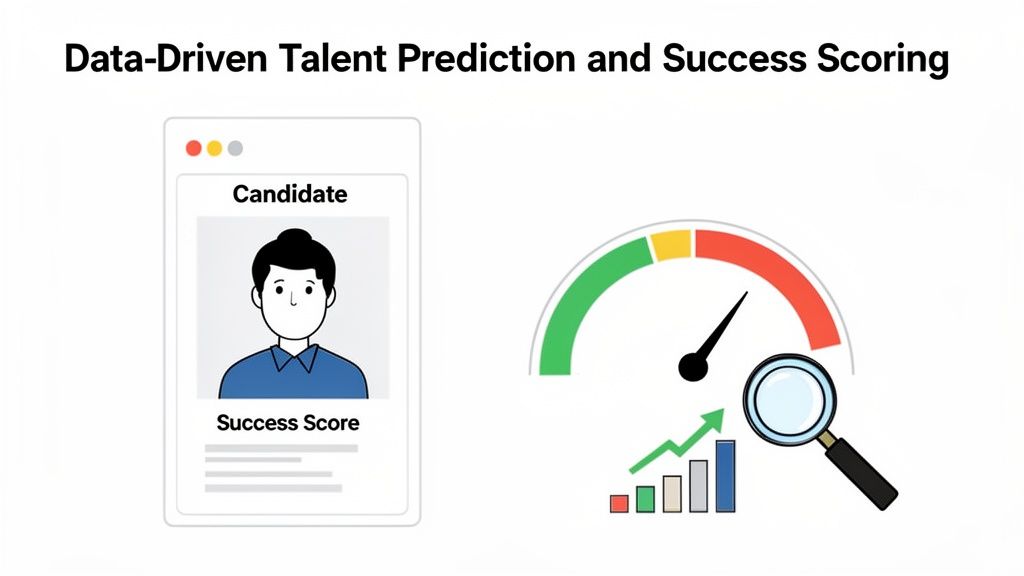
The Data-Driven Talent Prediction model moves beyond traditional resume matching by using machine learning to forecast the success of a potential hire. This innovation leverages historical performance data from thousands of past placements to identify the specific characteristics and skills that correlate with successful outcomes. By analyzing this data, platforms can generate a "success score" that predicts the likelihood of a strong fit.
Platforms like Shiny are integrating this model to de-risk executive placements. As more data is accumulated on which fractional executives drive measurable results in specific company environments, the predictive algorithms become increasingly accurate. This transforms recruitment from a subjective art into a predictive science.
Why It's a Top Business Model Innovation Example
This model creates a powerful competitive advantage through a self-reinforcing data loop. Every successful placement enriches the dataset, which in turn improves the accuracy of future predictions. This significantly reduces the risk of failed hires, saving companies time and money. For businesses, this means gaining higher confidence in their leadership choices.
Actionable Insights
For companies seeking to leverage predictive insights in their hiring, a focus on data and feedback is crucial.
- Track Comprehensive Data: From day one of an engagement, track not just task completion but the executive's actual impact on key business metrics.
- Build Feedback Loops: Implement a structured process for gathering performance feedback from both the client and the executive to refine success criteria.
- Prioritize Transparency: When using a platform with success scoring, ask for clarity on the data points used to generate the prediction to build trust.
- Continuously Refine Models: Work with partners who continuously update their predictive algorithms with new placement data to ensure ongoing accuracy.
10-Point Business Model Innovation Comparison
| Model | 🔄 Implementation Complexity | ⚡ Resource Requirements | 📊 Expected Outcomes | 💡 Ideal Use Cases | ⭐ Key Advantages |
|---|---|---|---|---|---|
| Fractional Executive Model – Shiny's Marketplace Approach | Moderate — build marketplace, vetting & onboarding flows | Platform engineering, vetting team, network sourcing (moderate) | Rapid access to C-suite talent; 40–60% cost reduction vs full‑time | Capital‑constrained startups needing part‑time senior leadership | Cost‑effective senior access; flexible scaling; diverse expertise |
| Talent Marketplaces with AI‑Powered Matching | High — ML models, continuous training and validation | Significant data engineering, compute, labeled outcomes (high) | 50–70% faster hires; improved match accuracy and engagement rates | High‑volume hiring or platforms needing scalable matching | Data‑driven, faster placements; reduced manual screening; scalable |
| Subscription‑Based On‑Demand Services Model | Moderate — billing, SLAs, tiering and retention systems | Customer success, predictable staffing, billing infra (moderate) | Predictable recurring revenue; stronger retention and LTV | Ongoing advisory needs where predictability matters | Recurring revenue; deeper client relationships; easier upsell |
| Network Effects & Marketplace Liquidity Model | High — two‑sided growth, bootstrapping critical mass | Heavy marketing, incentives, vetting to reach scale (high) | Exponential growth potential and strong moat at scale | Platforms aiming for category leadership and scale | Winner‑take‑most dynamics; high switching costs; data advantages |
| Flexible Labor Model — Portfolio Career | Low–Moderate — contracts, scheduling and conflict policies | Relationship management, flexible scheduling (low) | Access to experienced talent at lower cost; diverse expertise | Firms wanting part‑time senior advisors; executives seeking portfolios | Talent attraction; cost savings; flexibility for both parties |
| Industry‑Specialization Strategy — Vertical Focus | Moderate — develop domain expertise and tailored processes | Industry specialists, targeted marketing, vertical playbooks | Higher placement success; premium pricing within verticals | Verticals with concentrated startups (SaaS, FinTech, HealthTech) | Better match relevance; stronger brand authority; pricing power |
| Asynchronous‑First Work Model for Distributed Teams | Low–Moderate — establish norms, tooling and documentation | Collaboration tools, documentation, training (low) | Greater productivity in limited hours; persistent decision records | Distributed fractional teams across time zones | Efficient use of limited sync time; permanent context and transparency |
| Risk Reversal & Performance‑Based Pricing Model | High — KPI definition, legal and payment complexity | Measurement systems, contract management, financial reserves (high) | Higher conversion; aligned incentives; revenue volatility | Outcome‑measurable engagements (sales, KPIs, milestones) | Builds client trust; drives accountability; differentiates offering |
| Knowledge Transfer & Capability Building Model | Moderate — structured mentoring, playbooks and measurement | Time allocation for training, documentation, success metrics | Stronger internal capability; reduced long‑term dependency | Companies planning to internalize functions after growth | Multiplies impact; smoother succession; long‑term value creation |
| Data‑Driven Talent Prediction & Success Scoring Model | High — large datasets, predictive modeling, privacy controls | Data engineers, ML scientists, long‑term data collection (high) | Improved placement success rates; defensible data moat over time | Mature platforms with historical placement data | Predictive accuracy; competitive advantage; transparent scoring |
Your Next Step: Turning Innovation into Impact
The journey through these business model innovation examples reveals a powerful truth: strategic reinvention is essential for growth. The most successful companies don't just sell a better product; they build a better system for creating and delivering value.
These are not just stories of corporate giants. They are blueprints. The core principles behind a fractional marketplace, performance-based pricing, and asynchronous work are adaptable. They offer a clear path for small and mid-sized businesses to achieve disproportionate impact by challenging industry norms.
As you reflect on these examples, several key themes emerge:
- Value Proposition Reimagined: True innovation starts by questioning how you deliver value, not just what you deliver.
- Alignment of Incentives: The most resilient models succeed because they align the company's financial success directly with the customer's desired outcome.
- Operational Agility: Modern business models, particularly those leveraging fractional talent, are built for flexibility, allowing companies to scale resources without rigid, costly structures.
- Data as a Strategic Asset: Leading innovators use data not just for reporting, but as a core component of their value delivery system.
The gap between a brilliant idea and a successfully executed new model is bridged by experienced leadership. This is where many ambitious businesses falter; they have the vision but lack the specific executive-level expertise to navigate the complexities of transformation.
This is precisely where the fractional leadership model becomes a strategic game-changer. You don’t need a full-time, seven-figure C-suite to execute a world-class strategy. Instead, you can engage a seasoned fractional executive who has already guided other companies through the exact challenges you face. They bring the playbook, mitigate the risks, and drive implementation with the urgency and precision required to win.
Ready to bridge the gap between your vision and its execution? Shiny connects you with a curated network of elite, vetted fractional executives who specialize in driving business model innovation. Schedule a consultation to find the perfect leader to help you build, launch, and scale your company’s next chapter at Shiny.