
What Is a Chief Sales Officer and Why Your Startup Needs One
What exactly is a Chief Sales Officer (CSO)?
A CSO is the strategic mind behind your company's entire sales engine. They don't just manage salespeople; they design the systems, shape the culture, and build the long-term strategy that leads to predictable, scalable growth. Think of them as the chief architect of your revenue machine.
This isn't just a sales manager with a fancier title. A true CSO operates at the executive level, ensuring the entire sales function is built on a rock-solid foundation that can support your company's ambitions.
The Architect of Your Company's Revenue Engine

Imagine your sales team as a high-performance race car. Your reps are the skilled drivers, navigating the twists and turns of daily deals. But who designs the engine, maps the most efficient route around the track, and analyzes every lap to make sure you win?
That’s the Chief Sales Officer.
This is the leader who steps back from the immediate pressure of daily quotas. Their focus is on building the durable infrastructure needed for long-term, predictable growth, turning sales from an art form into a science.
Moving from Player to Coach
For many founders, early sales success comes from sheer personal hustle. You wear the sales hat, close deals yourself, and lead by example. While that works for a while, this approach has a ceiling. A business can't truly scale when its entire sales motion depends on one person's efforts.
A Chief Sales Officer guides this crucial shift. They take what works—that founder magic—and codify it into a repeatable, scalable playbook that anyone on the team can execute. Their primary contributions fall into a few key areas:
- Building Scalable Systems: They design the sales processes, methodologies, and tech stack (like your CRM) that allow the team to operate efficiently as it grows.
- Developing a Winning Culture: A CSO fosters an environment of high performance, continuous learning, and accountability. They are the head coach, mentoring managers and grooming the next generation of leaders.
- Crafting a Go-to-Market Strategy: They work with marketing and product to define ideal customers, nail down pricing, and map out market expansion plans.
A great CSO doesn't just manage salespeople; they build a revenue machine. Their success isn't measured by the deals they close personally, but by the predictable and scalable system they create for the entire organization.
The demand for this strategic oversight is huge. The global sales market is a $4.5 trillion industry, highlighting the critical need for seasoned leaders who can navigate complex markets and drive revenue growth. You can find more insights on the sales leadership landscape on kapable.club.
Ultimately, hiring a Chief Sales Officer is an investment in your company's future. It’s about laying the foundation for scalable success, ensuring your revenue engine doesn't just run—it wins.
What a Chief Sales Officer Actually Does
A Chief Sales Officer is the strategic architect behind your entire revenue engine. Their job goes way beyond hitting a quarterly number. Instead, they’re building the sustainable, predictable system that lets a company scale without stumbling over itself.
Think of a CSO as the city planner for your sales organization. A sales manager makes sure daily traffic flows smoothly, but the CSO is designing the highways, grids, and infrastructure that allow a small town to grow into a bustling metropolis.
Architecting the Sales Strategy
First and foremost, the Chief Sales Officer owns the company’s entire sales strategy. This isn't just about setting quotas; it's about defining the 'how' and 'why' behind every single sales motion, ensuring everyone is rowing in the same direction.
This strategic blueprint includes:
- Go-to-Market (GTM) Planning: The CSO works with marketing and product leaders to nail down the ideal customer profile (ICP), pinpoint lucrative market segments, and decide the best channels to reach them.
- Pricing and Positioning: They are instrumental in creating pricing models that are both competitive and profitable, ensuring the value proposition clicks with the target audience.
- Sales Methodology Implementation: A great CSO embeds a consistent sales methodology—like MEDDIC or the Challenger Sale—across the team. This gives everyone a shared language and a repeatable playbook.
Building an Elite Sales Team
A brilliant strategy is useless without the right people to execute it. A CSO is ultimately on the hook for building, coaching, and retaining a high-performance sales organization. This is about fostering a culture of excellence where people want to improve.
The true measure of a CSO isn't their own ability to close a monster deal. It's their ability to build a system where dozens of reps can close deals effectively and consistently. They are a force multiplier for talent.
This part of the job includes designing smart compensation plans, creating clear career paths to keep top performers, and delivering continuous coaching to level up the whole team's skills.
Chief Sales Officer Key Areas of Ownership
| Domain | Key Responsibilities | Impact on Business Growth |
|---|---|---|
| Strategic Planning | Develop GTM strategy, define ICP, set revenue targets, and create territory plans. | Aligns sales efforts with company goals, ensuring resources are focused on the most profitable markets. |
| Team Leadership | Recruit, hire, and train the sales team. Foster a culture of high performance and continuous learning. | Builds a motivated and skilled sales force capable of executing the strategy and hitting targets consistently. |
| Process & Operations | Design and optimize the sales process, implement the tech stack (e.g., Salesforce, Outreach), and manage forecasting. | Creates a predictable and scalable revenue engine by improving efficiency and data-driven decision-making. |
| Performance Mgmt. | Define KPIs, conduct pipeline reviews, and implement performance improvement plans. | Provides clear visibility into sales performance and enables proactive adjustments to stay on track. |
| Cross-Functional Collab | Work with Marketing on lead generation, Product on feedback, and Finance on budgeting. | Ensures a cohesive GTM motion where all departments are working together to drive revenue. |
This table highlights how the CSO acts as the central hub for all revenue-related activities, connecting strategy directly to execution.
Establishing Scalable Processes and Systems
As a company scales, the manual, scrappy processes that worked for a five-person team will inevitably break. A huge part of the Chief Sales Officer's job is to replace those fragile systems with something robust and scalable.
Their work here includes:
- Defining the Sales Process: They map out every stage of the sales cycle with crystal-clear definitions and exit criteria, bringing consistency and predictability to the pipeline.
- Implementing the Tech Stack: The CSO is responsible for choosing and managing the tools that power the sales machine, from the CRM to sales enablement platforms.
- Owning the Revenue Forecast: At the end of the day, the CSO is accountable for delivering a reliable sales forecast to the CEO and the board, predicting future revenue with confidence.
By mastering these three domains—strategy, team, and systems—a Chief Sales Officer turns sales from an unpredictable art form into a predictable science.
CSO vs. VP of Sales: What Is the Real Difference?
Confusing "Chief Sales Officer" and "VP of Sales" is a common but costly mistake. While both roles are critical, they serve different purposes. Hiring the wrong one means you get a tactical leader when you need a strategist, or vice versa.
Getting this right isn't about semantics; it's about aligning leadership with your company's most urgent needs.
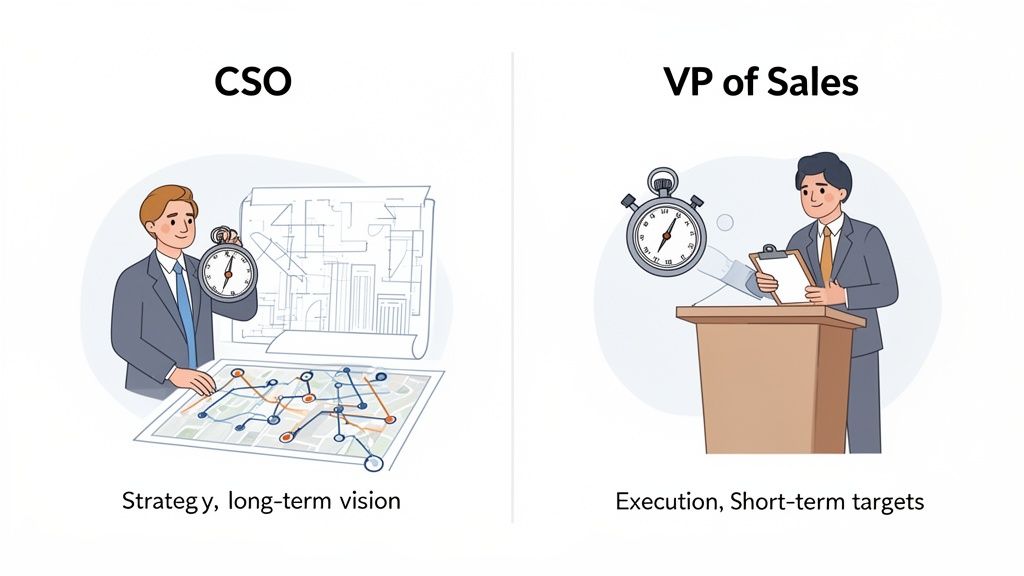
The Master Tactician: The VP of Sales
Think of the VP of Sales as your general on the battlefield. Their mission is execution. They are laser-focused on hitting this quarter's and this year's revenue targets. They live in the trenches with the sales team.
Their world revolves around optimizing the current sales process, managing the team, and ensuring the pipeline is healthy. Their success is measured by short-term metrics: quota attainment, sales cycle length, and win rates. They are experts at winning the battles happening right now.
The C-Suite Strategist: The Chief Sales Officer
The Chief Sales Officer, on the other hand, is the architect of the entire war. While the VP wins today's battle, the CSO designs the multi-year campaign for victory. This is a fundamentally strategic, forward-looking role.
A CSO operates at the C-suite level, ensuring the entire go-to-market motion is cohesive and built for long-term growth. They work with marketing on demand generation, product on the roadmap, and finance on long-range goals. They are building the sales organization of tomorrow.
This strategic perspective often overlaps with other C-suite roles. To better understand the modern executive team, you might find our guide exploring Chief Revenue Officer responsibilities helpful.
Comparing CSO and VP of Sales Roles
This table lays out the core differences to help you pinpoint which leader your business truly needs.
| Aspect | Chief Sales Officer (CSO) | VP of Sales |
|---|---|---|
| Primary Focus | Strategy and Architecture | Execution and Tactics |
| Time Horizon | Long-Term (1-3+ years) | Short-Term (Quarterly/Annually) |
| Scope of Influence | Cross-Functional (Sales, Mktg, Product) | Sales Department Focused |
| Key Metric | Predictable Revenue Growth, Market Share | Quota Attainment, Pipeline Velocity |
| Core Question | "Are we building the right revenue engine for the future?" | "Are we hitting our number this quarter?" |
The takeaway is simple: a VP of Sales executes the existing playbook, while a Chief Sales Officer writes a brand new one.
If you have a solid sales process and just need a leader to hit aggressive targets, a VP of Sales is your person. But if growth has stalled or you need to build a scalable foundation from scratch, the strategic vision of a Chief Sales Officer is what will unlock your next phase of growth.
Key Signals It’s Time to Hire a Chief Sales Officer
Knowing when to hire your first Chief Sales Officer is a critical decision. Move too soon, and you’ll burn capital. Wait too long, and you risk stalling out as competitors pull ahead.
The good news is, your business will send up flares when it's ready. These aren't minor growing pains; they're major inflection points that prove your current approach has hit its ceiling.
Your Founder-Led Sales Model Is Breaking
In the early days, nobody sells better than the founder. But this model has a hard limit. As the company grows, you inevitably become the bottleneck.
You’ll know you’ve hit this point when:
- You spend more time selling than leading. Your calendar is jammed with sales calls, leaving no room for strategy, fundraising, or steering the product.
- Deals hinge entirely on you. If a deal won't close unless you're in the room, you don't have a sales process—you have a dependency.
- You can't personally mentor every new rep. As the team expands, you no longer have the bandwidth to coach each person, resulting in inconsistent performance.
Your Processes Are Fracturing Under Pressure
The scrappy, informal methods that worked for a team of three will buckle under the weight of ten. Those "get it done" processes start creating more friction than they solve.
Look for signs of a process breakdown:
- Forecasting is a fantasy. Your sales projections are wild guesses, turning financial planning into a nightmare.
- It's the "Wild West." Every rep is selling differently, using their own messaging and discounts, creating a confusing customer experience.
- The CRM is a disaster zone. The data is incomplete or ignored, making it useless for smart decision-making.
A Chief Sales Officer is hired to transform this chaos into a repeatable, scalable revenue machine. They replace fragmented tactics with a unified sales methodology and reliable forecasting.
Your Team Needs Sophisticated Leadership
Once your sales team grows beyond a handful of reps, they need more than a manager who tracks their pipeline; they need a genuine leader. Someone who can provide sophisticated coaching, build clear career paths, and cultivate a high-performance culture.
A key 2024 priority for CSOs is customer growth and retention, a challenge that requires deep strategic thinking. This kind of leadership is exactly what scaling businesses need to win. You can find more insights on this in a recent CSO priorities report from Gartner.
If any of this sounds painfully familiar, it’s a strong sign that your ad-hoc methods have run their course. It's time for strategic sales leadership. For many companies at this stage, a fractional CSO is the perfect solution—giving you the executive expertise you need without the full-time financial commitment.
The Fractional CSO: A Smarter Path to Growth
For many growing companies, the six-figure salary of a full-time Chief Sales Officer just isn't feasible. Yet, you desperately need that executive-level sales strategy to build a scalable revenue engine. This leaves you in a tough spot.
This is exactly where the fractional leadership model comes in as a much smarter way forward.
A fractional CSO is a seasoned executive who plugs into your team for a set number of hours a week—usually from five to 25—to focus only on high-impact strategic work. You get the C-suite brainpower for a fraction of the cost.
Get the Architect, Not the Whole Construction Firm
Think of it this way: when building a house, you hire a world-class architect to design the blueprints. You pay for their genius and strategic plan. Once you have those perfect blueprints, your building crew can handle the day-to-day construction.
A fractional CSO operates the same way. They aren't there for daily administrative tasks. They are brought in to design and build the critical sales infrastructure your team needs to win.
The real power of a fractional CSO is strategic leverage. You get C-suite expertise and a proven playbook at a price point that makes sense for a growth-stage company, letting you punch way above your weight.
This decision tree shows the triggers—like founder burnout or broken processes—that signal it's time for a strategic sales leader.
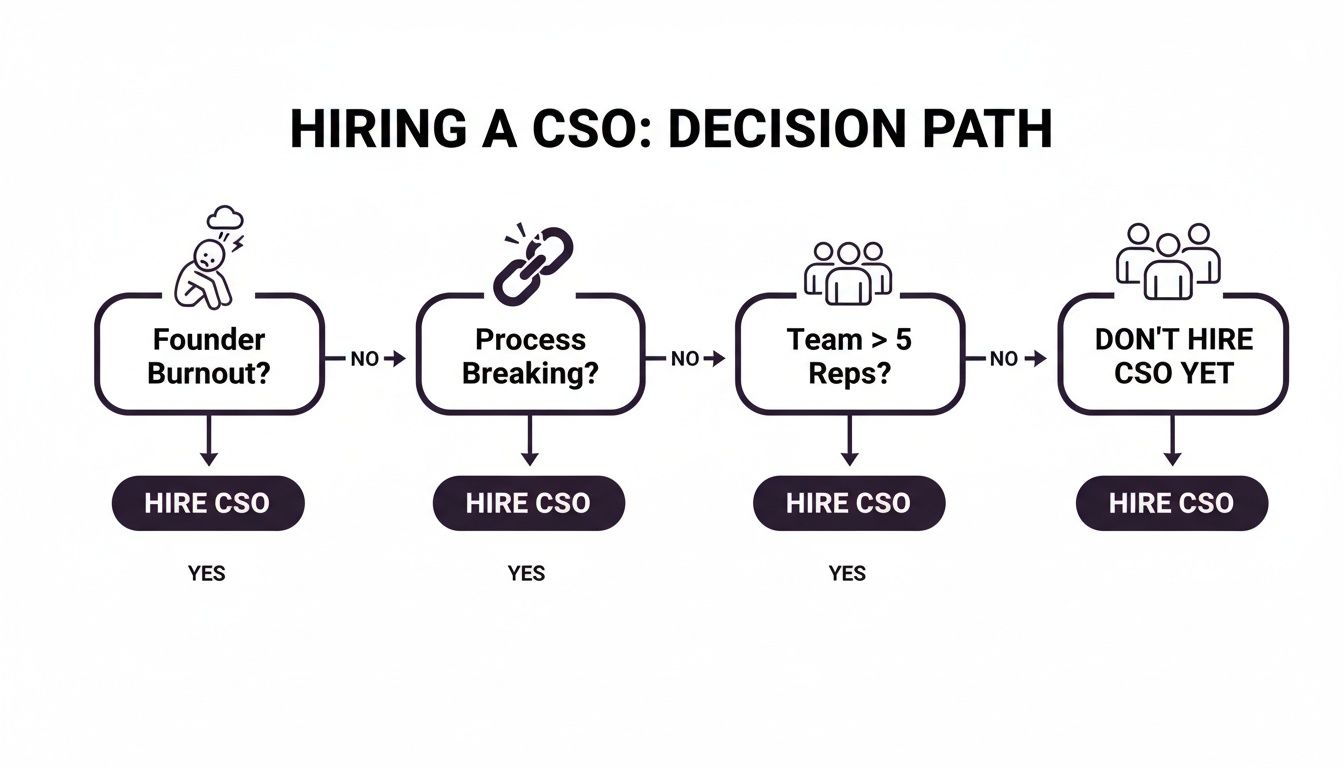
As the flowchart shows, once founder-led sales hits its limit, bringing in a strategic leader becomes the most critical next move.
When Is a Fractional Leader the Right Call?
A fractional executive is the perfect hire when you need to solve foundational problems and unlock your next stage of growth. This model is a game-changer when you need to:
- Build Your Sales Playbook From Scratch: If your sales process is a mix of gut feelings and tactics that only live in the founder's head, a fractional CSO will document and systematize it into a repeatable machine.
- Get the Company Ready to Scale: You can't just double your sales team and hope for the best. A fractional leader will set up your CRM correctly, build a real forecasting model, and design an onboarding program that actually works.
- Tap Into Niche Expertise: Breaking into a new vertical? A fractional CSO with deep industry experience can give you the specialized game plan you need to win—without the long-term commitment of a full-time hire.
This approach perfectly bridges the gap between needing a CSO and being able to afford one. To learn more about this model, read our guide on the role of a fractional VP of Sales.
By bringing on a fractional Chief Sales Officer, you’re making a direct investment in your revenue engine's strategic foundation. It's a play that delivers immediate results and sets you up for long-term success.
How to Hire and Onboard Your Next Sales Leader
Finding and integrating the right sales leader is a high-stakes move. This isn't just filling a seat; it's finding a strategic partner who will build your revenue engine for years to come. A smart, methodical approach is the only way to ensure this critical decision pays off.
It starts with clarity. Before writing a job description, you have to define what success actually looks like for this role in your company. A sharp focus on outcomes will attract the high-impact leaders you want.
Crafting a Job Description That Attracts Winners
Don't write a job description that reads like a laundry list of tasks. Elite candidates aren't looking for duties—they're looking for a challenge. Your job description should scream impact.
Instead of listing responsibilities, frame them as problems to be solved. For example:
- Instead of: "Manage sales forecasting."
- Try: "Build a predictable forecasting model that achieves 95% accuracy quarter-over-quarter."
- Instead of: "Train the sales team."
- Try: "Implement a coaching framework that increases average deal size by 20% within the first year."
This outcome-oriented approach signals that you're a results-driven organization and helps top candidates visualize themselves succeeding in the role.
Asking Interview Questions That Reveal Strategic Depth
Your interview process needs to cut through surface-level answers. You're testing strategic mindset, problem-solving skills, and leadership philosophy.
Ditch the generic questions. Dig into their past with situational prompts that force them to get specific. Here are a few powerful questions to add to your script:
- Walk me through how you built a sales playbook from the ground up at your last company. (This reveals their ability to create structure from chaos.)
- Describe a time you turned around an underperforming sales team. What were the first three things you did? (This tests their diagnostic and leadership skills under pressure.)
- How would you validate our ideal customer profile? What data would you look at in the first 30 days? (This shows their analytical and data-driven approach.)
Questions like these force candidates to provide concrete evidence of their skills. For more ideas on structuring your team, check out our guide on how to build a sales team from scratch.
Onboarding Your CSO for Immediate Impact
The hiring process doesn't end when the offer is signed. A structured onboarding plan is what separates a good hire from a great one. That first 90-day window is their chance to learn, build relationships, and score early wins.
A simple 30-60-90 day plan provides the perfect framework:
- First 30 Days (Learn & Diagnose): The focus is total immersion. Your new CSO should spend their time meeting key people across sales, marketing, and product to identify the biggest roadblocks and opportunities.
- Next 30 Days (Plan & Align): Armed with insights, the CSO now shifts to strategizing. They should present their initial findings and a draft strategic plan to the leadership team, aligning on priorities and KPIs.
- Final 30 Days (Execute & Optimize): Now, the plan goes into motion. The CSO starts implementing key initiatives, whether it's launching a new training program or refining CRM stages, to build momentum and show tangible progress.
A well-executed onboarding plan de-risks a critical hire. It provides the structure a new leader needs to quickly transition from learning the business to actively shaping its future.
Finding that perfect-fit executive can be a major challenge. If you need to tap into a network of vetted, experienced sales leaders ready to make an immediate impact, exploring a curated talent marketplace can connect you with the right person to drive your business forward.
Common Questions About the CSO Role
Thinking about bringing on a Chief Sales Officer is a big step. It’s natural to have questions, especially when weighing the full-time versus fractional models. Let's tackle some of the most common ones.
What's the Typical Salary for a Full-time Chief Sales Officer?
Hiring a full-time CSO is a serious financial commitment. Factoring in base salary, bonuses, and equity, the total compensation package often lands between $250,000 to over $450,000 annually.
The exact number varies, but this significant investment is why many growing businesses turn to the fractional model—you get the C-suite brainpower without the C-suite price tag.
When Is the Right Time to Hire a Fractional CSO?
The sweet spot is right after you've hit initial product-market fit but just before your sales process descends into chaos.
If the founder is still the primary salesperson and you know you need a repeatable, scalable sales engine, that's your cue. It's the perfect moment to bring in an expert to build the foundation for growth.
A consultant advises and leaves you to implement. A fractional CSO acts as an embedded member of your leadership team, taking accountability for both creating the strategy and driving its execution.
Can a Fractional CSO Really Manage a Sales Team?
Absolutely. A great fractional leader isn't there to micromanage daily call logs. They're there for high-impact leadership.
They focus their hours on what moves the needle: building scalable systems, leading strategic meetings, coaching key players, and refining the overarching sales strategy. They lead by empowering your team with the right frameworks and processes, giving them the clarity they need to win on their own.
By focusing on strategy and systems, a fractional Chief Sales Officer acts as a force multiplier for your entire sales function, creating a structure that keeps delivering results long after their engagement is over.
Ready to find the strategic sales leadership your business needs without the full-time cost? Shiny connects you with a curated network of over 3,000 vetted executives ready to drive your growth. Explore our fractional talent and schedule a consultation.