Head of Department Roles and Responsibilities Explained
Your CEO wants a growth plan, finance wants a forecast, and your team needs decisions before it can finish this week's work. You've taken responsibility for a department, but your calendar still looks like a senior specialist's calendar, with management squeezed into the gaps.
That's where head of department roles and responsibilities become more than a job description. The job is to turn company priorities into reliable delivery, then change how you lead as the team grows. You can remain accountable without personally planning, approving, and delivering every piece of work.
Core Duties of a Head of Department at a Glance
During your first week, requests arrive from every direction. Until you map the responsibilities, it's easy to mistake the loudest request for the most important part of the job.
The foundational responsibility is converting organizational strategy into measurable departmental execution. The U.S. Bureau of Labor Statistics identifies management duties including establishing goals and policies, overseeing budgets, directing goods or services, consulting colleagues, approving agreements, analyzing reports, and improving results.
Map responsibilities to visible outputs
Use an output to make each responsibility concrete. Owning strategy means producing an agreed plan, not attending strategy meetings.
Core head of department duties by area
| Area | What It Covers | Typical Output |
|---|---|---|
| Strategy and goals | Establish goals, policies and procedures for the function | Annual department plan |
| Budget | Oversee spend and approve costs within the budget | Monthly budget variance report |
| Delivery | Manage production of goods or delivery of services | Service levels and output tracking |
| People | Assign work, hire, develop and review staff | Team plan and review cycle |
| Reporting | Analyze financial and performance reports | Monthly KPI pack |
| Cross-functional | Consult executives and other departments, approve agreements | Dependency and decision log |
| Improvement | Identify cost reductions and better results | Improvement backlog ranked by impact |
Read the table from top to bottom. Goals establish direction; budget supplies resources; delivery turns both into results. People management builds the capability to sustain those results, while reporting makes performance visible.
Cross-functional work deserves its own space because departments rarely deliver independently. A marketing launch may need product approval, finance authorization, and sales readiness. Record those dependencies before promising a date.
Improvement is different from routine delivery. Keep a ranked backlog of process changes so urgent work doesn't permanently crowd out better ways of operating.
Adjust the role to organizational scale
In a large organization, the chief executive generally concentrates on policy and long-term strategy while operations managers direct daily activities. Smaller businesses combine more of those responsibilities in the same leader, so the role's breadth must match the support available.
Think of the department head as a conductor. You don't play every instrument, but you must know what each section needs before the performance starts.
For a practical self-check, copy the seven areas into your notebook. Mark which you own today, identify any without a clear owner, and note which consumes most of your week. That last answer often reveals the gap between your title and your actual job.
How to Turn Company Strategy into a Department Plan
Where does the plan start? With the executive team's choices, not a collection of projects your department would like to complete.
A useful plan makes trade-offs explicit. It tells colleagues what you'll deliver, what you won't undertake yet, and which assumptions could force a change.
Build the plan in six steps
Get the company priorities in writing. Ask the executive team for its top three priorities for the year. Treat this as a recommended planning limit, not an invitation to squeeze every existing initiative under a broad label such as growth.
Translate priorities into department goals. Start with one or two goals per company priority, each with a named owner. Describe the outcome, not the activity: improving customer onboarding is a goal; holding onboarding meetings isn't.
Choose measures and record baselines. A practical starting point is three to five KPIs per goal, provided each informs a decision. Record the starting value, measurement method, and reporting owner before agreeing on a target.
Create a dated roadmap. Give every milestone a delivery owner and capture prerequisites. If several projects need the same specialist, sequence them rather than pretending that person can complete everything simultaneously.
Allocate budget against goals. Connect staffing, tools, and external support to the outcomes they serve. Flag spending that supports no agreed goal, but check contractual obligations before removing it.
Set the review rhythm. Schedule monthly KPI reviews and quarterly priority resets. Use the review to decide what changes, not merely to present a dashboard.
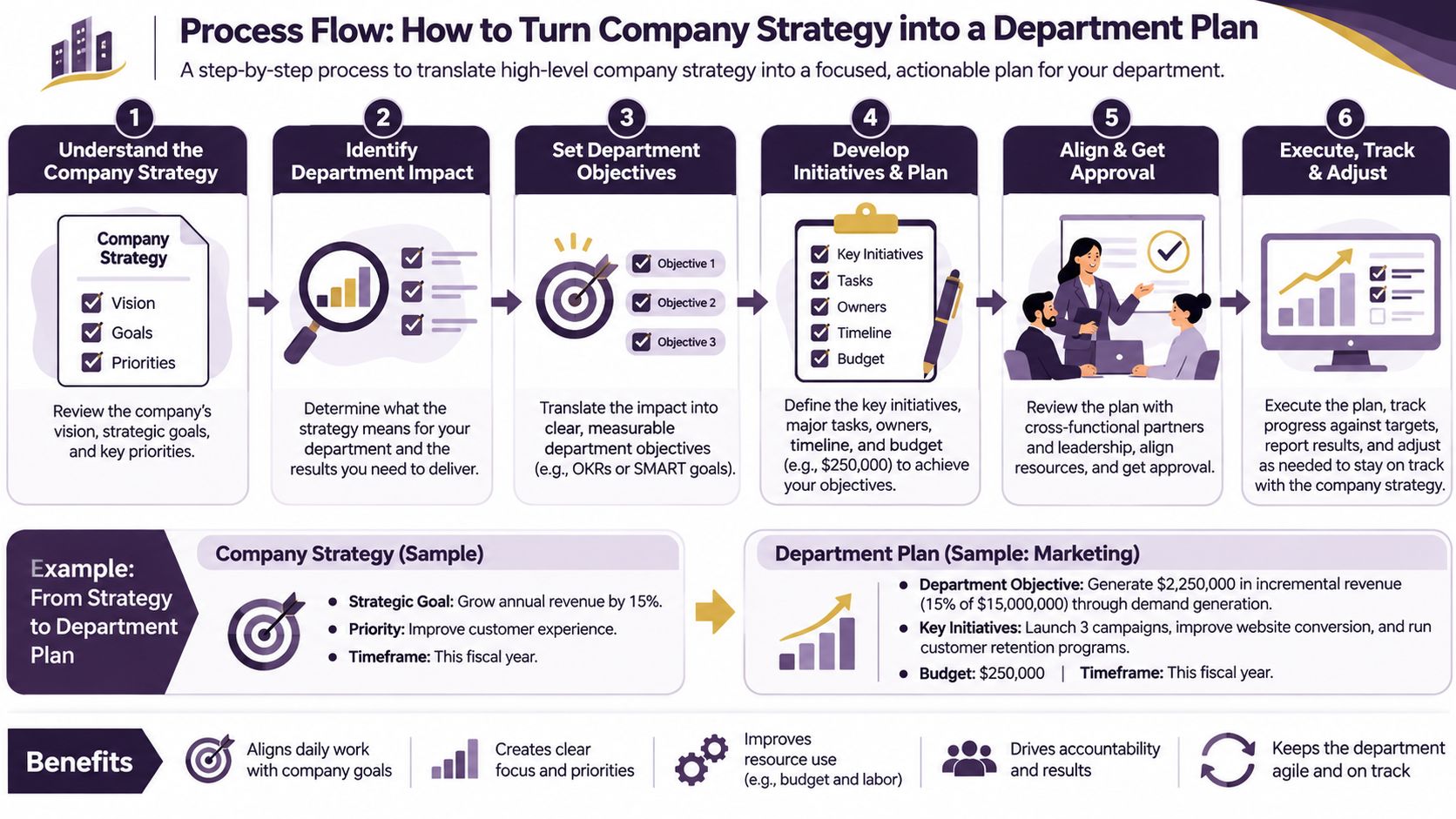
For a fuller planning template, use our guide to the strategic planning process steps.
Make the connection testable
Say a company wants faster renewals. Its support head sets a goal to remove support-related renewal delays, tracking median first-response time and renewal rate together each month. Faster replies alone wouldn't prove that customers are receiving useful resolutions.
Add escalation age and unresolved renewal blockers as diagnostic measures if they help explain performance. Keep the distinction clear: the department can influence renewals, but it shouldn't claim sole ownership of an outcome shared with sales and product.
Our Fractional Chief Product Officer role includes establishing and monitoring KPIs for product initiatives, alongside defining and managing the product roadmap to support timely delivery of features and enhancements. Those responsibilities illustrate how measurement and delivery planning belong together.
Planning discipline: More than five department goals is a useful warning to challenge the scope, not a reason to create smaller text on the planning slide.
The finished plan should fit on one page: goals with owners, KPIs with baselines, dated milestones, and the decisions needed to proceed.
Leading People Through Hiring, Feedback and Development
Hire against a written role scope, use structured interviews, and plan onboarding across the first 30, 60, and 90 days. Otherwise, you risk hiring someone for an unclear job and later judging them against expectations nobody documented.
For work-sample assessments, give candidates equivalent conditions and score the same criteria. Form Timer's guidance on how to set time limits on pre-employment tests is useful when you need a consistent assessment window without creating an open-ended unpaid assignment.

Make feedback part of the working week
Use weekly one-to-ones for the person's priorities, obstacles, workload, and development. Put routine project updates in your delivery tracker so the conversation doesn't become another status meeting.
Give feedback soon after observing the work. Name the behavior, explain its effect, and agree on the next attempt: a customer handover missing an owner needs a concrete correction, not a vague instruction to communicate better.
These habits need deliberate practice. In 2025, 47% of managers and above reported being fully engaged, while 57% said they'd never received extensive training on re-engaging teams, according to Kahoot!’s Workplace Engagement Report.
Start this month by protecting the recurring conversation and recording agreed actions. A performance management system should support those conversations, not substitute for them.
Develop capability rather than dependence
Ask each person to choose one skill and one stretch project per quarter. Agree on what good work looks like and where they can make decisions without permission.
The department head is less a runner than a relay coach, deciding when each person carries the baton. Taking it back whenever someone struggles prevents the team from becoming stronger.
Use this new-hire checklist:
- Written scope: Outcomes, responsibilities, and decision boundaries are clear.
- Onboarding plan: The 30-60-90 milestones distinguish learning from independent delivery.
- Standing one-to-one: The employee has protected time for support.
- Development goal: Agree on an initial learning goal during the first month.
Managing Time, Span of Control and Distributed Teams
Start with a two-week time log. Sort your hours into people, department delivery, specialist work, and administration, using your calendar alongside a simple spreadsheet.
Say the log shows roughly a day each week spent approving routine work a senior specialist could sign off. That's not just a busy calendar. It's a decision-design problem.
Remove work before adding meetings
Gallup-related analysis reported that average managerial span rose from 10.9 direct reports in 2024 to 12.1 in 2025, while managers continued performing individual-contributor work, according to Lab Manager.
Don't treat that average as a staffing target. Complexity, experience, and the amount of hands-on work matter when deciding what one head can cover.
- Delegate approvals: Specify spending or risk thresholds and exceptions.
- Name a specialist lead: Transfer recurring technical work with authority, not just responsibility.
- Decline decision-free meetings: Read the written update unless your participation changes an outcome.
For legal administration, HireParalegals' explanation of a virtual legal assistant can help distinguish support tasks from matters requiring qualified legal judgment. The same principle applies elsewhere: specialist support should remove defined work, not create an ambiguous extra reporting line.
Watch for slipping one-to-ones, growing review backlogs, and decisions waiting more than a week. Use these as operating warning signs, rather than universal staffing thresholds.
Make distributed work visible without surveillance
In 2025, only 54% of managers supervising remote workers strongly agreed they trusted those employees to be productive, while 57% of remote employees said they felt trusted by their manager, according to Gallup.
Publish decisions in a shared log, define outcomes and service levels, and make important information available asynchronously. Rotate meeting times so the same location doesn't always absorb the inconvenience.
Say you manage staff in London, Lisbon, and Toronto. You could replace daily status calls with a Friday written update and a weekly outcomes review, reserving live calls for difficult decisions or collaborative work.
Track quality, response-time trends, and unresolved handoffs, then ask people directly about isolation. Don't interpret a quiet Slack presence as poor performance.
Accountability requires evidence of completed work, not a permanent view of someone's screen.
Each month, ask: What did I stop doing? Which decision waited too long?
Problems Heads of Department Run Into and How to Respond
Missed deadlines, repeated approval requests, and disengaged employees can look like separate performance problems. Before judging individuals, check whether they're working inside a manageable system.
In 2025, 67% of managers reported struggling with heavy workloads, larger teams, unclear roles, or pressure between senior leaders and direct reports, according to Top Workplaces research cited by Training Industry.
Diagnose the warning sign
Warning signs, causes and first responses
| Warning Sign | Likely Cause | First Response |
|---|---|---|
| Missed deadlines across the team | Too many priorities for the capacity | Cut the goal list to three and re-sequence the roadmap |
| Team asks who decides | Decision rights never written down | Publish a decision log with owners and escalation rules |
| Senior leaders and reports give conflicting requests | No agreed priority order | Take the conflict to the executive sponsor with one trade-off to decide |
| Rising resignations or disengagement | Heavy workload and little feedback | Hold one-to-ones, review workload and check training needs |
| Quality drops in a remote subteam | Unclear outcome measures or isolation | Define outcome measures and add a regular team check-in |
| Head approves every item | Head is doing specialist work | Delegate approvals with clear value thresholds |
These are starting diagnoses, not proof of cause. A resignation may reflect circumstances outside work; declining quality may require technical training rather than another meeting.
For an illustrative reset, consider a head whose team missed three quarterly deadlines. They cut the goal list from seven to three and move two projects to a specialist lead, making ownership and available capacity explicit before recommitting.
Triage order: Clarify decision rights first, rebalance workload next, then address remaining people issues. Urgent safety or conduct concerns take precedence.
This order prevents you from coaching someone to move faster while they're still waiting for contradictory approvals. It also makes performance conversations fairer because expectations become achievable.
If a problem persists after two planning cycles, treat that as a practical trigger to revisit scope or capacity. More effort from the same overloaded leader isn't an organizational design.
When a Fractional Department Head Fits Better Than a Full-Time Hire
Buying a specialist machine outright makes sense when you'll use it continuously. Leasing it for a defined project makes sense when you need its capability without permanent ownership.
The analogy works for leadership capacity, although executives also need relationships and context. A fractional department head supplies senior judgment for an agreed commitment; the arrangement doesn't eliminate the need for internal execution capacity.
Lightcast reported that at least 34,000 U.S. workers held titles containing fractional in 2025, a 265% increase from 2019, and that 97% of fractional-role postings in 2026 came from small or medium-sized companies, compared with 3% from Fortune 1000 companies. Revelio Labs found that new executive positions mentioning fractional work rose from 5 per 1,000 in 2018 to 18 per 1,000 in 2024, more than tripling the rate.
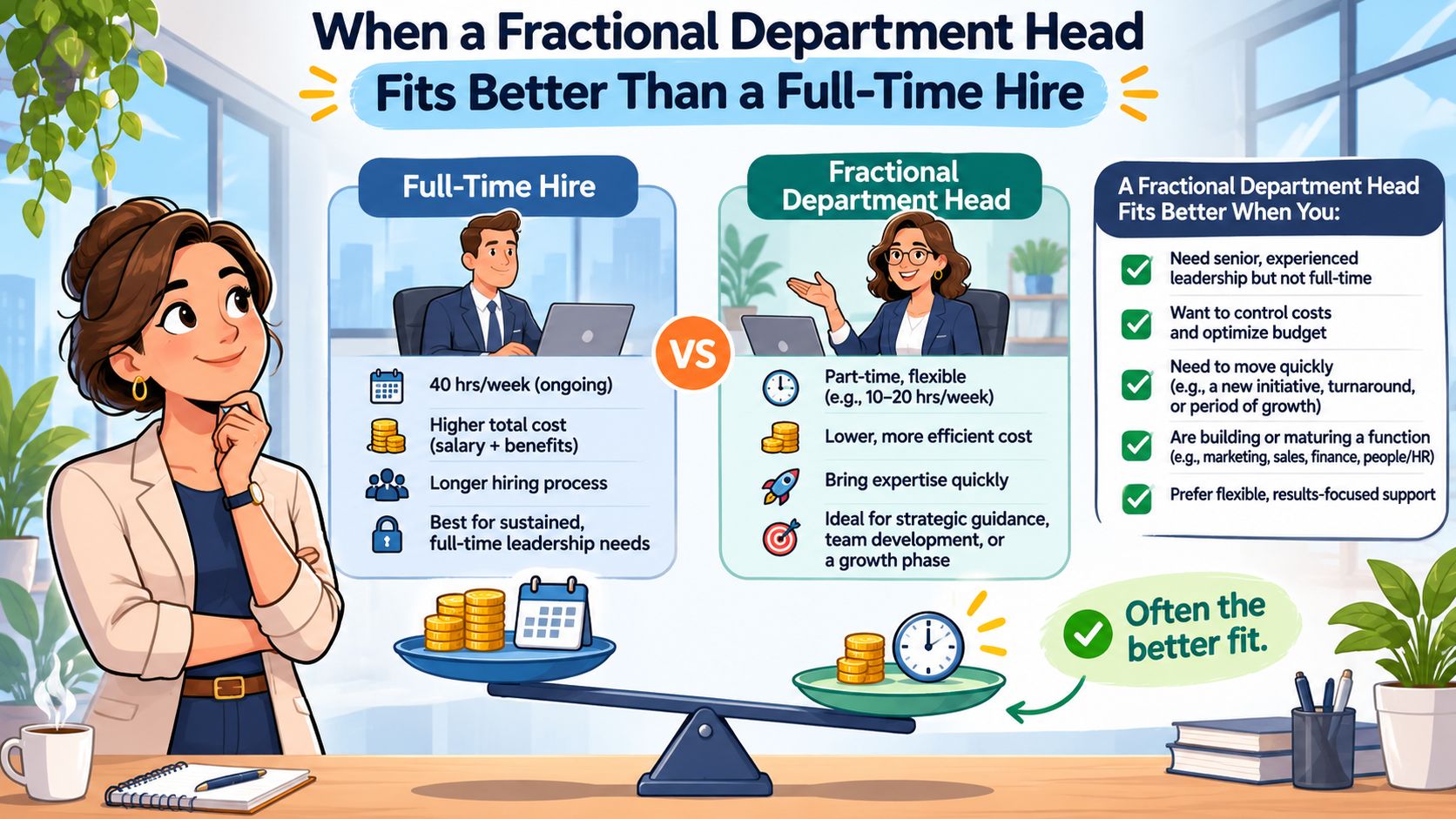
Match the arrangement to the mandate
A company preparing for a funding round might engage a fractional CFO to build reporting and forecasts. A business entering a new market might engage a fractional CMO to sharpen positioning before building a permanent team.
Define one mandate, agree on the weekly commitment, establish measurable outcomes, and set a review point to expand, replace, or convert the role. Approved Lux Personal Assistant's guide to hiring a fractional executive part-time offers additional context on the arrangement; our fractional leadership guide explains the broader model.
Strategic access still matters. Our Fractional Chief Product Officer role includes advising the CEO and board, with regular updates on product strategy and performance.
Full-time versus fractional department head
| Criterion | Full-Time Head | Fractional Head |
|---|---|---|
| Commitment | Full working week, open-ended | Agreed weekly hours tied to one mandate |
| Best for | Ongoing function with steady workload | A specific growth phase or capability gap |
| Recruitment lead time | Typically longer for a broad permanent search | Usually shorter when the scope is tightly defined |
| Cost structure | Fixed salary and benefits | Pay for the capacity the company uses |
| Exit path | Harder to unwind | Review point to expand, replace or convert the role |
Treat recruitment speed as a planning expectation, not a guarantee. Candidate availability and the specificity of your requirements can change either search.
Choose full-time when the function needs sustained, full-week leadership and frequent immediate decisions. Choose fractional when senior planning and oversight are missing, but capable people can carry delivery between leadership sessions.
Decide Whether Your Department Needs a Head Now
Does the department need a dedicated head now, and in what form? Use these checks as a discussion tool, not a mechanical hiring score:
- Defined function: Does it have its own goals and budget?
- Recurring accountability: Does someone need to own results every week, rather than only at key moments?
- Leadership capacity: Can current leaders absorb planning and people duties without dropping delivery?
- Testable progress: Would a 30-60-90 plan demonstrate meaningful progress within a quarter?
Three or more yes answers should prompt serious consideration of a dedicated head, but examine which answers they are. If existing leaders can comfortably absorb the work, that supports waiting rather than hiring automatically.
If the need centers on a specific growth phase or capability gap, a fractional head can be a lower-commitment test. Write a one-page role scope covering goals, decision ownership, KPIs, and a review date before posting the job or approaching a candidate.
Shiny connects businesses with vetted fractional executives who can take responsibility for departmental strategy, people, budgets, and results. Visit Shiny to explore our services or schedule a consultation, bringing your written mandate so we can help match it to the right executive.