
How to Manage Cash Flow: A Practical Guide for Founders
To manage cash flow, you must be on top of the money moving in and out of your business. It's a constant cycle of tracking, analyzing, and optimizing. This means forecasting your future financial position, getting paid faster, and being smart about when you pay your own bills. Getting this right is the secret to staying afloat and fueling real growth.
Why Mastering Cash Flow Is Your Business's Superpower
Profit on paper doesn't mean much if you can't make payroll next Friday. This is a terrifyingly common story for growing businesses.
Imagine a SaaS company with a killer product. Their revenue charts are hockey-sticking upwards, and their income statement looks amazing, showing healthy profits. But behind the scenes, they're scrambling to cover server costs because their enterprise clients all pay on 60-day terms.
This highlights the critical difference between being profitable and being cash-flow positive. Profit is an accounting metric. Cash is the oxygen your business needs to breathe, day in and day out. Running out of it is the number one reason businesses fail.
The Ultimate Strategic Advantage
Viewing cash flow management as just another accounting chore is a massive mistake. When your cash flow is healthy, you're in a position to act, not just react. It’s the fuel that lets you:
- Jump on opportunities: Found a great deal on essential equipment or get an unexpected chance to hire a rockstar engineer? With a strong cash position, you can say "yes" without flinching.
- Handle unexpected hits: A key client pays late, or a surprise expense pops up. A cash buffer turns what could be a crisis into a manageable hiccup.
- Build a resilient business: Consistent positive cash flow means you can reinvest in your product, team, and marketing, creating a powerful cycle of growth.
Mastering cash flow isn't just about survival. It's about giving your company the freedom to innovate, experiment, and thrive.
This guide is your playbook for getting that control. For many founders, bringing in an expert to implement these systems can change the game. A fractional leader, like a part-time CFO, provides the strategic oversight to turn financial theory into real-world results. If you’re ready to build a more resilient business, exploring our services could be your next best move.
Building Your First Actionable Cash Flow Forecast
A cash flow forecast isn't about gazing into a crystal ball; it's about building a GPS for your business finances. It gives you the power to make sharp, informed decisions today based on a clear picture of what’s coming down the road.
The most straightforward way to start is the direct forecasting method, which tracks the actual cash you expect to come in and go out. We'll focus on building a 13-week forecast—a common standard that gives you a full quarter of visibility. That's plenty of time to spot trouble and make adjustments.
For a deeper dive, our guide on financial forecasting for startups offers a more comprehensive look at building these crucial models.
This process boils down to three core phases: forecasting, managing inflows, and managing outflows.
A solid forecast dictates how you handle the money coming in and the money going out.
Mapping Your Cash Inflows
Let's say you just launched a SaaS company. Your inflows trickle in from different places at different times. Your first job is to map all of them out, week by week.
- Recurring Subscriptions: Got 20 customers paying $100/month? That's $2,000. The key is to break this down by when those payments actually hit your bank account.
- New Sales: Be realistic. If your sales team expects to close four new deals a month, project that cash based on your average sales cycle. A deal isn't cash until the contract is signed and you know the payment terms.
- One-Time Fees: Do you charge for setup or onboarding? Pinpoint the week you expect to receive those payments.
Projecting Your Cash Outflows
Next up are your expenses. This side of the equation is often easier since many costs are fixed or predictable. A common mistake founders make is forgetting the small stuff—it adds up fast.
- Fixed Costs: These are your non-negotiables. Think rent, payroll, and insurance. Map them to their specific due dates.
- Variable Costs: This includes things like server hosting, marketing spend, and payment processing fees. Planning a big ad campaign in week six? Make sure that cash outflow is on your forecast.
- Seasonal Dips: Is your business seasonal? An e-commerce brand might see a sales dip right after the holidays. You must acknowledge these patterns in your forecast.
Your forecast is a living document, not a "set it and forget it" exercise. Review and update it every single week. The goal isn’t 100% accuracy; it's about creating a reliable tool that minimizes surprises.
Finally, always build in a cash buffer. Unexpected expenses are a guarantee. Having a reserve that covers 1-2 months of operating expenses can be the difference between a minor hiccup and a major crisis. This entire process is where an experienced financial leader truly shines. A fractional CFO can implement these systems efficiently, turning your forecast from a simple spreadsheet into a powerful strategic asset.
Proven Tactics to Accelerate Cash Inflows
Waiting on payments can feel like holding your breath. A forecast tells you what cash should be coming in, but the real challenge is getting that money into your bank account. It’s about shrinking the gap between when you bill and when you get paid.
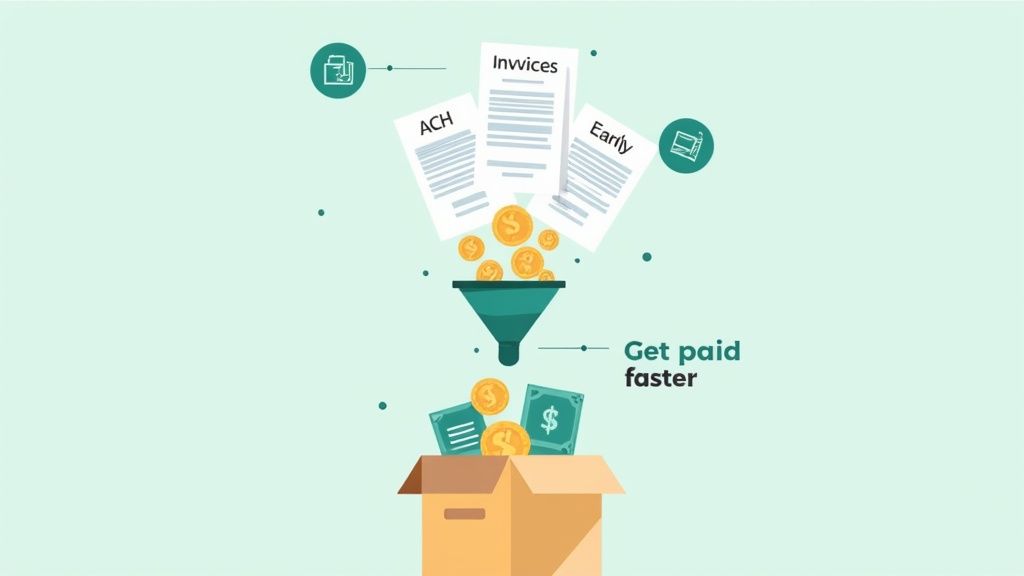
You need to make it incredibly easy for clients to pay you. Research found that businesses accepting online credit card payments saw 85% of their invoices paid within a week. The principle holds: reduce friction. The more payment options you offer—ACH, credit cards, wire transfers—the fewer excuses clients have for delays.
Make Early Payments a No-Brainer
One of the most effective ways to speed up collections is to incentivize good behavior. Offering a small discount for paying early can be a surprisingly powerful motivator.
For example, a “2/10, net 30” term means a client gets a 2% discount if they pay within 10 days; otherwise, the full amount is due in 30 days. Getting cash 20 days sooner is often worth far more than the small margin you give up.
Clear, upfront communication about payment terms is non-negotiable. Your invoice should spell out the due date, the methods of payment accepted, and any penalties for late payments or rewards for paying early.
Systematize Your Follow-Up Process
Hope is not a strategy for collecting overdue payments. You need a systematic, firm, yet professional follow-up process. Automating this can be a game-changer. Our guide on how to automate your startup’s receivables management provides a great roadmap for setting this up.
A solid system might look something like this:
- Day 1: Invoice is sent immediately upon project completion.
- 7 Days Before Due Date: A polite, automated reminder email goes out.
- 1 Day After Due Date: A friendly follow-up email is sent.
- 7 Days Past Due: A more direct email is sent, and a personal phone call is made.
For many founders, juggling these financial details while trying to grow the business is just too much. This is where a skilled fractional leader becomes invaluable. They can design and implement these systems, ensuring your cash pipeline flows freely so you can focus on what you do best.
Smart Strategies for Managing Cash Outflows
Controlling your cash outflow isn't about pinching pennies; it’s about becoming a master of timing. While bringing cash in faster is great, strategically managing when cash goes out can be just as powerful. It's how you keep cash in your account longer, giving you a crucial buffer.
This means turning your accounts payable from a to-do list into a strategic tool.
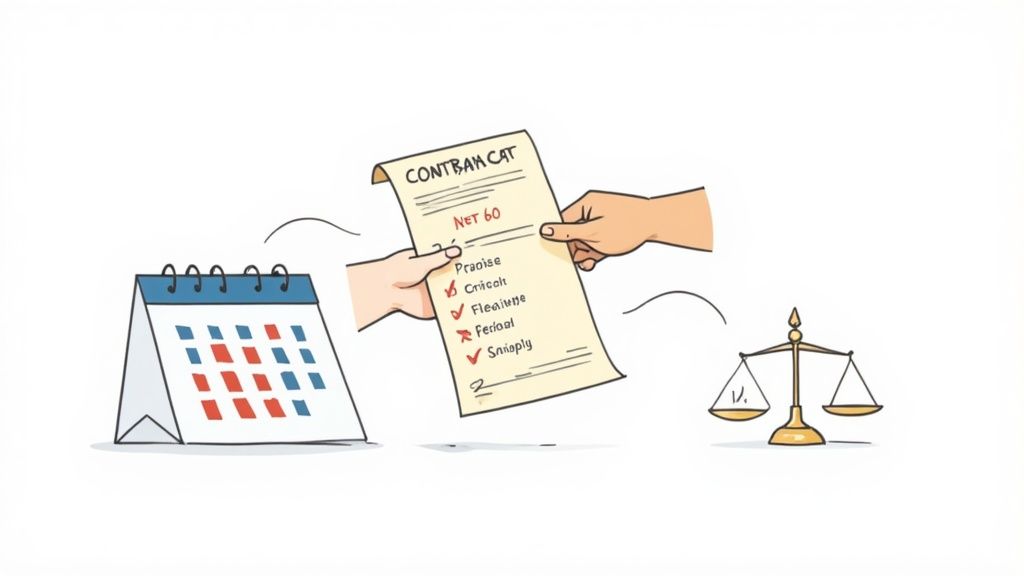
This isn’t about dodging your bills or damaging vendor relationships. When you manage your outflows intelligently, you ensure you always have the funds to pay on time, which builds trust and reliability.
Renegotiate and Extend Your Payment Terms
One of the most effective moves you can make is to renegotiate payment terms with your suppliers. If you’re on Net 30 terms, could you get to Net 45 or even Net 60? An extra 15-30 days of holding onto your cash can make a world of difference for your operational runway.
When you bring this up, frame it as a partnership conversation. You could say, “As we’re scaling up, we’re looking to solidify our key partnerships. Extending our terms to Net 60 would be a huge help and ensure we can increase our order volume with you over the next year.”
The goal here is to build strong, sustainable vendor relationships. Good partners will understand that your financial health is ultimately good for their business, too.
This kind of proactive cash management has become a major focus for businesses everywhere. Money market fund balances, a key indicator of companies hoarding cash, jumped 15% in a single year as businesses parked cash to stay liquid. Optimizing cash flow isn't just a defensive play anymore, it's a core strategy. You can discover more insights about this cash outlook and what it means for businesses.
Prioritize and Plan Your Payments
Not all bills carry the same weight. You need a simple system for prioritizing payments based on how critical they are to keeping the lights on.
- Tier 1 (Business-Critical): These are non-negotiables like payroll, rent, and core software. Delaying these could shut your business down.
- Tier 2 (Important but Flexible): This is for vendors you have a great relationship with. These are your first candidates for payment term negotiations.
- Tier 3 (Non-Essential): These are expenses you can postpone without an immediate hit to the business, like certain marketing campaigns or office upgrades.
This tiered approach ensures your limited cash always goes where it matters most. A fractional CFO can be a game-changer here, setting up these financial controls and even handling vendor negotiations, freeing you up to focus on growth.
Leveraging Technology for Smarter Cash Management
If you're still wrestling with a manually updated spreadsheet to manage your cash flow, you're flying blind. You’re making critical business decisions based on old information—a potentially fatal mistake for a startup. Modern technology is designed to be your financial co-pilot.
Today’s accounting software and cash flow tools take the tedious, error-prone work off your plate. They give you real-time dashboards showing exactly where your cash stands right now and send automated alerts before a potential shortfall hits.
The cash flow management software market is on track to jump from USD 369 million to over USD 1.1 billion between 2020 and 2025. This isn't just a niche trend; it’s a global shift. Businesses are realizing that using predictive analytics isn't a nice-to-have, it's a competitive necessity. You can learn more about the latest cash management software trends to see how smart companies are protecting their margins.
Choosing Your Financial Tech Stack
Not all tools are created equal. The right choice hinges on your company's size, complexity, and growth stage. The goal is a solution that frees up your time and gives you the confidence to make smarter strategic moves.
Here's a quick look at the common options:
- Integrated Accounting Software: Platforms like QuickBooks Online or Xero often come with built-in cash flow features. These are a great starting point for early-stage startups.
- Dedicated Forecasting Tools: Solutions like Float or Futrli plug into your accounting software to provide much more granular, scenario-based forecasting.
- AI-Powered Platforms: These advanced platforms use AI to dig through historical data, spot patterns, and deliver incredibly accurate predictions.
Cash Flow Management Tools Comparison
Choosing the right tool can feel overwhelming, but breaking it down by your immediate needs makes it simpler. Are you an early-stage startup needing basic oversight, or a scaling business needing to model complex scenarios?
| Tool Type | Best For | Key Features | Example |
|---|---|---|---|
| Accounting Software | Early-stage startups and small businesses needing an all-in-one solution. | – Basic cash flow statements – Bank reconciliation – Invoicing and expense tracking |
QuickBooks, Xero |
| Spreadsheets | Micro-businesses or founders who need a free, highly customizable option. | – Manual data entry – Basic formulas and charts – Total control over layout |
Google Sheets, Microsoft Excel |
| Dedicated Tools | Growth-stage businesses needing detailed, real-time forecasting. | – Direct integration with accounting software – Scenario planning – Automated alerts |
Float, Futrli |
| AI Platforms | Mature businesses with complex data seeking predictive insights. | – Predictive analytics – Anomaly detection – Advanced risk modeling |
HighRadius, Tesorio |
Ultimately, the best tool is the one that fits your current workflow and can grow with you.
The right technology investment pays for itself almost immediately. The hours saved on manual data entry, the costly errors avoided, and the ability to confidently seize an opportunity because you know you have the cash are invaluable.
The Role of an Expert Guide
Navigating this world of software can be overwhelming. Which features do you actually need? How do you implement a new system without grinding your operations to a halt? This is where an experienced fractional executive becomes a game-changer.
A fractional leader has been down this road dozens of times. They can quickly assess your needs, help you pick a tech stack that delivers the best ROI, and manage the entire implementation. Their expertise ensures you're not just buying software; you're building a solid financial system that scales with your business.
Knowing When to Call in a Financial Expert
When you first start out, managing cash flow with a simple spreadsheet feels empowering. But as your startup grows, that simplicity can quickly turn into a massive headache. Financial complexity doesn't just add up; it multiplies.
Are you constantly blindsided by cash shortages? Do you spend more time wrestling with financial models than you do talking to customers? These are classic warning signs that your DIY methods are creating more risk than they're worth.
Recognizing the Need for Help
When managing your finances starts to feel like a second full-time job, it's a clear signal that you need support. Today, with volatile interest rates, cash flow has become a top global risk. Yet many businesses are still stuck using manual processes that can't keep pace. You can read the full research about rising cash flow risks to see just how widespread this problem is.
Bringing in an expert isn't an admission of failure. It’s a strategic move toward sustainable growth. It’s about getting ahead of problems instead of constantly reacting to them.
For many scaling businesses, a fractional CFO is the perfect answer. You get access to top-tier strategic guidance—someone who can implement robust systems and proactively manage your cash flow—at a fraction of the cost of a full-time executive.
Our guide explains in detail what a fractional CFO does and how they can drive growth for a company like yours. If these challenges sound familiar, it might be time to see how an expert can help you build a more resilient financial future.
Got Questions About Cash Flow? We’ve Got Answers.
As you wrap your head around forecasting and optimization, a few common questions always pop up. Let's tackle some of the most common ones.
What’s the difference between positive cash flow and profit?
Profit is what’s left after you subtract all your expenses from your revenue—it's an accounting metric on your income statement. Positive cash flow means more physical cash landed in your bank account than went out during a specific period. A business can be profitable on paper but still go under if clients take too long to pay their invoices, choking your cash flow.
How often should a startup review its cash flow?
For any early-stage startup, a weekly cash flow review is non-negotiable. This rhythm allows you to spot potential shortfalls early and react before they become a crisis. As your business matures, you might shift to a bi-weekly or monthly review. But in the beginning, weekly is the gold standard.
What is the biggest cash flow mistake startups make?
Hands down, the most dangerous mistake is failing to create—and religiously maintain—a cash flow forecast. Glancing at your current bank balance is misleading. That number tells you nothing about the big bills coming down the pipe, like payroll, rent, or a critical supplier payment.
A forecast is your financial GPS. Without it, you're essentially driving blind and just hoping you don’t run out of gas.
Can I improve cash flow without increasing sales?
Absolutely. While more sales is always a great goal, you can make a huge impact by tightening up your operations.
- Get paid faster. Offer small discounts for early payments and have a clear follow-up process for overdue invoices.
- Negotiate with your suppliers. See if you can extend your payment terms to hold onto your cash a little longer.
- Watch your spending. Keep a close eye on operating costs and inventory levels. Tying up cash in unsold products or unnecessary subscriptions is a silent killer.
Juggling these financial details while trying to build and scale a business is a monumental task. It’s why so many founders turn to fractional leadership for expert guidance without the hefty price tag of a full-time executive.
Shiny is a marketplace of vetted, experienced executives ready to step in and build the robust financial systems you need to thrive.
Ready to get a real handle on your finances? Schedule a consultation and find the right fractional leader for your team.