Part-Time CFO for Startups: A Practical Guide
Tuesday afternoon, the coworking space is loud, but your finance process is silent. The spreadsheet doesn't match the bank feed, an investor is waiting for updated projections, and the board pack is due Friday. Payroll lands Wednesday, a major customer wants net-60 terms, and nobody can answer the question that matters most: how many months of runway do we really have?
That situation doesn't call for a prestigious executive title. It calls for experienced financial judgment, available quickly, for a defined amount of time. A part-time CFO for startups can take ownership of cash visibility, investor materials, forecasting, and board reporting without forcing an early-stage company into a permanent executive commitment.
The decision isn't just whether you can afford a CFO. It's whether your current finance capacity can support the next expensive decision, and whether a shared executive will still work when the company outgrows the model.
The Cash Question Every Founder Eventually Faces
By Wednesday morning, the founder has three versions of cash on hand. The accounting system shows one figure, the bank account shows another, and the operating spreadsheet contains assumptions nobody has updated since the last hiring plan. Each number looks plausible in isolation. Together, they create risk.
The founder's calendar makes the problem worse. Payroll needs approval, the customer wants extended payment terms, and the investor call is approaching. The founder can explain the product roadmap and pipeline, but not how the proposed contract changes collections, hiring capacity, or runway.
That is where a part-time CFO earns the role. The executive doesn't arrive to produce another retrospective report. They establish a usable cash forecast, reconcile the assumptions driving the model, and turn the week's urgent questions into decisions the founder can defend.
What changes during the first week
A capable CFO might start by separating facts from assumptions:
- Cash position: Confirm what the company has available and which obligations are already committed.
- Short-term forecast: Map expected receipts, payroll, vendors, taxes, and other near-term cash movements.
- Scenario model: Show what happens if the customer pays later, hiring moves forward, or fundraising takes longer.
- Investor narrative: Make sure the projections explain the business rather than merely displaying optimistic numbers.
- Board materials: Convert raw financial data into a concise view of performance, risks, and decisions required.
The CFO doesn't need to work every morning to create value. Fractional leaders commonly work 5 to 20 hours per client per month, with 10 to 15 hours often cited as a standard engagement, according to market reporting on fractional executive work. The right amount depends on the company's decision load, not the founder's desire to have a CFO nearby.
Practical rule: Hire senior finance capacity when guessing starts slowing decisions, not when the company reaches an arbitrary prestige milestone.
The trade-off is access. A part-time CFO won't be in every conversation, and the founder must provide clean access to systems and people. In return, the company gets an experienced operator for the periods when cash, capital, and credibility matter most.
What a Part-Time CFO Actually Does
A part-time CFO owns strategic finance on a recurring schedule, usually working one to three days per week according to the company's needs. The role reports to the CEO and makes financial decisions part of the operating rhythm, rather than treating finance as an extension of bookkeeping.
The boundaries matter. A bookkeeper records transactions. A controller protects accounting accuracy, manages the close, and maintains controls. A CFO converts that information into decisions about hiring, pricing, fundraising, investment, and risk. The CFO can improve the bookkeeper's or controller's work, but should not be hired to replace either role.
A fractional CFO typically divides time among several companies and may own a narrower mandate. “Part-time CFO” often describes the same capacity model with a more embedded operating role. A Big Four firm or boutique consultant usually delivers a defined project, then exits. A part-time CFO remains accountable for the recurring finance rhythm.
The role is a coach with an operating mandate
A useful comparison is a head coach who runs practices twice a week. The coach sets the plan, calls the plays, reviews performance, and owns the result. They are not in the locker room every morning, but the team still knows who is accountable for strategy.
In a startup, that accountability shows up through work such as:
- Cash forecasting: Maintain a weekly or rolling view of cash, obligations, collections, and runway.
- Board reporting: Produce a monthly pack covering performance, variance, risks, and decisions.
- Fundraising support: Build projections, scenarios, capital plans, and diligence materials.
- KPI instrumentation: Define metrics connecting revenue, costs, retention, margins, and cash.
- Audit preparation: Coordinate financial schedules, documentation, controls, and external requests.
- Finance cleanup: Resolve vendor records, cap-table inconsistencies, system gaps, and ownership questions.
The right engagement produces decisions, not just spreadsheets. If a candidate spends most of the interview discussing reconciliations and tax filings, you may be hiring accounting support rather than executive finance leadership.
For a fuller explanation of the role, read what a fractional CFO does. The capacity model should also have an exit condition: bring in more finance leadership when the company's decision load exceeds what a shared executive can reliably cover.
When a Startup Should Bring One In
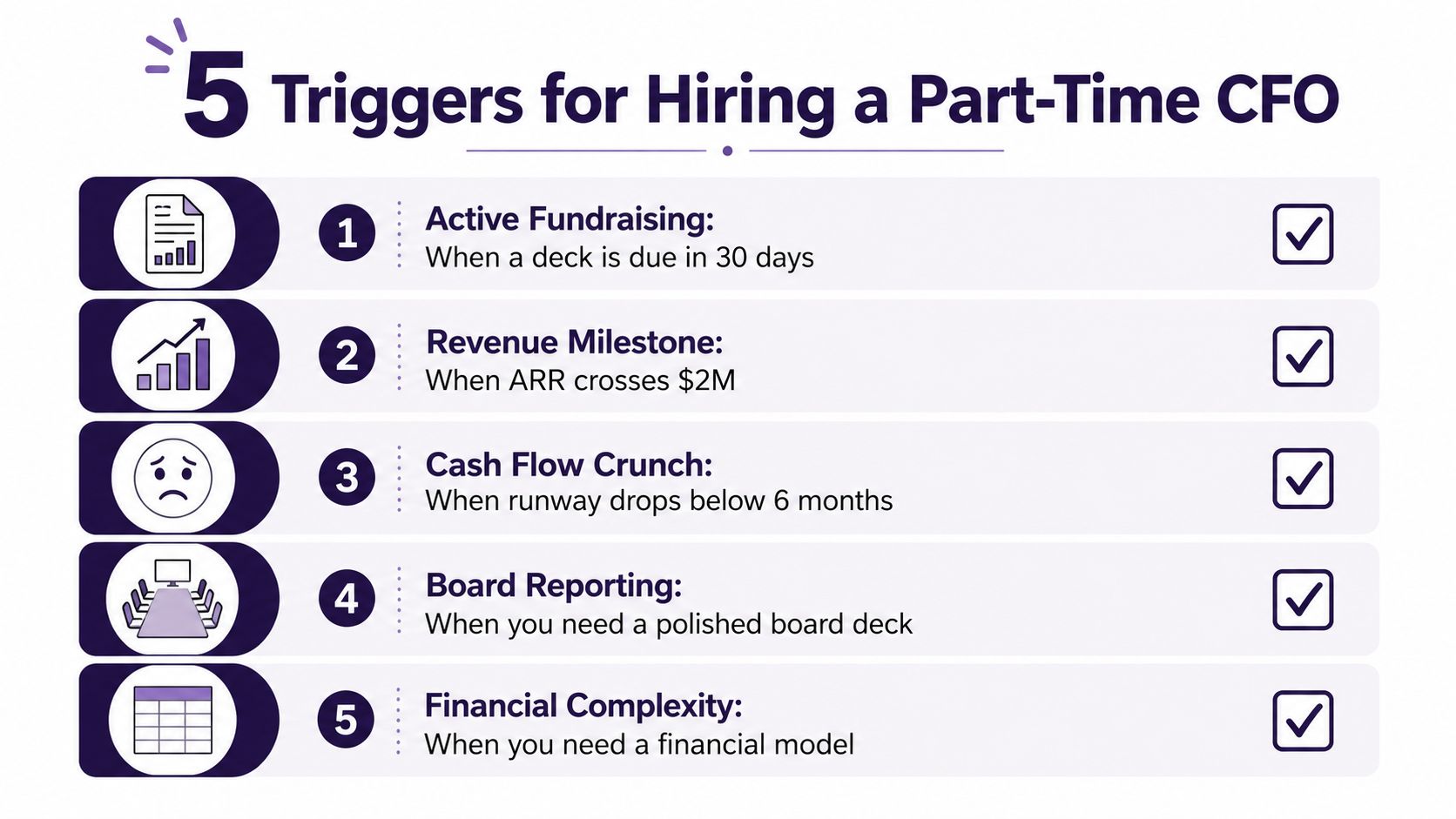
Don't hire a CFO because another startup hired one. Hire one when financial uncertainty creates a measurable operating problem.
The first trigger is active fundraising. If investors will scrutinize the model, data room, revenue assumptions, and use of funds, a founder shouldn't assemble those materials from disconnected spreadsheets. Fundraising work is often episodic, which makes fractional support particularly practical.
Five signals deserve attention
1. The raise is becoming a finance project.
A defensible model must connect pipeline, conversion, hiring, operating expenses, cash needs, and milestones. The CFO should also challenge the amount being raised and the assumptions behind it.
2. Burn is difficult to interpret.
A high spend level isn't automatically a problem. The problem is when the founder can't explain what spending buys, how long cash lasts, or which expense decisions change the outcome. A CFO should turn burn into a set of controllable choices.
3. The board is asking questions the team can't answer.
Once reporting becomes a recurring scramble, finance has moved beyond basic administration. Investors need consistent definitions, reconciliations, variance explanations, and a clear view of what management will do next.
4. Institutional diligence is approaching.
An audit, SOC 2 process, or institutional review can expose weak ownership, undocumented processes, and inconsistent financial records. A CFO coordinates the response and prevents the founder from becoming the project manager for every request.
5. Commercial structure is getting complicated.
Multi-entity operations, subscription and usage revenue, cross-border payroll, changing pricing, and complex contracts all create questions that bookkeeping alone won't answer.
A five-minute founder test
Answer yes or no:
- Cash: Can you explain the next major cash movements without opening several spreadsheets?
- Capital: Would an investor understand and challenge your model without finding basic inconsistencies?
- Reporting: Can you produce the board pack without founder-led manual work?
- Controls: Does someone own audit readiness, financial controls, and documentation?
- Decisions: Can your team quantify the impact of the next hire, pricing move, or expansion?
Several yes answers indicate that the issue is no longer bookkeeping. It is finance capacity, and waiting usually makes the eventual cleanup more expensive and disruptive.
How Part-Time CFO Pricing Really Works
A founder comparing a monthly retainer with a full-time salary is asking the wrong first question. The quote depends on scope, stage, urgency, availability, and the type of work. One CFO may maintain a reporting rhythm, while another leads fundraising, diligence, and finance-team design. Those are different capacity decisions, even if both engagements carry the same title.
Current guides place startup retainers around $3,000 to $12,000 per month and hourly work around $150 to $500 per hour. Fundraising and M&A projects are often priced separately, according to Pilot's fractional CFO cost guide.
Use the pricing model that matches the work:
| Model | Typical Range | Best For | Watch Out For |
|---|---|---|---|
| Retainer | $3,000 to $12,000 per month | Ongoing forecasting, reporting, and executive support | Undefined availability and scope creep |
| Hourly | $175 to $450 per hour in common benchmarks | Targeted advisory or limited recurring work | A low hour estimate that expands every month |
| Project-based | Priced separately from the retainer | Fundraising, audit preparation, or M&A diligence | Deliverables that aren't specific enough to verify |
Capacity should follow the decision load. Lighter advisory work may require 8 to 10 hours monthly. Fundraising often reaches 15 to 20 hours, while heavier engagements can require 25 to 30 hours. Guide-level pricing is around $2,000 to $5,000, $5,000 to $10,000, and $10,000 to $15,000 for those levels, as outlined by Kore1's startup engagement ranges.
The full-time comparison provides context, not a target. Early-stage guides place comparable CFO compensation around $180,000 to $400,000 or more annually. Series B benchmarks cite $350,000 to $500,000 or more all-in, according to startup CFO pricing guidance and Series B cost benchmarking. A fractional model prevents the company from paying for unused executive capacity, but strategic finance still costs money.
Put five terms in writing before signing:
- Hours and response times: State monthly capacity and define urgent requests.
- Deliverables: Name the forecast, board pack, model, dashboards, or diligence outputs.
- Meeting rhythm: Agree on CEO meetings, team reviews, and board preparation.
- Extra work: Clarify whether fundraising sprints, travel, or transaction support cost more.
- Exit terms: Set the trigger for shifting from fractional support to a full-time operator.
A founder should also review these part-time CFO cost considerations before approving the budget. Price predictability comes from precise scope. The exit clause matters just as much, because part-time support should expand or end when the company's capacity needs change.
Two Startups, Two Very Different Engagements
A part-time CFO doesn't come with a fixed job description. The same executive can be a lightweight financial architect for one company and an interim finance leader for another. The difference is not the title. It is the company's decision load, data quality, transaction complexity, and need for executive presence.
Consider a pre-seed SaaS company with nine months of runway, two engineers, and a founder managing all finance in a spreadsheet. The company doesn't need a permanent finance department. It needs control over cash and a credible way to communicate with investors.
The pre-seed operating model
The CFO works 8 to 12 hours per month. The initial priorities are deliberately narrow:
- Close the books with the existing accounting support.
- Build a 13-week cash forecast.
- Establish a basic chart of accounts in QuickBooks.
- Separate committed costs from discretionary spending.
- Prepare the founder for the first investor update.
The engagement is mostly about visibility. The CFO doesn't attend every product meeting or manage daily transactions. They create the structure the founder can use between sessions, then review the decisions that could materially affect runway.
Now compare that with a Series A fintech company at $3 million in ARR, closing its first institutional audit and preparing for a Series B. The same type of executive may be contracted for 60 to 80 hours per month, because the company isn't asking for light advisory coverage anymore.
The Series A operating model
The CFO now leads diligence, redesigns the financial model, hires a controller, and sits on the operating committee. They need deeper access to revenue systems, contracts, payroll, compliance documentation, and leadership decisions.
The relationship changes in three ways:
- The work becomes continuous. Audit requests, investor questions, and operating reviews arrive throughout the month.
- The CFO manages people and systems. A controller hire and finance-process redesign require ongoing supervision.
- The executive becomes part of the operating cadence. They aren't just preparing materials. They are shaping decisions with the leadership team.
Those cases show why simple hourly comparisons mislead. Early-stage benefit concentrates in cash visibility and founder guidance. Later, it shifts toward controls, diligence, team leadership, and institutional readiness. If the engagement is approaching the workload of a full-time executive, the company should evaluate whether the fractional arrangement is still a capacity advantage.
Hiring Checklist and Questions Founders Should Ask
Founders often hire a fractional CFO like a vendor. They skim a résumé, take a pleasant introductory call, and sign before defining what success means. That process selects for polish, not judgment.
Start with the problem. Fundraising preparation, burn control, board reporting, audit readiness, and commercial complexity require different experience. A CFO who excels at SaaS forecasting may not be the right choice for fintech controls or cross-border operations.
Set the engagement up before the interview
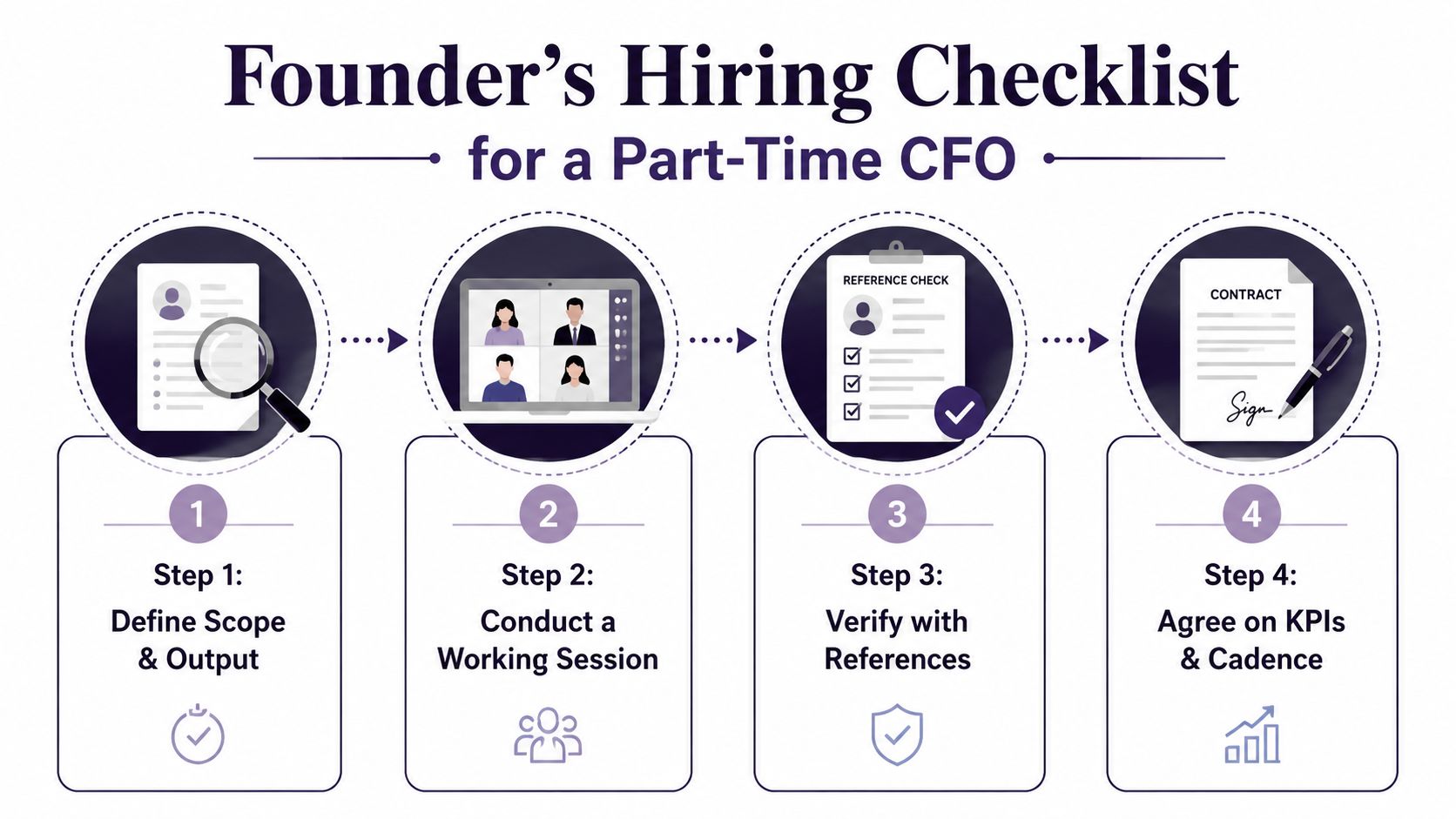
Write down:
- The business problem: State the decision or recurring failure the CFO must fix.
- The outputs: Name the model, forecast, board materials, dashboards, or diligence package.
- The capacity: Define monthly hours, meeting cadence, response expectations, and availability.
- The reporting line: Make the CEO accountable for prioritization and the CFO accountable for finance outcomes.
- The access plan: List accounting, banking, payroll, CRM, revenue, cap-table, and data-room permissions.
- The reference standard: Speak with a founder whose company had a similar stage and finance challenge.
Ask questions that reveal operating judgment
A strong interview should include a working session, not only a résumé review. Ask the candidate to:
- Walk through a 13-week cash forecast they've built, including the assumptions they challenged.
- Explain how they'd respond to a sudden 30% revenue miss, with attention to timing, communication, and decision priorities.
- Describe the first 30 days of an engagement in concrete deliverables.
- Name a time they told a founder not to raise, and explain the reasoning.
- Show how they'd handle incomplete or conflicting data without pretending the inputs are clean.
- Identify what they wouldn't work on during the first month.
Use these CFO interview questions to extend the conversation. The aim isn't to find the most impressive résumé. It's to find someone who can state what matters, challenge a founder respectfully, and finish the work without creating dependency.
A job description worth adapting
Scope: Own cash forecasting, investor reporting, financial modeling, and fundraising readiness for an early-stage startup.
Hours: Define the expected monthly capacity and peak periods.
Reporting line: CEO.
Compensation: State the approved range and separate project work from recurring support.
Cadence: Weekly CEO review, monthly reporting cycle, and board preparation as needed.
Start date: Include the date by which systems access and onboarding must begin.
Specificity attracts serious candidates. It also makes it easier to identify when the work has expanded beyond the original agreement.
When a Part-Time CFO Stops Being Enough
A part-time CFO stops working when the company's decisions require more access than the engagement provides. The early signs appear in the operating rhythm: investor questions sit unanswered, close cycles slip, and scheduled finance time goes to basic cleanup instead of judgment.
Pay attention to the pattern, not one difficult week. If every meeting begins with unresolved operational work, strategic analysis is already being displaced.
Capacity, not performance, sets the exit point
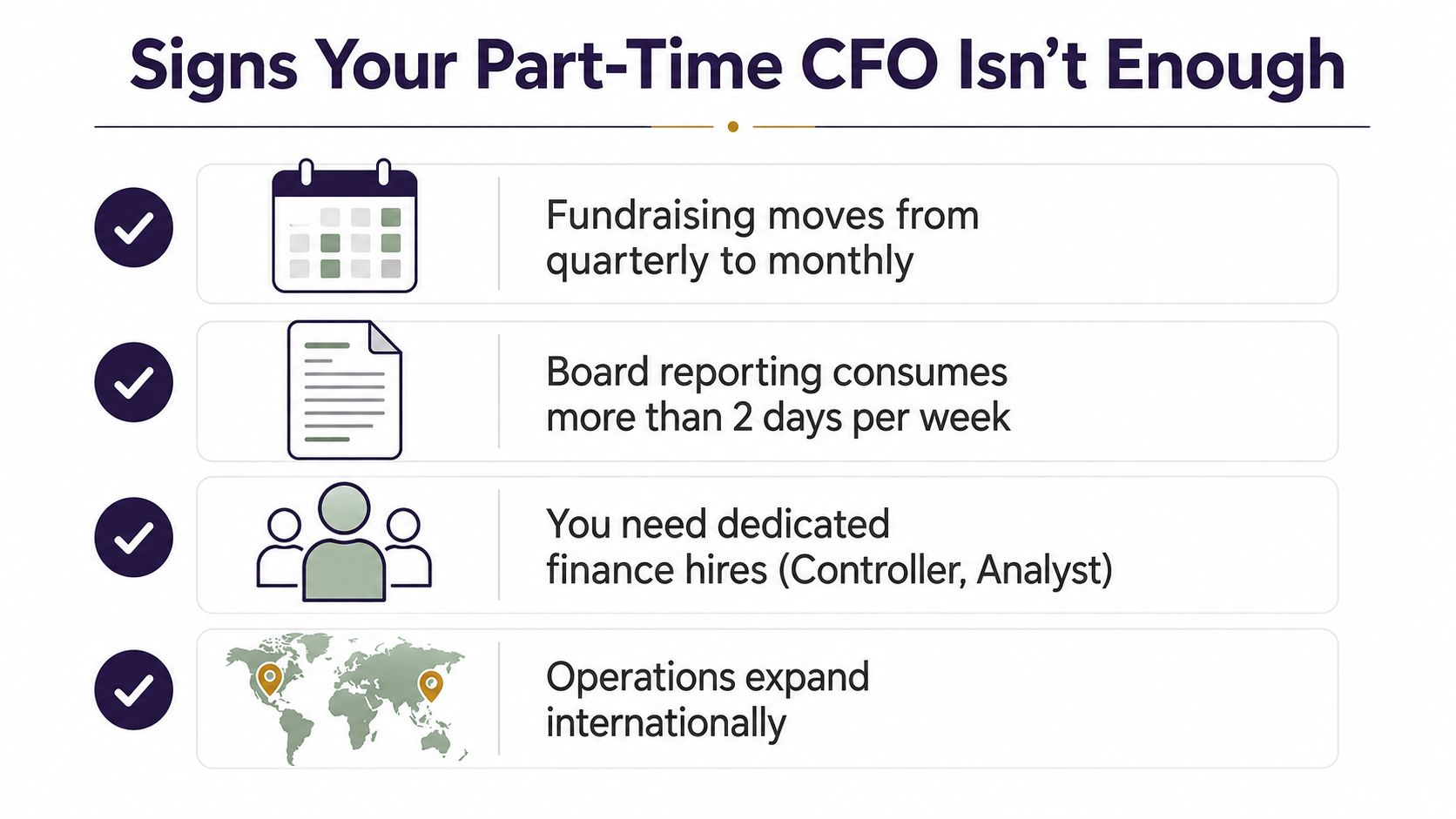
The model has reached its limit when:
- Fundraising becomes recurring: Investor preparation is no longer tied to one milestone and now occupies regular leadership time.
- Board reporting needs constant ownership: Materials require ongoing executive involvement rather than a defined monthly cycle.
- Finance management becomes daily work: Controllers, analysts, or other finance hires need supervision that the fractional CFO cannot provide in limited blocks.
- The business structure grows harder to control: International operations, multiple entities, transactions, or stronger controls demand continuous ownership.
- Leadership needs immediate access: Same-day investor calls and operating decisions cannot wait for the next available fractional block.
- A major transaction enters the plan: M&A, a significant financing, or complex diligence requires an operator present throughout the process.
Move to dedicated coverage when the company's strategic decisions outpace the hours available, not only after the part-time CFO has failed.
Start the handoff before the workload becomes a crisis. Have the fractional CFO document processes, map the finance organization, draft the full-time job description, and join candidate interviews. They can onboard the incoming CFO, transfer the financial model and reporting calendar, and remain briefly to preserve continuity.
The best transition treats fractional support as a capacity-building assignment with a defined exit. A strong CFO will say when the company needs dedicated coverage, even when that decision reduces their own engagement. That candor protects the business from stretching a part-time model past its useful life.
How Shiny Matches Startups With the Right Fractional CFO
Sourcing is where many founder-led searches lose time. Founders ask their network, interview generalists, compare conflicting recommendations, and negotiate terms while the underlying finance problem continues.
Shiny's marketplace uses a brief-based matching process. The founder submits the company's stage, runway, fundraising timing, industry, and required scope. The platform then presents a vetted shortlist of executives whose experience and availability fit the assignment.
A practical matching workflow
Start with the operating brief. Include the current finance stack, reporting weaknesses, upcoming transaction, and the decisions the CFO must support. A precise brief produces a more useful shortlist than a generic request for “startup finance help.”
Review relevant experience. Compare candidates by experience with SaaS, fintech, marketplaces, hardware, biotech, or another applicable business model. Sector context affects revenue recognition, metrics, controls, and investor expectations.
Hold focused introductory calls. Use the same questions with each candidate, then test one real scenario from the business. Ask what they would deliver first, which inputs they need, and what they believe should remain outside scope.
Select the engagement model. Agree on a retainer, hourly arrangement, or defined project. Document hours, deliverables, response times, data access, and the conditions that would trigger a transition.
Launch with a 30-day plan. The first month should produce visible finance infrastructure, such as a cash forecast, reporting calendar, model diagnosis, or diligence action list. The founder should know what is complete and what remains open.
Shiny is designed to compress a search that can otherwise take months into roughly a week, based on its marketplace positioning and the workflow described in the company information provided for this guide. The platform can help founders compare screened candidates, schedule conversations, and move toward a defined engagement without treating the CFO search as an open-ended recruiting project.
The important point is fit, not speed alone. A fast match to the wrong executive creates more work. A focused brief, a practical interview, and an explicit exit plan give the part-time model a better chance of delivering the capacity the startup needs.
Shiny connects startups with vetted fractional executives, including CFOs, for defined part-time finance leadership. Visit Shiny to explore the marketplace or schedule a consultation about the finance capacity your company needs next.