
What Is a Fractional CIO and How One Can Help
A fractional CIO is a highly experienced IT leader who works part-time, often for multiple companies at once, carrying real CIO-level authority for IT strategy, vendors, and cybersecurity without the full-time salary. Engagements commonly range from 8 to 15 hours per month, while more involved arrangements can reach 2 to 3 days per week, depending on the company's needs and the leader's commitment, as outlined by fractional CIO market guidance and UK fractional leadership pricing guidance.
Your company may be growing quickly, but the technology behind that growth probably wasn't designed all at once. Revenue is climbing, employees have adopted different tools for different jobs, vendors keep proposing expensive upgrades, and the person who knows the systems best may not be equipped to set the company's technology direction. The CEO still ends up deciding whether to replace the CRM, respond to a security concern, or approve another software contract.
That's usually when founders search for what is a fractional CIO. They aren't looking for another consultant to write a report. They need an experienced technology executive who can take the leadership seat part-time, make decisions within an agreed mandate, and stay accountable for whether the technology plan works.
The practical question isn't only whether you need senior IT leadership. It's where accountability should sit, how much authority the role needs, and whether the business has enough complexity to justify a full-time CIO. By the end, you'll be able to assess the role's duties, compare it with a full-time CIO or IT consultant, understand pricing structures, and recognize the signals that make fractional leadership either a strong fit or a poor one.
Why Growing Companies Are Asking This Question
Growing companies hit the same wall: technology decisions multiply faster than anyone owns them. A software company may have an internal IT manager, an outsourced help desk, several cloud platforms, and a security product bought after a customer questionnaire exposed gaps. Each choice made sense at the time. Together, they can create duplicated work, unclear ownership, and contracts that renew without anyone checking whether they still support the business.
The founder usually sees the gap in a planning meeting. The IT manager can explain what each system does, yet nobody can say which systems the company should keep, which risks deserve executive attention, or how technology spending supports the next stage of growth. At that point, what is a fractional CIO becomes a business question rather than a search query.
A fractional CIO is a senior IT executive who performs the CIO function on a part-time or contract basis. Academic research describes the role as an experienced IT leader who acts as a CIO according to client needs, often serving multiple clients while carrying the authority and responsibility associated with the position. The work can include managing internal IT staff and suppliers, not only making recommendations, as described in the peer-reviewed research on fractional CIOs and SMEs.
An MSP, systems administrator, or engineering leader may keep systems operating. A fractional CIO determines whether the operating model, security posture, vendors, and technology roadmap fit the company's objectives. That distinction places accountability at the executive level. The internal team can continue handling daily operations, while the fractional CIO owns agreed technology decisions and follows through on their outcomes.
The model now serves more than companies seeking a temporary cost workaround. Industry analysis reports a global fractional executive economy above $5.7 billion in 2024 to 2025, growing by about 14% annually, with demand for fractional CIOs and CTOs reportedly rising 68% year over year from 2023 to 2024, according to industry analysis of fractional executive demand.
For a founder, the decision is about ownership. If technology affects revenue, customer trust, compliance, or operational scale, someone must own the decisions and their consequences. A fractional CIO can fill that leadership gap before a full-time executive makes financial or organizational sense.
Understanding the Fractional CIO Role and Its Core Duties
A founder approves a major software purchase, the IT manager raises security concerns, and an MSP recommends a different system. Each person may have useful information, but who makes the final technology decision, accepts the risk, and checks whether the result serves the business?
A fractional CIO clarifies those decision rights. They do not handle every technical task. They decide which technology choices matter, set priorities, coordinate the people and suppliers involved, and remain accountable for agreed outcomes throughout the engagement.
Core definition: A fractional CIO is an experienced technology leader who performs the CIO role part-time, with responsibility for strategy, governance, suppliers, security, and technology outcomes aligned to the company's needs.
The role has formal grounding in academic literature. The 2022 peer-reviewed study of fractional CIOs describes a leadership model that can carry CIO-level authority while managing client IT staff and suppliers. That responsibility distinguishes the role from a consultant who delivers a one-off report. The fractional leader stays involved in governance and helps ensure decisions are carried through.
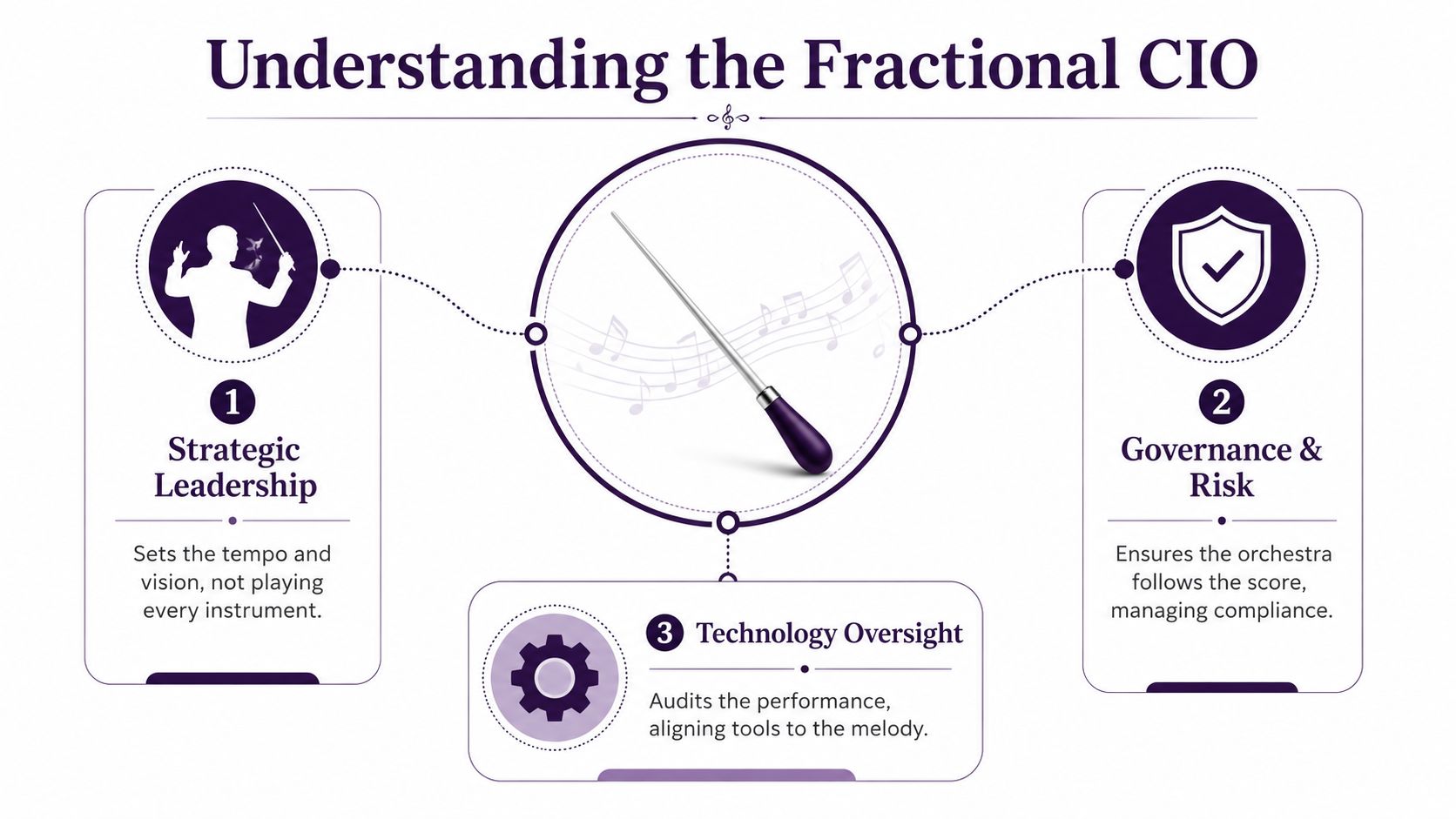
The responsibilities that define the role
IT strategy and roadmapping connect business plans to technology priorities. The CIO identifies dependencies and creates a roadmap that states what should happen, why it matters, and who owns delivery. A founder should receive clear tradeoffs, not a shopping list of tools.
Digital transformation leadership covers changes such as moving core systems, updating infrastructure, improving data practices, or introducing AI into workflows. The fractional CIO tests whether an initiative addresses a real business problem before the company commits people and money to execution.
Vendor and supplier oversight gives the business one informed decision-maker during renewals, procurement, escalations, and contract reviews. The CIO may not negotiate every clause, but they define requirements, question unsuitable recommendations, and check that suppliers meet agreed responsibilities.
Cybersecurity governance sets the company's risk posture, clarifies controls, assigns ownership, and coordinates remediation. A fractional CIO is not automatically a penetration tester or incident responder. They make sure specialists, internal teams, and vendors work from an executive-approved security plan.
Compliance coordination links technology controls with legal, customer, and audit obligations. The CIO helps finance, legal, security, and operations understand what must be documented and who must close each gap.
Internal team coaching builds capability beyond the engagement. The leader can mentor an IT manager, improve escalation paths, and teach the team to make decisions against the roadmap instead of waiting for the CEO.
Use this checklist to test the fit:
- Direction: Is there a documented technology strategy?
- Governance: Does someone approve priorities and accept technology risk?
- Suppliers: Does one accountable leader oversee MSPs, software vendors, and specialists?
- Security: Can the company explain its security posture and remediation priorities?
- People: Does the internal IT team know what it owns and when to escalate?
Several “no” answers point to a leadership gap. Buying another technical product will not resolve unclear ownership. A fractional CIO may be the better next decision when the founder needs one person to set direction and stand behind the result.
Fractional CIO vs Full-Time CIO vs IT Consultant
A founder choosing among these roles is really choosing where accountability sits. A full-time CIO occupies the leadership seat every day and carries the ongoing cost of a senior executive. An IT consultant usually owns a defined assignment, such as selecting software or preparing an assessment. A fractional CIO holds the leadership seat part-time, with responsibility for agreed decisions and outcomes.
The cost difference matters, but it is not the whole decision. A full-time CIO compensation package often exceeds $200,000 annually in major markets, before broader employment costs, according to fractional IT leadership cost guidance. A fractional CIO usually works through a retainer, project fee, or other part-time arrangement. A consultant may cost less for a narrow task, while the company keeps responsibility for converting the recommendation into an operating decision.
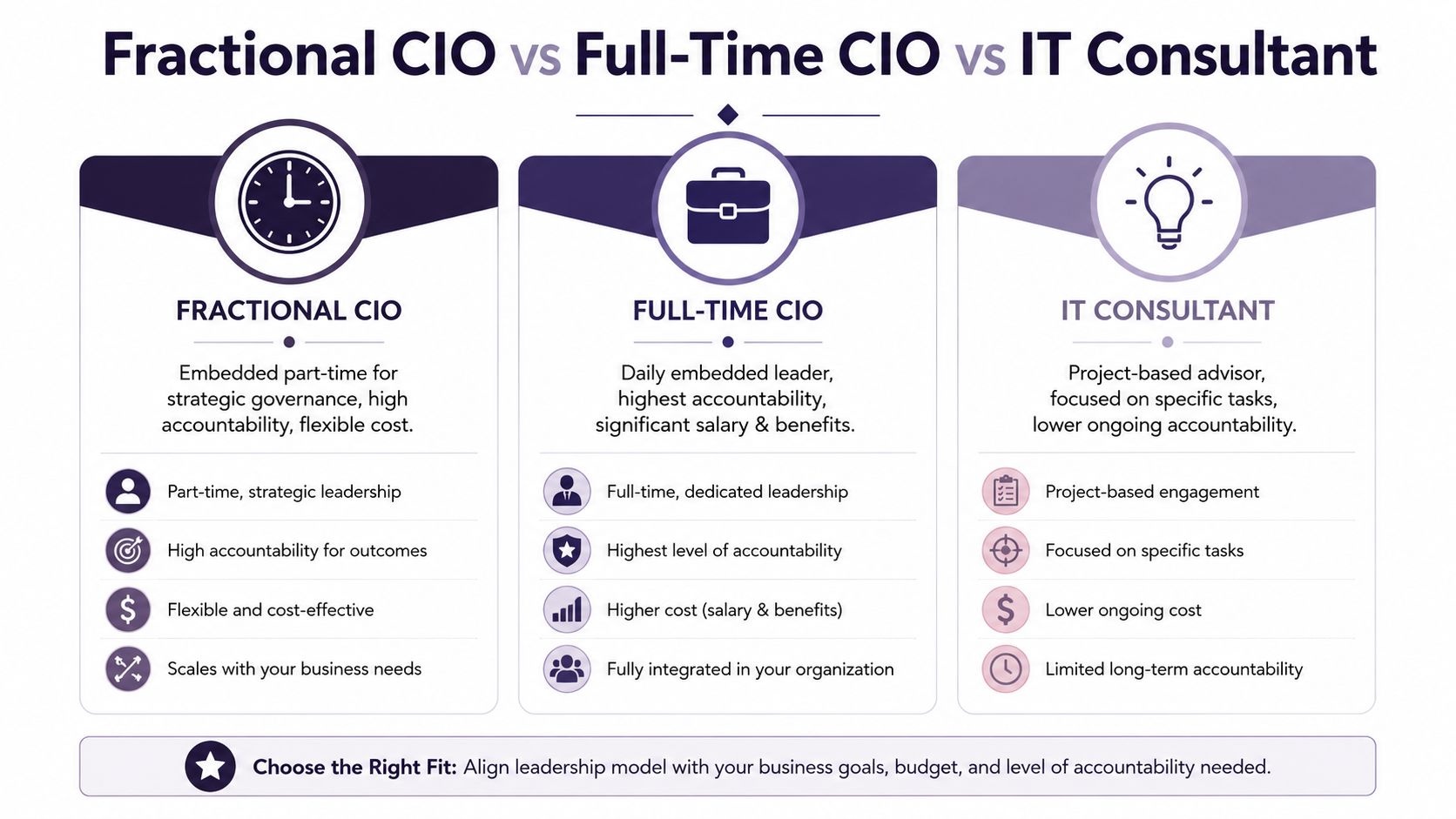
Comparison at a glance
| Attribute | Fractional CIO | Full-Time CIO | IT Consultant |
|---|---|---|---|
| Commitment level | Part-time, recurring engagement | Daily, ongoing employment | Defined project or assignment |
| Accountability | Owns agreed technology outcomes and governance | Owns the full technology function | Owns deliverables within a scope |
| Cost structure | Retainer, project fee, or hourly arrangement | Salary, benefits, and employment costs | Project or hourly fee |
| Best fit | Growth-stage company needing executive direction | Organization needing daily executive leadership | Company needing specialist advice or a discrete deliverable |
| Internal presence | Regular leadership participation | Continuous organizational presence | Limited to the project or advisory need |
A fractional CIO should own the technology roadmap, prioritization process, vendor recommendations, security posture, and executive reporting when the engagement assigns those duties. The CEO retains corporate strategy, risk appetite, and decisions that affect the whole company. The finance lead controls budget approval and financial controls. An MSP remains responsible for contracted operational services, while an internal IT manager handles assigned execution and team management.
These boundaries need to be written into the engagement. If the CIO can recommend a vendor but cannot approve the selection, accountability stops at the recommendation. If the CIO receives unlimited authority over budgets, personnel, and risk, the company may create a governance problem instead.
Practical rule: The person accountable for an outcome needs enough decision rights to influence it.
The models can also work together. A fractional CIO may set the roadmap and make executive recommendations, an MSP may run support, a security specialist may perform technical testing, and an internal manager may oversee daily operations. The CEO remains the final owner of company-wide priorities and risk.
For a broader explanation of the executive role, see this guide to what a chief information officer does.
How Fractional CIO Pricing Works
A founder comparing fractional CIO proposals is buying access to judgment, not blocks of calendar time. A light advisory engagement might cover a few hours each month for executive decisions and roadmap review. A transformation engagement requires more involvement because the CIO may coordinate vendors, staff, security work, and implementation choices.
The fee structure usually follows one of three models:
- Monthly retainer: The company pays for an agreed level of recurring access, governance, and deliverables. This suits businesses whose priorities change while executive guidance remains ongoing.
- Project fee: The CIO prices a defined transformation, audit preparation effort, or technology planning assignment. The agreement should explain what happens if the work reveals additional requirements.
- Hourly arrangement: The business pays for access as needed. This can fit a short advisory question, but it may encourage the company to buy too little time when sustained leadership is required.
Published guidance lists monthly fractional CIO retainers from $5,000 to $15,000, with complex engagements reaching $22,000. Hourly marketplace rates commonly range from $200 to $450, according to a 2026 fractional CIO cost guide. UK guidance describes 4 to 8 hours per month at approximately £1,795 to £3,500, 1 to 2 days per week at £4,000 to £8,000, and 2 to 3 days per week at £8,000 to £14,000, as shown in UK fractional CIO engagement guidance.
Fractional CIO cost benchmarks
| Engagement Type | Typical Cost | Rate Basis |
|---|---|---|
| Advisory, 4 to 8 hours per month | £1,795 to £3,500 | Monthly retainer |
| Standard, 1 to 2 days per week | £4,000 to £8,000 | Monthly retainer |
| Intensive, 2 to 3 days per week | £8,000 to £14,000 | Monthly retainer |
| Broader market engagement | $5,000 to $15,000 per month | Monthly retainer |
| Complex engagement | Up to $22,000 per month | Scope and commitment |
| Marketplace access | $200 to $450 per hour | Hourly rate |
These figures use different currencies and describe different scopes, so they are not universal quotes. They show how cost rises with access and complexity. Compare the proposal with the commitment of a full-time CIO, which often exceeds $200,000 annually, rather than with the lowest consultant rate.
Treat the first 90 days as a separate phase. Discovery, contract review, security assessment, roadmap creation, and decision-rights design can demand concentrated effort. A company that buys too few hours may receive a polished strategy without enough leadership to put it into practice.
Before approving a fee, ask the candidate to specify deliverables, required meetings, decision authority, and the point at which additional work needs approval. The clearest proposal connects payment to outcomes the CIO can influence, not merely time spent.
When to Hire a Fractional CIO and When Not To
A founder may face a growing technology budget, an upcoming security audit, an AI initiative, a failing vendor relationship, or a board requesting clearer technology governance. These situations signal a need for executive ownership, especially when the internal team can do the technical work but nobody is accountable for choosing priorities and accepting risk.
Decision complexity determines whether a fractional CIO fits. Several teams, suppliers, risks, and business goals may need to move together. A fractional CIO provides the decision structure, while the CEO retains business accountability and internal IT retains responsibility for execution within its technical remit.
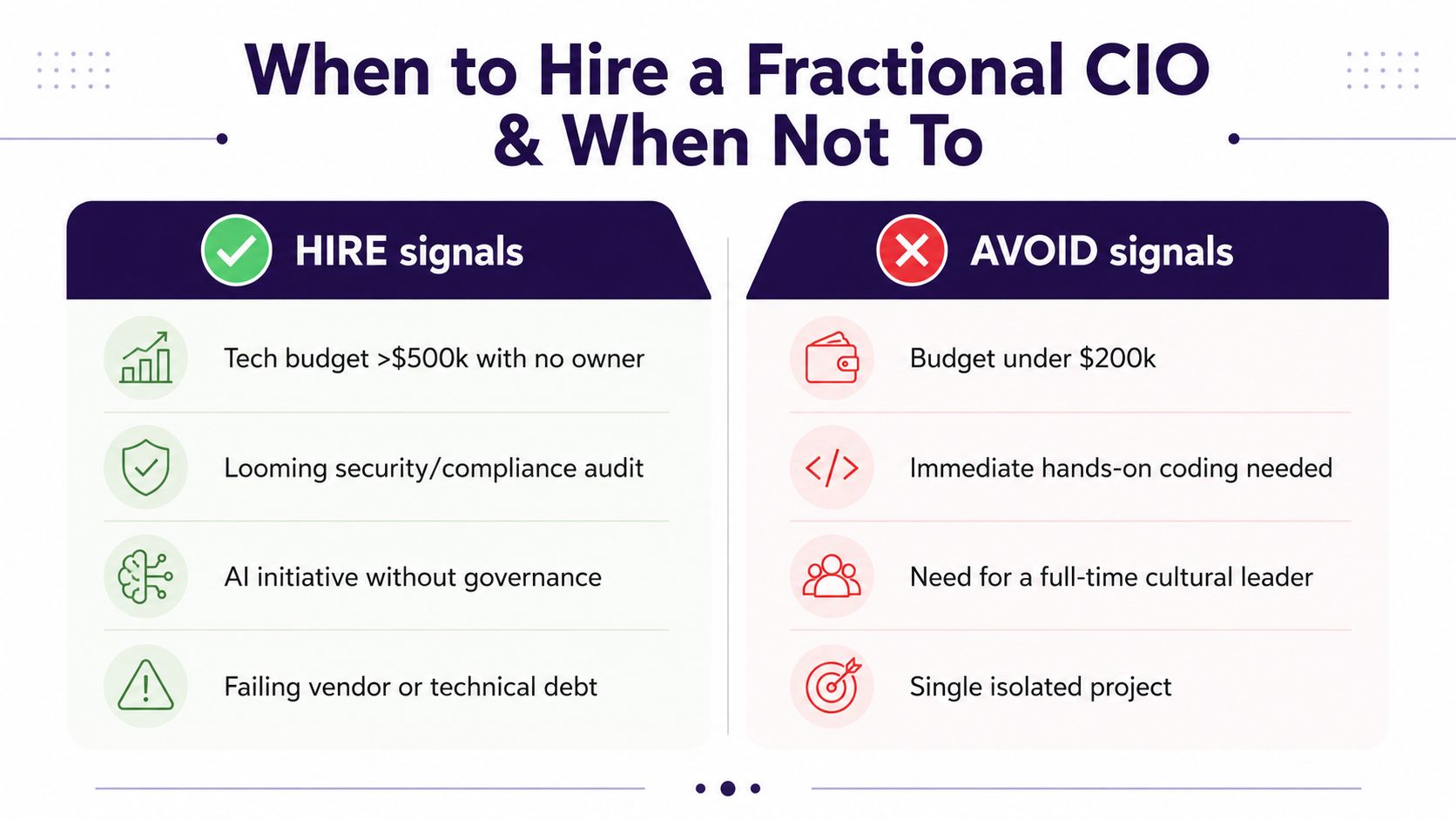
Signals that support a fractional hire
- Unowned technology spending: Finance sees recurring software and infrastructure costs, but no executive can explain which investments support business goals.
- Security or compliance pressure: An audit is approaching, customer requirements are tightening, or remediation work has no senior owner.
- AI without governance: Teams want to deploy AI, but nobody has set acceptable-use rules, data safeguards, vendor review, or accountability.
- Vendor breakdown: An MSP or strategic supplier misses expectations, while internal staff lack the authority or experience to reset the relationship.
- Transformation without sequencing: Leaders approve initiatives that compete for the same people, systems, or budget.
- Board-level credibility needs: Directors want a clear view of technology risk and one accountable executive voice.
In these cases, the fractional CIO owns prioritization, governance, and escalation. Internal IT can implement the plan, and specialist providers can perform focused work. For example, the CIO may define an AI roadmap or coordinate security remediation without personally configuring systems. The CEO still decides how much risk and investment the company will accept.
Signals that point elsewhere
Part-time leadership can become too thin when the company needs daily operational command. Frequent outages, infrastructure changes, personnel decisions, or incident response may require a full-time CIO who is present for every escalation and operating decision.
A permanent leader may also suit heavy regulatory complexity or a transformation spanning security, data, architecture, and change management. A fractional CIO can support the transition, but sustained coordination across these areas may justify a full-time hire and specialist team.
A small, isolated project needs a narrower solution. Hire a consultant or specialist when the outcome is defined, decision rights are already clear, and the company has no continuing governance gap.
The guidance on fractional CIO fit for cybersecurity, AI, and transformation supports matching the model to workload and risk. For a temporary leadership gap, an interim chief information officer may provide clearer authority until the company decides whether to appoint a permanent CIO.
Real-World Fractional CIO Use Cases for Startups
A startup may have strong engineers, reliable vendors, and a founder who makes every technology decision. Growth exposes the gap: nobody owns the decisions that connect architecture, risk, suppliers, and business priorities. The following scenarios show where a fractional CIO can take accountability without replacing the internal team.
A SaaS startup preparing for its first major funding round has capable developers but no technology roadmap beyond the next release. The founder brings in a fractional CIO for 5 to 25 hours per week, then assigns clear authority over technology planning and executive reporting. The CIO maps the product architecture, sets infrastructure priorities, reviews security expectations, and prepares an executive-level plan. The engineering lead still owns implementation. The fractional CIO owns the sequence of decisions, so investors receive a credible explanation of how the platform can scale.
A FinTech company faces pressure from customers and partners to demonstrate control over access, vendors, data, and incident response. Its compliance lead understands the requirements, and its technical team knows the systems, yet no one owns the complete technology risk picture. The fractional CIO coordinates both groups, sets remediation priorities, challenges supplier commitments, and reports unresolved risks to the CEO. The CEO decides which risks and investments the company will accept. The CIO makes sure those choices are documented, assigned, and followed through.
An e-commerce business has accumulated payment tools, analytics platforms, marketing integrations, inventory systems, and customer-service applications. The problem is overlapping software and unclear integration risk. The fractional CIO inventories the stack, links each system to a business capability, reviews renewal decisions, and creates a modernization sequence for internal teams and suppliers to execute. The founder retains budget authority, while the CIO owns the recommendation and governance process.
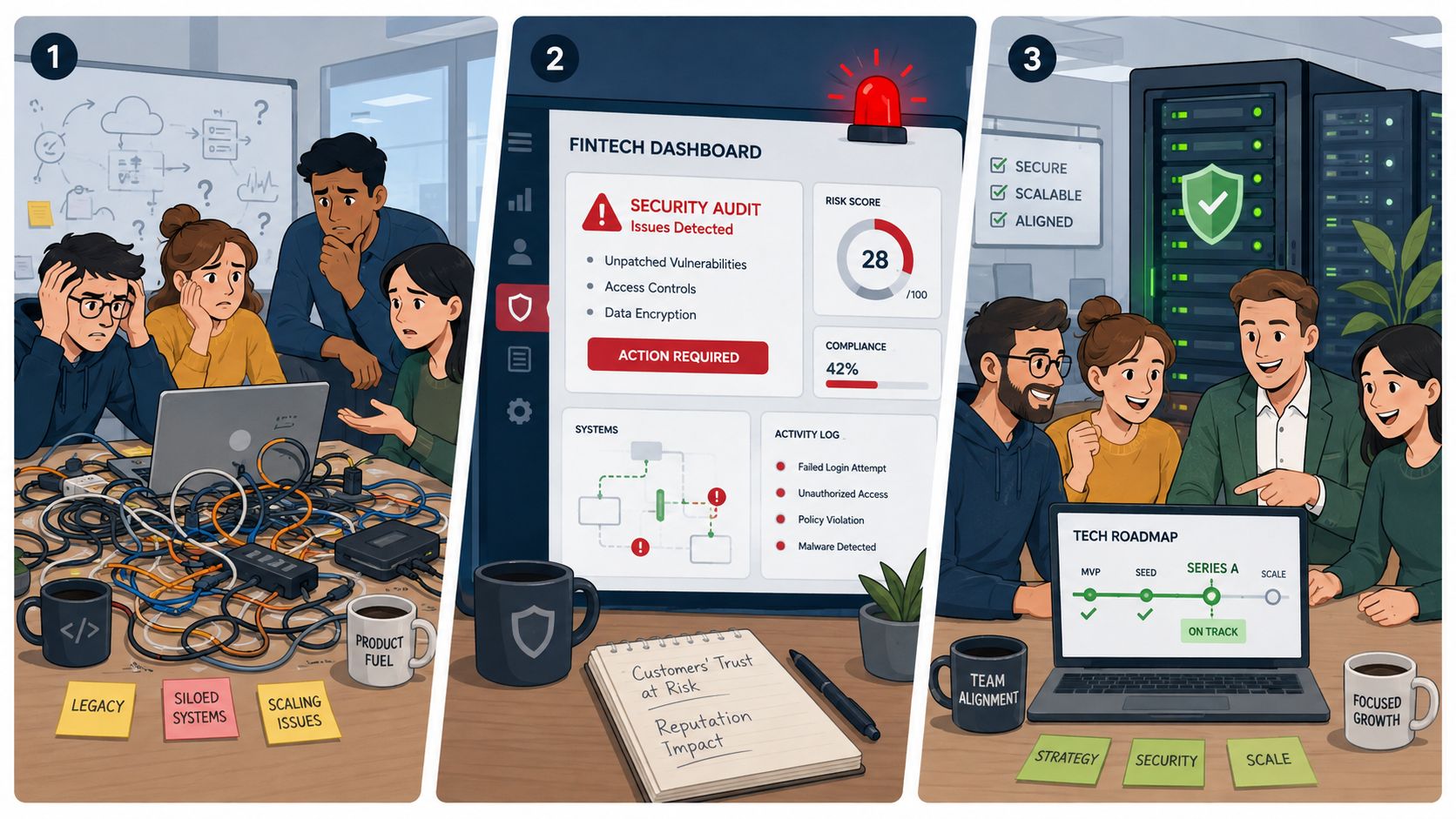
How a marketplace changes the search
Founders may struggle to source senior technology leaders because their personal networks do not include experienced CIOs. A fractional executive marketplace can organize the search:
- Role definition: The company describes its objectives, constraints, required availability, and decision authority.
- Candidate matching: The platform compares the role with a vetted executive pool and presents relevant profiles.
- Structured interviews: The founder evaluates leadership style, operating experience, and technical judgment against the actual need.
- Onboarding support: The engagement begins with agreed scope, access, reporting, and working rhythms.
Shiny offers this marketplace approach, connecting companies with vetted executives across SaaS, FinTech, HealthTech, Ecommerce, AI, manufacturing, professional services, and energy. Its platform supports job posting, candidate matching, interviews, and onboarding, giving founders a structured alternative to informal referrals.
The sourcing method matters less than the operating agreement. Before signing, the founder should identify which decisions the fractional CIO owns, which remain with the CEO, and which stay with internal IT. That clarity determines whether the engagement produces accountable leadership or another layer of advice.
Onboarding Your Fractional CIO and Measuring Success
A fractional CIO should enter with a decision brief, not just a calendar invitation. Provide contracts, system inventories, risk registers, budgets, vendor contacts, and active initiatives. Schedule listening sessions with the CEO, finance lead, internal IT manager, security owner, and business stakeholders so the CIO can distinguish facts from assumptions.
The first 90 days should create a clear operating pattern:
- Discovery and listening: Record systems, suppliers, obligations, risks, team responsibilities, and unresolved decisions.
- Prioritized roadmap: Rank urgent risks separately from modernization work, and connect each priority to a business outcome.
- Quick wins: Resolve a vendor escalation, assign an ownership gap, remove a redundant tool, or organize security remediation.
- Steady-state governance: Set decision meetings, reporting, risk escalation, roadmap reviews, and supplier accountability.
Use executive onboarding best practices to establish the CIO as an accountable leader rather than an external adviser.
A practical success checklist
- Roadmap: Leadership has a technology plan tied to business priorities.
- Ownership: Each major initiative has a named decision-maker and delivery owner.
- Risk: Audit and security findings have priorities, owners, and due dates.
- Suppliers: Leadership can see vendor performance, renewals, and escalation paths.
- Team capability: Internal staff handle more routine decisions without escalation.
- Executive communication: The CEO and finance lead receive concise updates on investment, risk, and progress.
The founder still owns company strategy and final tradeoffs. Internal IT owns day-to-day delivery unless the operating agreement assigns otherwise. The fractional CIO owns the technology decisions and governance explicitly delegated to the role.
Success means the company makes faster, safer, more coherent decisions, with less dependence on one executive's constant intervention.
If you are deciding whether your company needs a fractional CIO, Shiny can help define the role, match you with vetted fractional executives, and structure onboarding around your technology priorities.