10 Vendor Management Best Practices to Scale Your Business
For fast-growing companies, managing external partners can quickly devolve into a chaotic mix of spreadsheets, missed deadlines, and unclear ROI. You hire experts to save time and accelerate growth, but without a clear framework, you spend more time managing them than benefiting from their expertise. This isn't just an administrative headache; it's a strategic bottleneck that stifles innovation and drains resources.
Effective vendor management isn't about rigid bureaucracy. It’s about building a scalable system that turns your external talent—from software providers to specialized consultants—into a powerful, integrated extension of your core team. By implementing proven vendor management best practices, you can reduce risk, optimize costs, and ensure every dollar spent on external help directly contributes to your strategic goals.
Think of it like building a championship sports team. You don't just sign star players; you need a general manager who understands how to scout talent, negotiate contracts, and create a system where everyone's skills complement each other to achieve a common goal. A well-managed vendor ecosystem provides the leverage needed to compete with larger players, allowing you to access top-tier talent without the overhead of full-time hires.
This guide provides 10 actionable vendor management best practices specifically designed for an agile, high-stakes environment. We'll explore how to build a robust framework that maximizes the value of every partnership, with a special focus on how fractional executives can both implement and thrive within this system.
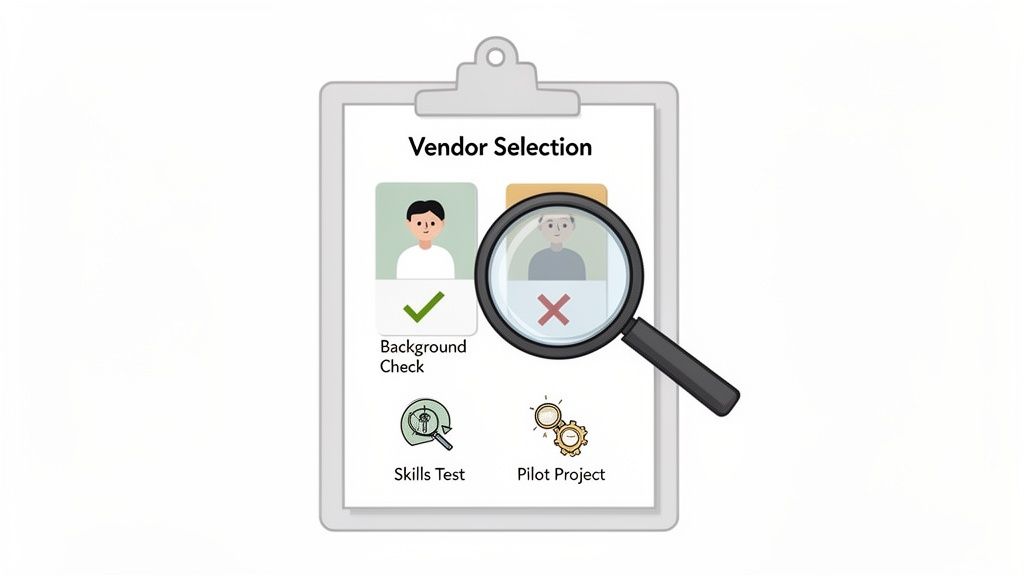
1. Establish Clear Vendor Selection Criteria and a Rigorous Vetting Process
One of the most critical vendor management best practices is starting before a contract is even signed. Establishing a standardized, documented framework for evaluating and selecting vendors eliminates inconsistency, reduces risk, and ensures every partner aligns with your company's strategic goals. This proactive approach moves beyond simple cost comparisons to a more holistic evaluation of value, reliability, and fit.
For a growing business, where a single poor vendor choice can derail a critical project, this structured process is non-negotiable. It involves defining your ideal vendor profile before you even begin your search. This includes required qualifications, specific industry expertise, technical capabilities, and even cultural alignment.
How to Implement a Structured Vetting Process
A robust vetting process validates a vendor's claims and predicts their future performance. Consider a multi-stage approach similar to how top companies hire key talent. For more insights into creating a structured evaluation system, you can explore these detailed recruiting best practices.
Here’s a practical, tiered model you can adopt:
- Initial Screening: Review proposals against your predefined criteria.
- Skills Validation: Use skills assessments or request detailed, relevant case studies that mirror your challenges.
- Stakeholder Interviews: Involve key team members who will work directly with the vendor to gauge collaboration and cultural fit.
- Pilot Project: For significant partnerships, assign a small-scale, paid trial project to evaluate their work quality, communication, and reliability firsthand.
- Reference Checks: Go beyond the provided list. Ask for references from past clients who faced similar challenges to yours.
A fractional executive can be invaluable here. An experienced fractional COO, for instance, won't just hire vendors; they will design the entire vetting scorecard to ensure every partner, from your CRM provider to your legal counsel, meets a consistent standard of excellence.
2. Define Clear Scope of Work and Performance Metrics
Ambiguity is the enemy of successful vendor relationships. One of the most essential vendor management best practices is to eliminate gray areas from the start by creating a detailed Statement of Work (SOW) and defining clear, measurable Key Performance Indicators (KPIs). This foundational step transforms subjective expectations into an objective framework for accountability and performance evaluation.
For a growing business, where every dollar and minute counts, a vague scope can lead to project delays, budget overruns, and frustrating disputes. A well-defined SOW acts as the single source of truth, detailing all deliverables, timelines, communication protocols, and success criteria. It ensures both you and your vendor share the exact same vision of what "done" looks like.
How to Implement a Performance-Driven SOW
A great SOW goes beyond a simple to-do list; it’s a strategic document that links vendor activities directly to business outcomes. For example, a SaaS company might set a vendor's KPI to reduce customer acquisition cost by 15% in Q3, while a manufacturing firm might track a 10% improvement in production efficiency.
Here’s a practical model for creating clarity and measuring success:
- Define Core Objectives: Start with the "why." What is the primary business goal this vendor relationship is meant to achieve?
- Itemize Deliverables: Break down the project into specific, tangible outputs. Avoid vague terms like "assist" or "support."
- Establish Key Metrics: Select 3-5 critical KPIs to track. Combine leading indicators (like pipeline growth) with lagging indicators (like closed-won revenue) for a complete picture.
- Set Baselines and Targets: Document the starting point for each KPI to accurately measure progress over time.
- Schedule Regular Reviews: Mandate weekly or bi-weekly check-ins to review progress against the established metrics and SOW.
An experienced fractional CMO won't just manage a marketing agency; they will architect the SOW and KPIs to ensure the agency's activities directly contribute to revenue growth. They translate high-level business goals into precise, actionable vendor metrics, ensuring your investment delivers a measurable ROI.
3. Implement a Vendor Management System (VMS) or Tracking Platform
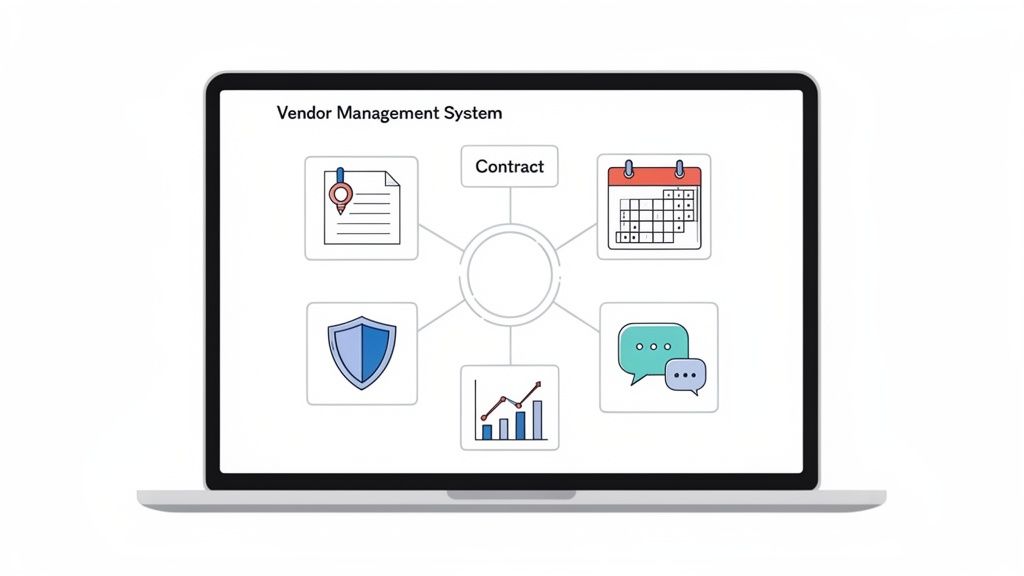
As your vendor list grows, managing relationships, contracts, and performance via spreadsheets and email becomes unsustainable. One of the most impactful vendor management best practices is to centralize this complexity using a dedicated Vendor Management System (VMS) or a lightweight tracking platform. This creates a single source of truth, automating administrative tasks and providing crucial visibility into your entire vendor ecosystem.
For a scaling company, a VMS isn't just an organizational tool; it’s a strategic asset. It standardizes how you store vendor information, track deliverables, manage payments, and monitor compliance. This systemization frees up your team from chasing documents and allows them to focus on strengthening strategic partnerships and maximizing vendor value.
How to Implement a Vendor Management System
Adopting a VMS doesn't have to be an enterprise-level overhaul. Many businesses start with agile tools like Airtable or Monday.com to create custom, lightweight vendor trackers. The key is to choose a solution that fits your current needs while offering the ability to scale. For a deeper dive into streamlining business operations, you might find valuable parallels in these project management best practices.
Here’s a practical approach to selecting and rolling out a system:
- Start with Core Needs: Begin by tracking essential data like contact information, contract renewal dates, and performance scorecards.
- Automate Key Reminders: Set up automated alerts for critical deadlines, such as contract expirations or performance reviews.
- Establish Role-Based Access: Ensure sensitive information, like pricing and contract terms, is only visible to authorized personnel.
- Prioritize Integrations: Choose a platform that can connect with your existing accounting and project management tools.
- Leverage Reporting: Use the platform’s analytics to track spending, identify performance trends, and spot opportunities for negotiation.
Centralized platforms are crucial for managing specialized talent like fractional executives. Having a system ensures every high-impact engagement is managed with clarity, consistency, and a clear view of ROI from day one.
4. Maintain Regular Communication and Performance Reviews
Signing a contract is the beginning, not the end, of a vendor relationship. One of the most impactful vendor management best practices is establishing a regular, structured communication cadence. Consistent touchpoints prevent small misunderstandings from escalating into major issues, ensure alignment on strategic goals, and build a true partnership rather than a purely transactional arrangement.
For businesses leveraging specialized expertise, this ongoing dialogue is vital. When a fractional executive is integrated into your team, for instance, regular performance reviews and syncs are essential to track progress against KPIs and pivot strategies as needed. This feedback loop ensures the vendor remains a high-value asset, continuously adapting to your business needs.
How to Implement a Structured Communication Cadence
A proactive communication strategy keeps both parties accountable and informed. The goal is to create a predictable rhythm that balances oversight with efficiency, ensuring meetings are productive, not burdensome. Think of it as the operating system for your vendor relationships.
Here’s a practical, tiered model for effective communication:
- Weekly Check-ins: Short, tactical meetings (e.g., 15-30 minute stand-ups) to discuss immediate tasks and remove blockers.
- Monthly Performance Reviews: A more formal review of progress against KPIs and SLA metrics.
- Quarterly Business Reviews (QBRs): Strategic, forward-looking sessions to discuss the overall partnership, review long-term goals, and plan for the upcoming quarter.
- Document Everything: Use a shared system to document meeting notes, decisions, and action items with clear ownership and deadlines.
Clear communication is foundational to maximizing ROI. When a fractional VP of Sales joins your team, their success depends on structured syncs to review pipeline, forecast accuracy, and sales strategies, ensuring they are fully integrated and driving measurable results from day one.
5. Develop Comprehensive Onboarding and Integration Programs
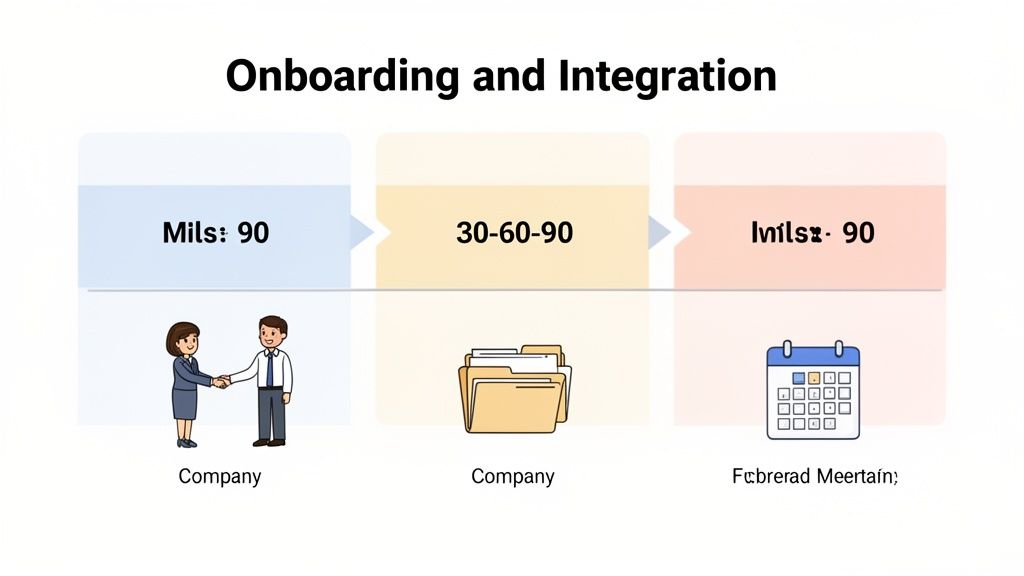
Effective vendor management doesn't stop once a contract is signed. A structured onboarding program is essential to accelerate a new vendor's productivity and seamlessly integrate them into your organization. Failing to properly onboard a partner is like hiring a key employee and giving them a laptop with no login; it wastes valuable time, creates confusion, and delays results.
Where speed and efficiency are paramount, a strong onboarding process ensures your new vendor understands your culture, systems, and immediate priorities from day one. This significantly reduces the "ramp-up" period, allowing them to start delivering value almost immediately instead of spending weeks figuring things out.
How to Implement a Structured Onboarding Program
A repeatable, documented process ensures consistency and sets every vendor up for success. Treat vendor onboarding with the same seriousness as executive onboarding, as their impact can be just as significant. For more on this, you can review these best practices for modern leadership success.
Here’s a practical checklist to build your program:
- Pre-Start Preparation: Provide all necessary system access, login credentials, and key documents like process maps or organizational charts.
- Stakeholder Introductions: Schedule brief 1:1 meetings with all key team members the vendor will be collaborating with during their first week.
- Assign a Point of Contact: Designate one internal team member as the vendor’s go-to resource for questions.
- Set Clear 30-Day Goals: Define specific, achievable objectives for the first month focused on learning, observation, and initial small wins.
- Schedule Regular Check-ins: Plan for weekly follow-ups to address any early roadblocks.
A well-defined onboarding process is one of the most impactful vendor management best practices for maximizing ROI. When you engage a fractional executive, they arrive with a clear plan, having already been briefed on your company's core challenges, ensuring they are ready to contribute strategically from the very first meeting.
6. Build Long-Term Relationships and Strategic Partnerships
A crucial evolution in vendor management best practices is shifting from a purely transactional mindset to building strategic, long-term partnerships. This approach reframes vendors from external suppliers into integrated extensions of your team, creating a mutual investment in success. When both parties are aligned on long-term goals, the relationship produces far more value than a simple service-for-payment exchange.
For a growing company, this strategic alignment can be a powerful competitive advantage. A partner who deeply understands your business vision, culture, and roadmap can proactively suggest innovations, offer flexible solutions during challenging periods, and scale their services in lockstep with your growth. This moves the dynamic from cost management to value creation.
How to Cultivate Strategic Partnerships
Transforming a vendor relationship into a strategic partnership requires intentional effort and open communication. It’s about building trust and demonstrating that you see them as critical to your journey.
Here’s a practical framework for fostering these powerful connections:
- Share Your Vision: Schedule annual strategic planning sessions. Share your roadmap and objectives to give them the context needed to contribute meaningfully.
- Offer Growth Opportunities: Actively provide feedback on how your partners can improve their offerings to better serve your evolving needs.
- Integrate and Involve: Invite key vendor contacts to relevant internal meetings or company events. This fosters a sense of belonging and strengthens collaborative bonds.
- Create Mutual Benefits: Establish referral programs, offer to be a case study, or provide testimonials for exceptional partners.
The value of long-term relationships is exemplified in the fractional executive model. Founders often re-engage with the same fractional leaders across multiple ventures because the executive has a proven track record, understands the founder’s working style, and can deliver value almost immediately, eliminating the friction of a new search and onboarding process.
7. Create Contingency Plans and Exit Strategies
Effective vendor management best practices extend to the end of a partnership. Even the best vendor relationships can end due to changing business needs, performance issues, or unforeseen circumstances. Proactively creating contingency plans and clear offboarding strategies protects business continuity, prevents operational chaos, and preserves institutional knowledge.
The departure of a critical vendor or contractor can halt progress on key initiatives. A documented exit strategy mitigates this risk by outlining every step, from knowledge transfer to final handoffs. This isn't about anticipating failure; it's about building resilience into your operations and ensuring no single vendor becomes an operational dependency.
How to Implement a Proactive Exit Plan
A well-managed exit should be a controlled process, not a frantic reaction. It requires defining the terms of departure and the mechanisms for a seamless handover from the very beginning of the relationship.
Here’s a practical framework for building your vendor contingency plans:
- Define Exit Triggers: Clearly document the specific performance metrics or contract breaches that would initiate a vendor transition.
- Establish Knowledge Transfer Protocols: Mandate that all critical processes are documented in a shared, accessible location in real-time, not just at the end.
- Identify Backup Vendors: Proactively identify and maintain relationships with one or two alternative vendors for critical functions.
- Plan for Overlap: For crucial roles, build a two-week transition overlap into your plan where the outgoing and incoming vendors can work together.
- Conduct an Exit Interview: Capture feedback and lessons learned to refine your vendor management process for future partnerships.
The fractional executive model inherently de-risks vendor transitions. If a fractional leader's engagement concludes or your needs change, having access to a pre-vetted talent pool allows you to quickly find and onboard a new executive with the right expertise, ensuring minimal disruption.
8. Implement Risk Management and Compliance Monitoring
Effective vendor management best practices extend deep into legal, financial, and operational oversight. Implementing a formal risk management and compliance monitoring program is not just for large enterprises; it's a critical shield for any business. This practice involves systematically identifying, assessing, and mitigating potential risks posed by third-party relationships, from data security breaches to regulatory non-compliance.
A vendor handling sensitive customer data, for instance, can become a significant liability if they fail to meet standards like HIPAA or SOC 2. Proactively managing these risks protects your company from fines, lawsuits, and reputational damage.
How to Implement Vendor Risk and Compliance Monitoring
A structured approach to vendor risk management transforms it from a reactive task into a strategic advantage. To build a comprehensive framework, you can explore various risk management strategies tailored for growing companies.
Here’s a practical model for ongoing monitoring:
- Create Vendor Risk Tiers: Categorize vendors based on their access to sensitive data and the criticality of their service (e.g., High, Medium, Low risk).
- Mandate Compliance Documentation: Require proof of necessary certifications and insurance (e.g., SOC 2 reports, cyber liability insurance).
- Include Right-to-Audit Clauses: Ensure your contracts give you the right to audit the vendor's compliance with security and regulatory requirements.
- Conduct Annual Reviews: Schedule yearly check-ins with high-risk vendors to review their compliance status and security protocols.
- Use Compliance Management Tools: Platforms like Vanta or Drata can help automate the continuous monitoring of a vendor's security posture.
For roles involving sensitive financial or operational data, vetting is paramount. This is why it's critical to partner with services that perform comprehensive background checks and rigorous vetting on all talent in their network, ensuring that when you hire a fractional CFO or COO, they have a verified history of integrity.
9. Leverage Data Analytics and Performance Insights
Effective vendor management best practices extend beyond relationship management into the realm of objective, data-driven decision-making. By leveraging analytics, you can move from subjective assessments to a clear understanding of vendor performance, cost-effectiveness, and direct impact on business outcomes. This approach transforms vendor management from an operational task into a strategic lever for improvement.
For growing businesses, this means every dollar spent on a vendor is accountable and its ROI is measurable. Whether it's a SaaS provider or a fractional executive, data provides the unvarnished truth about their contribution. It allows you to identify top performers, address underperformance proactively, and optimize your vendor ecosystem.
How to Implement Data-Driven Vendor Analysis
A systematic approach to data ensures you are tracking the right things and can make informed decisions. It’s about creating a transparent feedback loop supported by concrete numbers, not just anecdotal evidence.
Here are practical steps to get started:
- Establish Baselines: Before a vendor begins, document your current performance metrics. For a fractional VP of Sales, this might be your current sales pipeline value and close rate.
- Create Shared Dashboards: Use simple tools to build dashboards that track key performance indicators (KPIs).
- Track Leading and Lagging Indicators: Monitor both activity metrics (leading indicators like calls made) and outcome metrics (lagging indicators like revenue growth).
- Conduct Quarterly Business Reviews (QBRs): Use these meetings to review the data, discuss trends, and collaboratively set goals for the next quarter.
- Focus on ROI: Regularly compare the cost of the vendor against the tangible value they deliver.
By defining clear success metrics during the engagement process, companies can directly measure the impact of their fractional leaders. A tech startup could track a fractional CTO's influence on engineering velocity and product release cycles, providing clear, quantifiable proof of their value.
10. Foster Vendor Ecosystem and Collaborative Networks
One of the most advanced vendor management best practices involves shifting from managing individual, siloed vendors to cultivating an integrated ecosystem. Instead of treating each partner as an isolated spoke, you create a hub where they can coordinate, share knowledge, and collaborate. This approach transforms a collection of contractors into a cohesive, high-impact team.
For growth-stage companies, this is a force multiplier. Imagine a fractional CFO, VP of Sales, and CMO all working independently. Their impact is limited. But when they coordinate weekly on growth strategy, sharing financial data, sales pipeline insights, and marketing campaign performance, their collective value skyrockets. This synergy prevents conflicting initiatives and ensures all efforts are pulling in the same direction.
How to Build a Collaborative Vendor Ecosystem
Building a collaborative network requires proactive facilitation and the right tools. The goal is to create shared visibility and incentives that encourage teamwork rather than competition.
Here’s a practical framework for creating this environment:
- Establish a Central Communication Hub: Create a shared Slack or Microsoft Teams channel for all key vendors for quick problem-solving.
- Implement Shared Project Management Tools: Use platforms like Asana or Monday.com to provide a single source of truth for project timelines and progress.
- Host Regular Coordination Meetings: Schedule weekly or bi-weekly syncs with all primary vendors to review unified goals and discuss roadblocks.
- Set Unified Goals and Success Metrics: Define overarching objectives that require contributions from multiple vendors.
- Recognize and Reward Collaboration: Publicly acknowledge instances where vendors worked together to solve a complex problem.
A key role of a fractional executive, like a COO or Chief of Staff, is to serve as the conductor of this vendor orchestra. They are uniquely positioned to manage these cross-functional relationships and ensure all partners, from strategic consultants to implementation specialists, are perfectly aligned with the company’s vision.
Vendor Management Best Practices: 10-Point Comparison
| Strategy | 🔄 Implementation complexity | ⚡ Resource requirements | 📊 Expected outcomes | ⭐ Key advantages | 💡 Quick tip |
|---|---|---|---|---|---|
| Establish Clear Vendor Selection Criteria and Vetting Process | Moderate→High — design rubrics, multi-stage assessments, pilot tests | Moderate — HR time, assessment tools, background-check costs | High — more consistent, higher-quality hires; reduced onboarding friction | Reduces hiring risk; ensures consistent evaluation across vendors | Use weighted scoring and trial projects to validate fit |
| Define Clear Scope of Work and Performance Metrics | Moderate — write SOWs, define SMART KPIs and cadence | Low–Moderate — stakeholder time to agree metrics and baselines | High — prevents scope creep; enables objective performance measurement | Clarifies accountability and enables contract enforcement | Start with 3–5 KPIs; include leading and lagging indicators |
| Implement a Vendor Management System (VMS) or Tracking Platform | High — platform selection, integration, setup and training | Medium–High — subscription fees, IT integration, admin support | High — centralized data, real-time visibility, streamlined payments and audits | Single source of truth; enables data-driven vendor decisions | Begin with core features; ensure API integrations and role-based access |
| Maintain Regular Communication and Performance Reviews | Low–Moderate — establish cadence, agendas, review templates | Low — recurring meeting time and documentation | Medium–High — early issue detection; stronger alignment and accountability | Builds relationships; enables timely course correction | Schedule recurring meetings with agendas and documented action items |
| Develop Comprehensive Onboarding and Integration Programs | Moderate — prepare access, stakeholder introductions, 30/60/90 plans | Moderate — onboarding owner, documentation, time from internal teams | High — faster ramp-up, clearer expectations, improved retention | Decreases time-to-impact; reduces confusion and missteps | Prepare system access before start and assign a single point of contact |
| Build Long-Term Relationship and Strategic Partnerships | Moderate — strategic planning, shared roadmaps, trust-building | Low–Moderate — ongoing touchpoints, potential pricing commitments | High — stability, deeper integration, mutual investment in success | Reduces turnover; yields better pricing and institutional knowledge | Hold annual strategy sessions and share multi-year vision |
| Create Contingency Plans and Exit Strategies | Low–Moderate — document handoffs, set exit triggers, ID backups | Low — documentation effort and maintaining backup relationships | High — preserves continuity and institutional knowledge during transitions | Minimizes disruption; shortens transition time | Document processes continuously and plan overlap transitions |
| Implement Risk Management and Compliance Monitoring | Moderate→High — legal review, audits, security and compliance checks | Medium–High — legal resources, compliance tools, ongoing monitoring | High — reduced legal/financial exposure; regulatory compliance | Protects legal interests; builds stakeholder confidence | Require insurance/NDAs and conduct annual compliance reviews |
| Leverage Data Analytics and Performance Insights | Moderate — instrument KPIs, build dashboards and reporting cadence | Medium — analytics tools, data sources, analyst time | High — objective decisions, ROI visibility, vendor benchmarking | Identifies high vs. low performers; supports negotiations with data | Establish baseline metrics and share dashboards with vendors |
| Foster Vendor Ecosystem and Collaborative Networks | Moderate — set coordination forums, shared goals, governance norms | Moderate — facilitation time, collaboration platforms, coordination effort | Medium–High — reduced silos, faster problem resolution, synergy | Multiplies impact through vendor collaboration and shared learning | Use shared PM tools and weekly coordination meetings for key vendors |
Unlocking Growth with Strategic Leadership
Navigating the complex world of vendor relationships can feel like a full-time job, especially for lean, growing businesses. Transforming this function from an administrative task into a strategic growth engine requires a dedicated, structured approach. Moving beyond ad-hoc agreements and reactive problem-solving is not just an operational improvement; it's a fundamental shift that builds organizational resilience and competitive advantage.
The journey from chaotic vendor management to a streamlined ecosystem involves more than just implementing a new tool. It requires a holistic framework that integrates everything from selection and risk assessment to performance tracking and long-term partnership development. Mastering these vendor management best practices is what separates companies that merely survive from those that truly scale.
From Tactical Tasks to Strategic Imperatives
Let's distill the core principles we've covered into actionable takeaways. Your goal is to build a system, not just complete a series of tasks. This system should be built on three pillars:
- Clarity and Alignment: Success begins with clear expectations. This means meticulously defining selection criteria, creating unambiguous Scopes of Work (SOWs), and establishing concrete Key Performance Indicators (KPIs).
- Proactive Engagement: The most fruitful vendor relationships are not "set it and forget it." They thrive on regular communication, structured performance reviews, and a commitment to building genuine partnerships.
- Risk Mitigation and Optimization: A robust vendor management framework must be forward-looking. This involves creating detailed contingency plans, continuously monitoring for compliance and security risks, and leveraging data to optimize costs and performance.
The Leadership Gap: Why Implementation Fails
For many founders and CEOs, the gap between knowing these best practices and successfully implementing them is a matter of bandwidth and expertise. Building these systems requires senior-level strategic thinking and hands-on execution—a combination that is often in short supply. You might have a great team, but are they equipped to design a company-wide vendor risk protocol or negotiate complex multi-year contracts?
This is where the power of fractional leadership becomes a game-changer. Instead of hiring a full-time, high-cost executive, you can embed a seasoned expert into your team on a part-time basis to build these systems for you.
A fractional COO can architect the operational workflows and implement a Vendor Management System. A fractional CFO can analyze vendor ROI and build financial controls. They don't just advise; they build, execute, and transfer knowledge to your team. This model provides the precise executive oversight needed to transform your vendor relationships into a powerful, scalable asset that fuels your company's growth.
Ready to bridge the gap between knowing and doing? At Shiny, we connect you with a network of over 3,000 vetted, top-tier fractional executives who specialize in building the exact systems your business needs to scale. Explore our marketplace of on-demand talent and discover how the right leadership can help you master your vendor ecosystem and accelerate your growth.