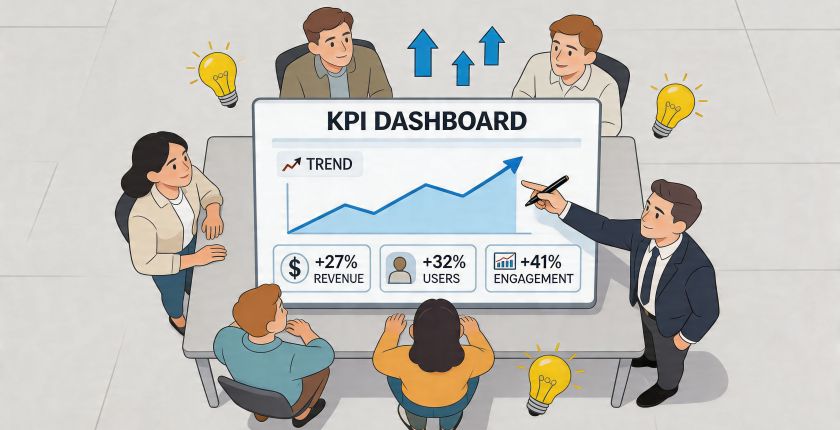
Master Your Quarterly Business Review
If your quarterly business review feels like a hostage situation, you're not alone.
A founder walks into a conference room with a stack of slides, a dozen half-prepared leaders, and a quiet hope that this time the meeting will produce something more useful than explanations. Four hours later, everyone knows what happened last quarter. No one is fully clear on what changes next week.
That version of the quarterly business review drains energy because it asks the wrong question. It asks, “What happened?” and stops there. Startups need a different meeting. They need one that asks, “What did we learn, what are we changing, and who owns the move?”
Enterprise playbooks often miss this. They assume you have deep benches, dedicated analytics support, and full-time executives across every function. Many growth-stage companies don't. In fact, 70% of founders report executive hiring barriers, which is one reason flexible leadership models matter. Integrating part-time executives can help bridge that gap and lead to an estimated 20-30% faster growth alignment, according to McKinsey's discussion of quarterly business review challenges and startup constraints.
Beyond the Status Update: Reframing the QBR for Growth
The bad quarterly business review usually follows a familiar script. Sales reads out pipeline numbers. Marketing explains campaign activity. Product defends roadmap slippage. Finance flags burn. By the end, the team has reviewed a quarter that already happened and avoided the harder conversation about the quarter that's about to start.
That isn't a strategy meeting. It's a delayed reporting ritual.

What founders usually get wrong
Founders often treat the QBR as a bigger version of the weekly leadership meeting. That's the first mistake. Weekly meetings should handle execution drift, blocked projects, and short-term decisions. A quarterly business review should step up a level.
It should answer questions like these:
- Where is growth coming from: Which customer segments, channels, or offers are gaining traction, and which are stalling.
- What risk is building: Churn signals, margin pressure, delivery strain, or product friction that hasn't yet shown up in top-line results.
- What deserves more resources: The bets worth doubling down on, and the work the team should stop funding.
- What changed outside the company: Buyer behavior, competitor moves, customer feedback, or market shifts that require a response.
A strong QBR does one thing especially well. It forces trade-offs into the open.
A useful quarterly business review doesn't end with more visibility. It ends with fewer unresolved decisions.
What the meeting becomes with the right operator
When someone with real executive pattern recognition runs the process, the tone changes. The conversation gets tighter. Leaders stop hiding behind activity metrics. Departments stop presenting in silos. The review turns into a decision forum.
That is where fractional leadership can have an outsized impact in a startup. A fractional COO can structure the meeting around operating choices, not slide ownership. A fractional CFO can separate a revenue problem from a margin problem. A fractional CMO can challenge whether marketing is creating demand or just reporting reach. The founder no longer has to moderate, diagnose, and decide at the same time.
For startups, that shift matters because bandwidth is the primary constraint. The QBR shouldn't become another cost center. It should become the room where the company aligns around the next quarter's most important moves.
Building Your Strategic Scorecard
A quarterly business review is only as good as the scorecard behind it. If the data is vague, inconsistent, or packed with vanity metrics, the discussion will wander. Teams will debate definitions instead of making decisions.
The scorecard needs to do less. Not more.
Start with business health, not dashboard aesthetics
Many startup dashboards look polished and still fail the most basic test. They don't help a leadership team decide what to do next. A good QBR scorecard should tell a story about momentum, customer quality, and operating health.
According to Mailchimp's guide to quarterly business reviews, an effective scorecard tracks Year-over-Year growth, Customer Lifetime Value, Net Promoter Score, and churn rate. Those measures matter because they expose whether growth is seasonal or structural, whether customers are becoming more valuable over time, whether advocacy is improving, and where retention is weak. A declining CLTV, in particular, is an early warning sign of churn risk or a weak expansion strategy.
Build around a few decision-grade metrics
A startup doesn't need a giant KPI library for a quarterly business review. It needs a focused operating view. I like to organize it by function, but only include metrics that can trigger action.
Here’s a practical approach:
Sales
- Pipeline quality: Not just total pipeline, but whether it reflects real buying intent.
- Conversion movement: Where deals stall between stages.
- Retention and expansion signals: Whether current customers are renewing cleanly or requiring rescue.
Marketing
- Channel efficiency: Which channels generate qualified demand, not just traffic.
- Message resonance: Whether campaigns attract the right buyers.
- Funnel handoff quality: Whether marketing is giving sales opportunities or homework.
Product and customer success
- Usage trends: Which features or workflows correlate with stickiness.
- NPS direction: Whether advocacy is rising or slipping.
- Churn patterns: Which customer cohorts are leaving and why.
Finance and operations
- Revenue against target: Plus the main drivers of variance.
- Pricing and retention effects: Whether growth is volume-led or quality-led.
- Delivery strain: Whether the company is scaling in a way operations can support.
Separate vanity from signal
A useful rule is simple. If a metric can go up while the business gets weaker, it doesn't belong in your headline QBR pack.
That means most startups should be skeptical of metrics like:
- Raw lead volume: More leads can still mean worse fit.
- Website sessions alone: Traffic without conversion clarity rarely helps.
- Feature release counts: Shipping isn't the same as adoption.
- Social engagement totals: Attention isn't revenue.
A better approach is to connect each metric to a decision. If churn rises, who investigates root cause. If CLTV declines, what changes in onboarding, packaging, or account management. If YoY growth weakens, which assumptions in the go-to-market plan get challenged.
Practical rule: Every metric on the QBR scorecard should answer one of two questions. Do we need to change course, or should we invest more here?
Create one source of truth before the meeting
Startups get into trouble when each function brings its own spreadsheet, its own definitions, and its own preferred cut of the numbers. That's how QBRs turn into data arbitration.
Set one shared scorecard before the meeting. Freeze the numbers. Lock the definitions. Then distribute the materials early enough that leaders can prepare judgment, not just react to data.
If you need inspiration for the format, these executive dashboard examples for startup leadership teams are a useful reference point. The point isn't to copy a template blindly. It's to create a scorecard that lets everyone discuss the same business reality.
What a startup scorecard should feel like
The best scorecards don't overwhelm. They create tension in the right places.
A strong one usually does three things:
- Shows trend, not just snapshot
- Pairs lagging metrics with leading indicators
- Makes problems hard to hide
That last point matters. If the scorecard lets every function lead with its best-looking number, the quarterly business review will drift back into storytelling. You want a scorecard that surfaces discomfort early. That's where strategy starts.
Assembling Your QBR Dream Team
A quarterly business review fails when the room is full of presenters and short on decision-makers. Startups especially make this mistake because they confuse “inviting stakeholders” with “building the working group that can resolve trade-offs.”
The right QBR team is small enough to think clearly and broad enough to see the whole business.
Who needs to be in the room
At minimum, the meeting should include the people who own outcomes across the company. Not every manager needs a seat. Every decision-maker does.
The core team usually looks like this:
- CEO or founder: Sets the strategic frame and makes the final call when trade-offs can't be resolved.
- Finance lead: Brings financial discipline to growth conversations and pressure-tests assumptions.
- Sales leader: Interprets pipeline quality, forecast confidence, and deal friction.
- Marketing leader: Explains demand quality, positioning performance, and channel choices.
- Product or operations leader: Connects growth plans to delivery capacity and execution risk.
- Customer success lead: Brings the voice of the customer into retention and expansion decisions.
If you're a startup, one person may cover two or three of those roles. That's fine. The point is role coverage, not headcount.
Where fractional leaders change the quality of the meeting
The hidden problem in many startup QBRs isn't lack of effort. It's lack of senior context. A founder may understand the business thoroughly but still not have time to prepare the scorecard, run the discussion, challenge assumptions, and document decisions in one meeting. A junior team member can compile data but often won't know where to push.
Fractional executives fill that gap with operator judgment.
A fractional CFO can tell whether “we missed plan” is a top-line issue, a pricing issue, or a retention issue. A fractional CMO can spot when the team is optimizing for cheap leads instead of qualified pipeline. A fractional COO can keep the meeting moving, force clarity on action items, and stop the discussion from sinking into detail.
Here’s the cleanest way to compare the options.
QBR Contributions by Role
| Role | Typical Focus | Strategic Value |
|---|---|---|
| Founder or CEO | Vision, priorities, final trade-offs | Keeps the review tied to company direction and makes calls when functions disagree |
| Department head | Functional performance and context | Explains the why behind the data and flags constraints inside the function |
| Junior analyst or chief of staff | Data gathering, slide prep, note-taking | Improves organization and visibility but may not challenge assumptions or drive cross-functional decisions |
| Fractional CFO | Revenue quality, margins, forecast logic, resource allocation | Brings financial interpretation and helps the team decide what to fund, fix, or stop |
| Fractional CMO | Demand generation, positioning, funnel quality | Challenges channel assumptions and connects marketing performance to revenue outcomes |
| Fractional COO | Meeting structure, operating cadence, accountability | Turns a reporting session into an execution system with owners, deadlines, and follow-through |
The founder shouldn't play every role
I see this often. The founder writes the agenda, cleans the metrics, chases updates, moderates the room, and then tries to think strategically during the discussion. That's too many jobs. It weakens the meeting before it starts.
The best quarterly business reviews have a clear split:
- One person owns the process
- Each leader owns the truth in their area
- The founder owns decisions and direction
The QBR gets better the moment the founder stops being both the air traffic controller and one of the planes.
There are different ways to staff that process role. Some companies use a chief of staff. Some use an experienced operator. Some use a part-time executive through a marketplace such as Shiny, which connects startups with vetted executives for 5 to 25 hours a week across functions and industries. The model fits well when a company needs senior judgment but doesn't need, or can't support, a full-time hire.
Keep the room disciplined
A dream team still needs rules. Don't let the meeting swell into a town hall. Keep attendance limited to people who meet one of these tests:
- They own a headline metric
- They control a key resource
- They can approve or unblock action
- They bring necessary market or customer insight
Everyone else can get the readout after.
That's not about exclusion. It's about preserving the quality of the conversation. The more observers you add, the more likely people are to present for optics instead of debating the business openly.
The High-Impact QBR Agenda Template
Most quarterly business review agendas are built like school presentations. Each department gets a slot. Everyone reads slides. Time runs out right when the useful conversation should begin.
A better agenda is designed around decisions. That requires discipline before the meeting and a tighter flow inside it.
Research cited by Stratrix on quarterly business review methodology notes that 70% of executives find their QBRs ineffective for driving strategic decisions. One reason is that the meeting stays backward-looking. Their best-practice approach dedicates at least 50% of the meeting to forward planning and uses a Rule of Four, meaning no more than four headline metrics per function.
That principle is the backbone of a strong startup QBR.

The work before the meeting
A high-impact quarterly business review starts well before anyone enters the room.
Use a simple prep standard:
- Freeze the data early: Last-minute number changes destroy trust.
- Pre-read in advance: Send materials ahead so meeting time goes to debate, not discovery.
- Include decision questions: Each section should end with the choice the team needs to make.
- Force honesty: Ask every presenter to surface at least one below-plan metric.
This is the same logic behind any strong leadership cadence. If you want the room to think, don't make it spend the first hour orienting itself. If your team needs a reset on meeting discipline broadly, these practical guidelines for running effective meetings are worth applying outside the QBR too.
A 120-minute growth-focused agenda
For startups, I prefer a compressed format. It keeps energy high and discourages overproduction. A two-hour session can do real work if the prep is tight.
Here is a structure that works.
Opening and action review
Start with unfinished business. Review the last quarter's commitments first, not the newest charts.
Cover:
- Completed actions
- Items still in progress
- Decisions that were made but not implemented
- Actions that should be formally dropped
This segment should be brief. The point isn't to shame anyone. It's to establish whether the company follows through on what it says matters.
Key wins and hard truths
Now move into the top-line readout. At this stage, leaders review the quarter, but only at the altitude that supports decision-making.
Use a short sequence:
- What improved
- What missed plan
- Why it happened
- What changed externally
Keep the conversation anchored to headline metrics. If someone needs five slides to explain one number, the metric probably isn't ready for a QBR.
Operating note: If a detail only matters to one function and doesn't affect a strategic decision, move it to a monthly review.
Strategic deep dive
This is the center of gravity. Pick one or two topics that matter most for the next quarter. Not five. Not everything.
Examples include:
- Falling expansion revenue in a core customer segment
- Pipeline growth that isn't converting
- Rising churn tied to onboarding or product adoption
- Delivery bottlenecks that threaten renewals
- Pricing friction in a new market motion
A good operator earns their keep by keeping the room focused on the decision, not on side arguments. They also bring in external context. Stratrix recommends time for market intelligence, and that's smart. A startup should always reserve a short segment for win-loss patterns, customer feedback, and any market shifts that affect the next quarter's plan.
Closing with decisions, not summaries
The last part of the quarterly business review should feel decisive. If people are summarizing themes at the end, you've probably left value on the table.
Finish with a visible action log:
- Owner: One person, not a committee
- Due date: Specific and realistic
- Expected result: What should change if this action works
- Checkpoint: When the team will review progress before the next QBR
A QBR only becomes strategic if it changes the operating plan. That means budget moves, priority resets, revised OKRs, or explicit choices to stop work. If none of that happens, the meeting was informative but not useful.
What doesn't belong on the agenda
Cut these without guilt:
- Departmental victory laps
- Detailed project updates with no decision attached
- Dense slide walkthroughs
- Metrics that no one can influence
- Debates over definitions inside the meeting
The best agenda creates momentum because everyone knows the room is there to decide, not perform.
Common QBR Pitfalls and How to Sidestep Them
Every bad quarterly business review has a recognizable pattern. You can usually spot the failure mode in the first twenty minutes. The deck is too long, the conversation is too safe, or the room has no mechanism for turning ideas into action.
The good news is that these problems are predictable. That means they're fixable.

Status theater
This is the most common failure. Everyone reports. Nobody decides. Leaders leave the room with more context but no shift in priorities, no reallocation of resources, and no clarity on next steps.
Symptoms are easy to spot:
- Slides dominate airtime
- Questions stay polite and shallow
- Problems are described, not resolved
- The founder ends the meeting by asking for follow-up offline
The cure is structural. Every section of the QBR should contain a decision question. Not “Any thoughts?” but “Do we keep funding this channel?” or “Who owns fixing onboarding drop-off?” If the question isn't explicit, the room will default to updates.
The data deluge
Some teams assume more information creates better decisions. It usually creates fatigue. Once people are buried in charts, they stop listening for signal and start scanning for their own section.
Keep the review lean:
- Limit headline metrics: Put supporting data in an appendix.
- Distribute pre-reads: Let people absorb detail before the meeting.
- Use one slide, one point: If a slide has three messages, it has none.
- Show trend and implication: Don't present isolated numbers.
A startup QBR should feel sharp, not encyclopedic.
The accountability black hole
This one is expensive because it creates the illusion of progress. The team has a productive discussion, agrees on several smart moves, and then returns to normal operating chaos. By the next quarter, half the actions are forgotten and the same issues show up again.
Fix it with mechanical discipline:
- Assign one owner per action
- Set a due date before moving on
- Track progress between QBRs
- Review prior actions first in the next session
Smart discussion without ownership is just expensive recycling.
The one-size-fits-all review
Not every function, team, or account deserves the same QBR format. One of the more practical ideas in modern QBR design is to tier the approach. As EverAfter's explanation of quarterly business review structure notes, successful companies use high-touch strategic reviews for the most critical functions or accounts and more efficient, digital-first check-ins for others.
Startups should do the same internally.
For example:
- Core growth drivers: Sales, retention, and cash flow may deserve full strategic treatment every quarter.
- Stable functions: Teams running smoothly can submit lighter updates with a short discussion block.
- Smaller customer segments or lower-priority initiatives: Handle them with templates or async review unless they show risk.
This isn't about neglect. It's about focus. If every topic gets equal airtime, the important ones don't get enough.
The founder bottleneck
Some QBRs fail because the founder can't stop rescuing the meeting. They answer every question, soften every conflict, and leave no room for real ownership from the team.
The sidestep is counterintuitive. The founder should speak less during the data review and more during the decision points. Let leaders defend their analysis. Let disagreements surface. Then step in to make the call when needed.
A simple test for meeting health
If you want to know whether your quarterly business review is working, ask three questions after it ends:
- Did we make decisions that changed the next quarter's plan
- Does every action have one owner
- Would a team member know what stopped, started, or increased because of this meeting
If the answer is no, don't add more slides. Redesign the meeting.
From Review to Results: Driving Action and Aligning OKRs
A quarterly business review creates value after the meeting, not during it. The discussion matters, but only if it changes what the company does next. That means the output of the QBR must flow directly into priorities, operating plans, and OKRs for the next quarter.
If the meeting ends with notes but no system, the company learns nothing at scale.
Turn decisions into a tracked action plan
The simplest post-QBR framework is still the most effective. Every meaningful decision should be captured with four fields:
- Action
- Owner
- Due date
- Expected business outcome
That final field is the one many teams skip. Don't just write “improve onboarding” or “fix pipeline hygiene.” Write the intended result. It forces clarity and makes follow-up possible.
A fractional operator is often useful here because they can turn broad leadership discussion into executable workstreams. Founders are usually best at setting direction. Operators are better at building the accountability loop.
Connect QBR outputs to next-quarter OKRs
The strongest quarterly business review doesn't sit beside your OKR process. It feeds it.
A practical sequence looks like this:
Review what the quarter revealed
- Which assumptions held
- Which targets were missed
- Which opportunities emerged
Translate findings into objective-level changes
- Keep an objective if the strategy is still right
- revise it if the strategy changed
- retire it if the business no longer needs it
Rewrite key results based on current evidence
- Use the QBR to tighten the relationship between strategy and measurable progress
Assign operating ownership
- Every OKR needs a real owner and a regular review cadence
Many startups falter in their approach, treating OKRs as a planning artifact and the quarterly business review as a separate reflection meeting. That split weakens both. The QBR should be the moment the company decides what next quarter's objectives need to reflect.
If your current process feels loose, a performance management system built around accountability and goal tracking can help connect reviews, owners, and follow-through more cleanly.
Measure whether the QBR itself is paying off
You should also evaluate the return on the process. If the quarterly business review consumes executive time, prep effort, and coordination cost, it should justify itself.
A simple ROI formula is:
(Incremental Revenue from QBR Actions / Cost of QBR Prep) x 100
That formula is useful because it forces discipline. It makes the team identify which decisions from the QBR produced real commercial outcomes and what it cost to prepare and run the process. According to Mural's discussion of quarterly business reviews, effective QBRs can boost customer retention by 25% and upsells by 15% in SaaS and SMB environments, which gives leaders a practical way to connect review quality to financial outcomes.
What post-QBR execution looks like in practice
A good follow-up rhythm doesn't need to be heavy. It needs to be consistent.
Use this pattern:
Within two days
- Send the action log
- Confirm owners and dates
- Flag any unresolved decisions
Mid-quarter
- Hold a short check-in on the major actions
- Adjust if assumptions have changed
- Escalate blocked items early
At the next QBR
- Start with last quarter's commitments
- Review what got done, what slipped, and why
The quarterly business review should leave fingerprints on the next quarter's calendar, budget, and OKRs. If it doesn't, it was only a conversation.
Why fractional leadership fits this stage
This is the part startup teams often underestimate. Running one decent QBR is manageable. Building a repeatable operating cadence around it is harder. That requires prep discipline, metric consistency, owner follow-up, and enough executive judgment to connect the review to real strategic choices.
Fractional leaders are a strong fit when the company needs that rigor but isn't ready for another full-time executive seat. They can own the cadence, coach functional leaders, sharpen the scorecard, and make sure the meeting changes the business instead of just documenting it.
That doesn't make the founder less important. It lets the founder stay focused on the highest-impact work.
If your quarterly business review still feels like a bloated update meeting, it may be a leadership design problem more than a meeting problem. Shiny helps startups connect with experienced fractional executives who can bring structure, strategic judgment, and accountability to QBRs without requiring a full-time hire. If you need a stronger operator in the room for the next quarter, it's worth exploring the fit.